On this page
Earlobes take six to ten weeks to heal. Cartilage takes six to twelve months. Those two numbers cover almost every ear piercing, and the table below gives the range for each placement.
The Cleveland Clinic’s medically reviewed guide agrees: about six to eight weeks for a lobe, and between six and twelve months for cartilage piercings such as the helix, conch, rook, daith and tragus. The figures here are for full healing, the point at which the piercing can safely take a change of jewelry, not the point at which it stops hurting.
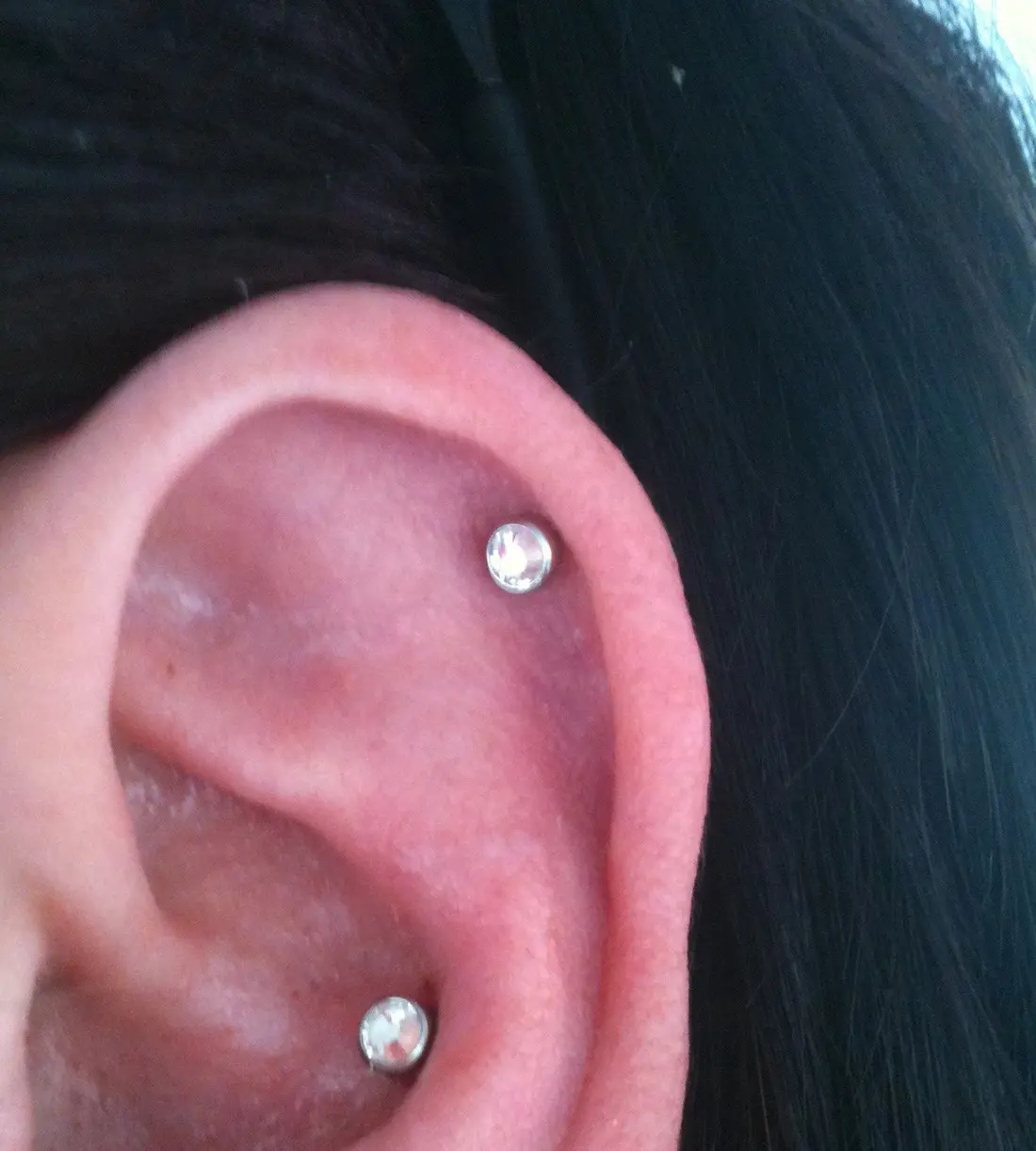
Photo by Fiona Henderson via Wikimedia Commons, CC BY 2.0.
Healing time for every ear piercing
| Piercing | Type | Healing time | Downsize at |
|---|---|---|---|
| Lobe | Soft tissue | 6-10 weeks | 4-6 weeks |
| Second lobe | Soft tissue | 6-10 weeks | 4-6 weeks |
| Stacked lobe | Soft tissue | 6-10 weeks | 4-6 weeks |
| Transverse lobe | Soft tissue | 3-6 months | 6-10 weeks |
| Vertical tragus | Skin | 2-4 months | 4-6 weeks |
| Tragus | Cartilage | 6-9 months | 4-8 weeks |
| Forward helix | Cartilage | 6-9 months | 6-10 weeks |
| Daith | Cartilage | 6-9 months | 6-10 weeks |
| Helix | Cartilage | 6-12 months | 6-10 weeks |
| Double helix | Cartilage | 6-12 months | 6-10 weeks |
| Hidden helix | Cartilage | 6-12 months | 6-10 weeks |
| Flat | Cartilage | 6-12 months | 6-10 weeks |
| Conch | Cartilage | 6-12 months | 6-10 weeks |
| Rook | Cartilage | 6-12 months | 6-10 weeks |
| Anti-tragus | Cartilage | 6-12 months | 6-10 weeks |
| Snug | Cartilage | 6-12 months | 8-12 weeks |
| Orbital | Cartilage | 6-12 months | 8-12 weeks |
| Industrial | Cartilage | 9-12 months | 8-12 weeks |
These are typical ranges for a well-placed piercing with the right jewelry and ordinary aftercare. Healing is individual, and the top of a range is normal rather than slow. The healing time chart compares every piercing on the site, not just the ear.
Why lobes are quick and cartilage is slow
Soft tissue such as the earlobe has a rich blood supply. Blood carries the cells and nutrients that repair a wound, so a lobe heals in weeks.
Cartilage has almost no blood supply of its own. It is fed by the thin layer around it, so repair creeps in from the edges. That is why a conch takes months when an earlobe takes weeks, and why cartilage infections are more serious. The cartilage guide covers what cartilage is and which piercings go through it.
An earlobe piercing, stage by stage
Week 1. Tenderness, swelling and redness at the front and back. Clear or slightly yellow fluid that dries to a crust is normal.
Weeks 2-4. The swelling settles and the crusting eases. By about week three a lobe feels finished, and that is the danger point: people swap in costume earrings, react to the metal, and blame the piercing.
Weeks 4-6. If your starter post was long, have it downsized. Lobes swell less than cartilage, so this comes around sooner.
Weeks 6-10. Healed. Wait the full time, then change into implant-grade titanium or solid gold. The lobe piercing guide has more.
A cartilage piercing, stage by stage
Cartilage piercings look finished long before they are, which is the trap.
- Weeks 1-2: swelling, warmth and tenderness. Normal.
- Weeks 2-12: crusting on the jewelry, occasional itching, and an outside that looks completely settled. It is not.
- Months 3-12: the channel inside quietly matures. It is still vulnerable to a single knock, and it is still not the time for a hoop.
Downsize at six to ten weeks, or eight to twelve for a snug, an orbital or an industrial, once the swelling has gone. Have your piercer do it. Helix piercing healing time follows the most popular placement week by week.
The itching in the middle stretch is normal and is covered in why is my piercing itchy. Do not change the jewelry because it stopped hurting. It usually stops hurting around week three and is not healed for months.
How to know it is healed
Do not go by the calendar alone. A piercing is healed when all four of these are true:
- No tenderness when you press gently beside the jewelry.
- No discharge or crusting for at least two weeks.
- No redness or pink tinge at either opening.
- The jewelry moves freely, with no tugging or resistance.
The Cleveland Clinic gives the same signs: it does not hurt, it is not red or swollen, it is not crusty or flaking, and the jewelry rotates easily. If one of the four fails, wait a month and check again.
When can I change my cartilage piercing has an interactive checklist that tests your piercing against its expected healing time.
What slows an ear piercing down
- Sleeping on it. The APP says sleeping directly on a healing cartilage piercing can cause irritation and even shift the piercing’s angle, and suggests a travel pillow on top of your pillow with the ear in the opening.
- Headphones and phones. In-ear buds and over-ear pads press on cartilage all day.
- Hair, hats, masks and glasses. Anything that catches on the ear pulls on the channel.
- Changing jewelry early, and hoops before the channel has matured.
- Touching and turning it. Every touch brings bacteria, and turning drags crust through the channel.
- Over-cleaning, or cleaning with alcohol, hydrogen peroxide or ointments.
- Poor-quality jewelry. Externally threaded posts, plated metal and nickel cause irritation that looks like a healing problem.
- Not downsizing when the swelling drops.
- Swimming before it has healed.
Almost all of it is within your control. How to clean an ear piercing covers the routine.
Healing more than one at a time
Ear piercings heal in parallel, but each keeps its own timeline, and the slowest one sets when you can call the ear done. Two healing cartilage piercings on the same ear also mean that side is unavailable for sleeping for months.
If you are planning several, sketch the whole ear with your piercer first. Which side should you pierce and ear piercing ideas help with that.
When healing is not normal
- A bump. Usually mechanical irritation, and the cause is something pressing on it. See piercing bumps and cartilage piercing bumps.
- Infection. Heat, spreading redness, thick coloured discharge, pain that increases, or a fever needs a doctor the same day. Leave the jewelry in unless a doctor says otherwise. Untreated cartilage infection can permanently deform the ear. See infected ear piercing.
- Migration. Jewelry that sits closer to the surface than it did, with thinning skin over it. See a piercer promptly. See piercing rejection.
- A lump that spreads beyond the piercing and keeps growing over months. See the keloid guide.
The Cleveland Clinic advises seeing a primary care physician, a dermatologist or an urgent care facility if symptoms persist or return.
If you take jewelry out for a while once the piercing has healed, how long a piercing takes to close explains why it can shrink faster than you would expect.
A healing piercing should stay out of pools, hot tubs and the sea: see swimming with a new piercing. Most piercings also need a shorter post fitted while they heal, so read piercing downsizing too. More detailed guides: earlobe, cartilage in general, tragus, daith and industrial.
Not medical advice
This page is educational. If a piercing is hot, has spreading redness or coloured discharge, or you feel feverish or unwell, see a doctor rather than waiting it out.
Frequently asked questions
How long does an ear piercing take to heal?
Earlobes take six to ten weeks. Cartilage piercings take six to twelve months, and the longest, an industrial, can take nine to twelve. Both look healed long before they are.
How long does an earlobe piercing take to heal?
Six to ten weeks. It feels finished at around three weeks, which is when people change earrings too early and irritate it. Have a long starter post downsized at four to six weeks, and wait the full time before switching.
How long does a cartilage piercing take to heal?
Six to twelve months for most placements, including helix, conch, rook, snug, flat and anti-tragus. A tragus, daith or forward helix is typically six to nine months. The outside looks settled by month three, but the channel inside is still maturing.
How do I know when my ear piercing is healed?
Four things must all be true: no tenderness when you press beside the jewelry, no discharge or crusting for at least two weeks, no redness at either opening, and jewelry that moves freely without tugging. The Cleveland Clinic describes the same signs: no pain, no redness or swelling, no crust, and jewelry that rotates easily.
Can I make an ear piercing heal faster?
No product speeds it up. What you can do is avoid slowing it down: sterile saline twice a day, hands off, no sleeping on it, no early jewelry changes, no in-ear headphones on a healing cartilage piercing, and a downsize at the right time.
Can I change my earrings before the piercing is fully healed?
The only change that should happen early is the downsize, done by your piercer once the swelling has gone. Anything else, such as a new style or a hoop, waits until the piercing has passed all four tests.
Sources
- Cleveland Clinic - Ear piercing 101: healing, hurting, cleaning and morehttps://health.clevelandclinic.org/what-to-expect-when-getting-your-ears-pierced
- Association of Professional Piercers - Suggested aftercare for body piercingshttps://safepiercing.org/aftercare/
- American Academy of Dermatology - Caring for pierced earshttps://www.aad.org/public/everyday-care/skin-care-basics/tattoos/caring-for-pierced-ears
- Association of Professional Piercers - Troubleshootinghttps://safepiercing.org/troubleshooting/
This article is for education only and is not medical advice. If a piercing is hot, swollen, spreading redness, oozing yellow or green discharge, or you have a fever, see a doctor today.