On this page
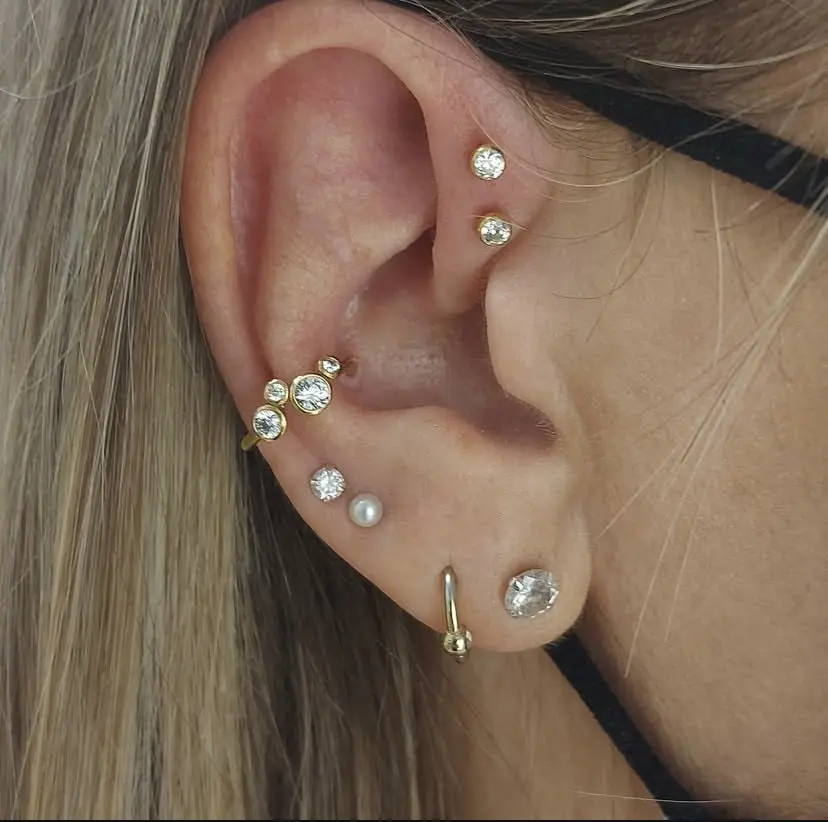
A second lobe is the second hole in your earlobe, sitting above the first. Same soft tissue, same procedure, same easy healing.
It is the most commonly added piercing there is, and it is worth its own page for one reason: where it goes decides what you can add afterwards.
The gap matters more than you think
The usual spacing is roughly 6 to 8 mm above the first, but that number is a starting point rather than a rule. What actually decides it is the size of your lobe and the jewelry you intend to wear.
Two studs sitting 5 mm apart look fine with small flat backs and look crowded with anything larger. Two hoops at the same spacing will touch. A piercer judges the gap against your lobe and against what you say you want to wear, which is why it is worth mentioning if you have plans.
If you might eventually want a third, say so now. Spacing a second in isolation often leaves a third with nowhere sensible to go, particularly on a small lobe. Have your piercer mark the whole run even if you are only having one done today.
Pain
About 2 out of 10, the same as your first. The lobe is soft, well supplied with blood, and the needle passes in an instant. This is the piercing people describe as over before they realised it had started.
Healing
Six to ten weeks. Soft tissue heals in weeks, not months, which is the whole reason lobes are where people start.
- Days 1-5: mild tenderness, a little swelling.
- Weeks 1-4: crusting, occasional itching, quickly unremarkable.
- Weeks 4-10: the channel finishes maturing.
Downsize at four to six weeks. Even on a lobe, the initial post is longer than the finished piercing needs, and a long post catches on hair, towels and pillows. Piercing downsizing explains it for every placement.
The temptation with lobes is to change the jewelry as soon as it stops hurting, which is usually around week two. Do not. It stops hurting well before it is healed, and an early change is the most common way an easy lobe piercing turns into an irritated one. The jewelry change guide explains how to judge it.
How long it can be left empty, which depends far more on how long you have had it than on where it is, is in how long a piercing takes to close.
Needles, not guns
This applies to lobes as much as to cartilage, and it is worth saying because lobes are exactly where guns are still used.
A needle removes a small core of tissue and leaves a clean channel. A gun forces a blunt stud through with spring pressure, which tears rather than cuts, and the plastic mechanism cannot be autoclaved between customers. The jewelry a gun uses is also usually the wrong shape and the wrong material for healing.
A studio that pierces lobes with single-use needles costs a little more and is straightforwardly better. See the ear piercing hub for the rest of the case.
The gun versus needle guide explains exactly what a gun does to tissue and why no professional uses one.
Aftercare
Sterile saline twice a day, hands off, no rotating, no sleeping on that side for the first few weeks. That is the entire routine. The ear cleaning guide has the detail.
Lobes are forgiving, but they are not immune. The two things that cause trouble are early jewelry changes and heavy earrings worn before the channel is mature.
Jewelry
Flat-back labret stud, 18 or 16 gauge, implant-grade titanium, downsized to 5 or 6 mm. Threadless or internally threaded so the post is smooth. See the materials guide.
Once fully healed, a second lobe takes anything: studs, huggies, small hoops, drops. Keep weight sensible. Heavy earrings worn daily stretch a lobe channel over years, and a stretched lobe hole does not shrink back on its own.
The flat back guide covers post lengths and gauges by placement.
What comes next
- Stacked lobe: several deliberately close together, the current trend.
- Transverse lobe: horizontally through the lobe, a genuinely different and slower piercing.
- Helix: the usual first step into cartilage, and a different proposition entirely.
Cost
$25 to $60 in a US studio, plus $20 upwards for jewelry. Most studios discount a second piercing done in the same session, so a pair costs less than two visits. Tip 15 to 20 percent.
Frequently asked questions
What is a second lobe piercing?
The second hole in the earlobe, sitting above the first. It is the same soft tissue, the same procedure and the same healing as a standard lobe piercing, and it is the usual next step after a first.
Does a second lobe piercing hurt?
About 2 out of 10, the same as a first. The lobe is soft tissue with a good blood supply and the needle passes in an instant. Most people are surprised by how little there is to it.
How far above the first should a second lobe sit?
Around 6 to 8 mm is typical, but it depends on the size of your lobe and the jewelry you plan to wear. The gap has to leave room for both pieces without them touching, which is the judgement your piercer is making.
How long does a second lobe take to heal?
Six to ten weeks. It is soft tissue, not cartilage, so it heals in weeks rather than months and forgives far more than any cartilage piercing does.
Can I get a second lobe piercing at the same time as my first?
Yes. Lobes are the one part of the ear where several at once is genuinely fine, and doing them together is how a piercer gets the spacing even.
Can I get a third lobe piercing?
Yes, and the same spacing rule applies twice over: enough of a gap from both piercings already there that none of the jewelry touches. It is worth mapping out all three placements with your piercer up front rather than adding them one at a time and running out of room on a small lobe. Three or more evenly spaced lobe piercings is generally what people mean by a stacked lobe, which has its own look and its own spacing conventions.
Should I get a second lobe pierced with a gun?
No. A gun forces a blunt stud through with spring pressure rather than removing a clean channel, and the device cannot be autoclaved. Use a studio that pierces with single-use needles, even for a lobe.
Sources
- Association of Professional Piercers - Suggested aftercare for body piercingshttps://safepiercing.org/aftercare/
- Association of Professional Piercers - Why piercing guns are a problemhttps://safepiercing.org/piercing-guns/
- American Academy of Dermatology - Caring for pierced earshttps://www.aad.org/public/everyday-care/skin-care-basics/tattoos/caring-for-pierced-ears
This article is for education only and is not medical advice. If a piercing is hot, swollen, spreading redness, oozing yellow or green discharge, or you have a fever, see a doctor today.