On this page
Most ear piercings people believe are infected are irritated instead. The distinction matters, because irritation is fixed by changing what you are doing and infection is treated by a doctor.
The simplest test is whether the problem stays put or spreads.
Navel piercings have their own version of this guide: infected belly button piercing.
Irritated or infected
| Irritated | Infected | |
|---|---|---|
| Redness | A small halo right at the piercing | Spreading outward across the ear |
| Temperature | Normal or slightly warm | Hot to the touch |
| Discharge | Clear, white or straw-coloured, dries to crust | Thick yellow, green or grey, often smells |
| Swelling | Settles after the first week | Increases after the first week |
| Pain | Tender when touched | Throbbing, constant, worsening |
| You feel | Fine | Possibly feverish, unwell, swollen glands |
| Treatment | Remove the cause, plain saline | See a doctor |
Clear or whitish fluid that dries into a crust on the jewelry is a normal part of healing. It is lymph, not pus.
Signs that need a doctor the same day
- Skin hot to the touch with redness spreading away from the piercing
- Thick yellow or green discharge, or a foul smell
- Swelling increasing after the first week
- Severe or throbbing pain
- Fever, chills or feeling generally unwell
- Red streaks running away from the site
- Swollen, tender glands in the neck or in front of the ear
Red streaks or fever mean the same day, not tomorrow.
Do not remove the jewelry
This is the most important thing on this page, and it is the opposite of what most people’s instinct tells them.
Jewelry keeps the channel open so that fluid can drain. If you take it out, the surface skin closes over within hours while infection is still inside the tissue, and a surface infection that would have responded to treatment can become a closed abscess that needs draining.
Leave it in until a doctor tells you otherwise. If a clinician does want it out, they will often replace it with an inert retainer to keep the channel patent.
Cartilage is different, and more serious
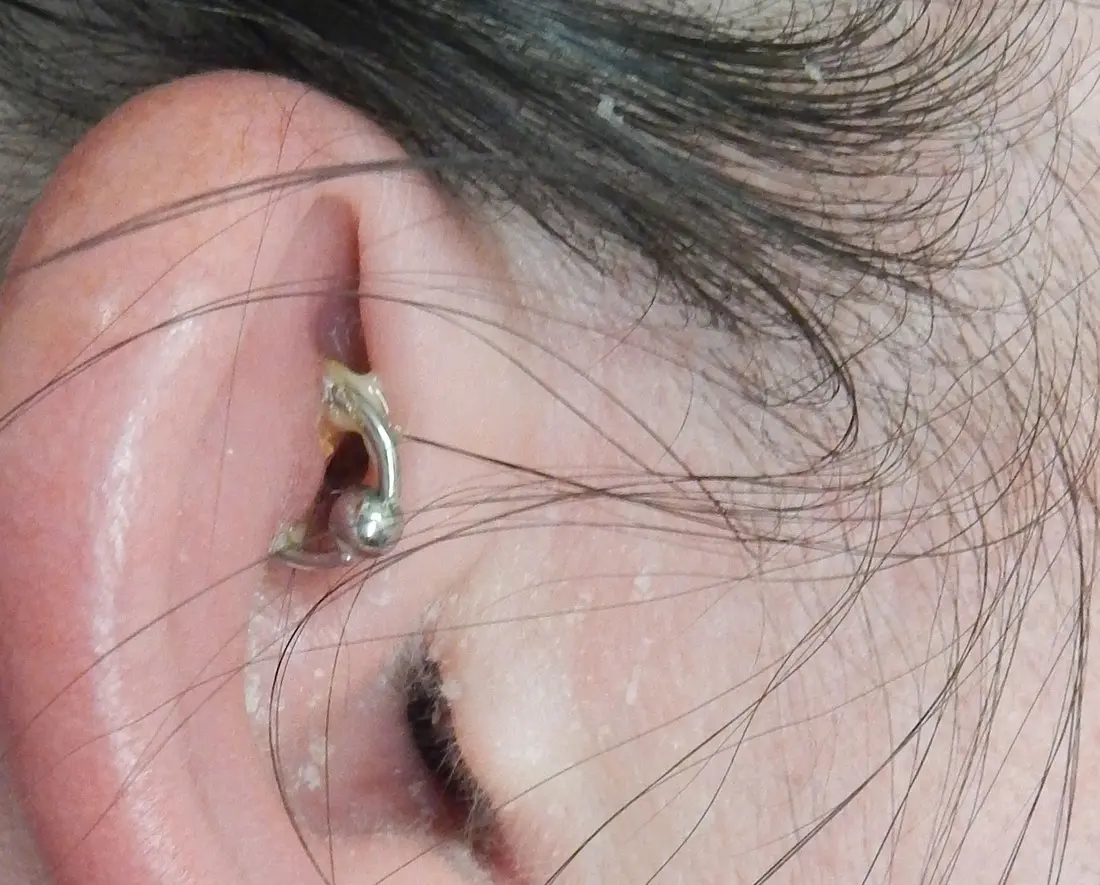
Perichondritis. Photo by James Heilman, MD via Wikimedia Commons, CC BY-SA 4.0.
An infected lobe is unpleasant. An infected helix, conch, rook, tragus or industrial is a bigger problem.
Cartilage has almost no blood supply of its own. It is fed by the thin membrane covering it, which is why cartilage piercings take six to twelve months to heal in the first place. That same poor blood supply means:
- The immune system reaches an infection slowly.
- Oral antibiotics penetrate the tissue less effectively.
- Infection can damage cartilage permanently, which in severe cases distorts the shape of the ear.
If you suspect infection in a cartilage piercing, do not spend a week trying saline. See a doctor promptly and tell them it is cartilage, because that changes which antibiotic is appropriate.
This is also the strongest practical argument against piercing guns above the lobe: blunt force through cartilage causes more tissue trauma than a needle, and the equipment cannot be autoclaved.
What a doctor will do
What treatment you get is a doctor’s decision, and the sources we read do not set out a protocol. The APP says a localized infection may be helped by saline soaks or hot compresses that encourage drainage, and that a mupirocin cream or gel, not an ointment, has been found effective. WebMD’s nose article says that if home care does not help, you may need antibiotics.
The APP says removing jewelry during an infection may result in an abscess. Do not try to drain anything yourself, and ask the doctor whether the jewelry should stay in.
Take the full course. Stopping when it looks better is how a partially treated cartilage infection comes back.
While you are waiting for an appointment
- Keep the piercing clean with plain sterile saline, twice a day.
- Wash your hands before touching anywhere near it.
- Do not apply antibiotic ointment, alcohol, peroxide or tea tree oil.
- Do not squeeze or attempt to drain anything.
- Do not remove the jewelry.
- Sleep on the other side.
- A clean, warm compress can be comfortable and may help drainage. Do not use anything reusable that has touched the piercing before.
Why it got infected
Usually one of these:
- Touching it with unwashed hands.
- A gun piercing, which causes more tissue trauma and cannot be fully sterilised.
- Poor-quality jewelry, particularly externally threaded posts that drag through the channel.
- Swimming in a pool, hot tub, lake or sea before healing.
- A knock or tear that opened the channel.
- An early jewelry change that damaged the healing tissue.
Prevention is the ordinary aftercare routine plus ear-specific practicalities: saline only, hands off, no rotating, no sleeping on it, no swimming, implant-grade jewelry, and needles rather than guns.
If it is a lump rather than a spreading infection
A discrete bump beside the jewelry that is not hot and not spreading is almost certainly an irritation bump. Different problem, different fix: see piercing bump vs keloid.
Not sure whether it is infected? Irritated or infected piercing has a symptom table, and how to treat an infected piercing covers the steps that apply to any placement.
Frequently asked questions
How do I know if my ear piercing is infected?
Infection spreads. Look for skin hot to the touch, redness expanding outward from the piercing, thick yellow or green discharge, swelling that increases after the first week, throbbing pain, or fever. Irritation stays localised and produces clear or whitish fluid.
Should I take the jewelry out of an infected ear piercing?
No, not unless a clinician tells you to. Removing it allows the surface to close over while infection is still inside the channel, which can turn a treatable surface infection into an abscess.
Is an infected cartilage piercing more serious than a lobe?
Yes. Cartilage has a very poor blood supply, so it fights infection slowly and antibiotics reach it less easily. A cartilage infection can damage the cartilage permanently, so it needs medical attention promptly rather than a week of waiting.
Can I treat an infected ear piercing at home?
Mild irritation, yes, with plain saline and by removing the cause. A genuine infection needs a doctor. Home antibiotic ointments do not reach inside the channel and trap moisture against the wound.
What does an infected ear piercing look like?
Bright or dark red skin spreading beyond the piercing, visibly swollen, often shiny and hot. Discharge is thick and yellow, green or grey rather than clear, and often smells. The whole ear may feel hot and painful rather than just the piercing.
How long does an infected ear piercing take to heal?
With appropriate treatment, a mild surface infection usually improves within a few days and clears in one to two weeks. A cartilage infection can take considerably longer and sometimes requires oral antibiotics for several weeks.
Sources
- Mayo Clinic - How to treat a piercing infectionhttps://www.mayoclinic.org/healthy-lifestyle/adult-health/expert-answers/ear-piercing-infection/faq-20452841
- American Academy of Dermatology - Caring for pierced earshttps://www.aad.org/public/everyday-care/skin-care-basics/tattoos/caring-for-pierced-ears
- Association of Professional Piercers - Troubleshootinghttps://safepiercing.org/troubleshooting/
This article is for education only and is not medical advice. If a piercing is hot, swollen, spreading redness, oozing yellow or green discharge, or you have a fever, see a doctor today.