On this page
The earlobe is soft tissue, not cartilage, which changes everything: it hurts less, heals in weeks rather than months, and forgives mistakes that would end a helix. It is where most people start and it is the foundation of every curated ear.
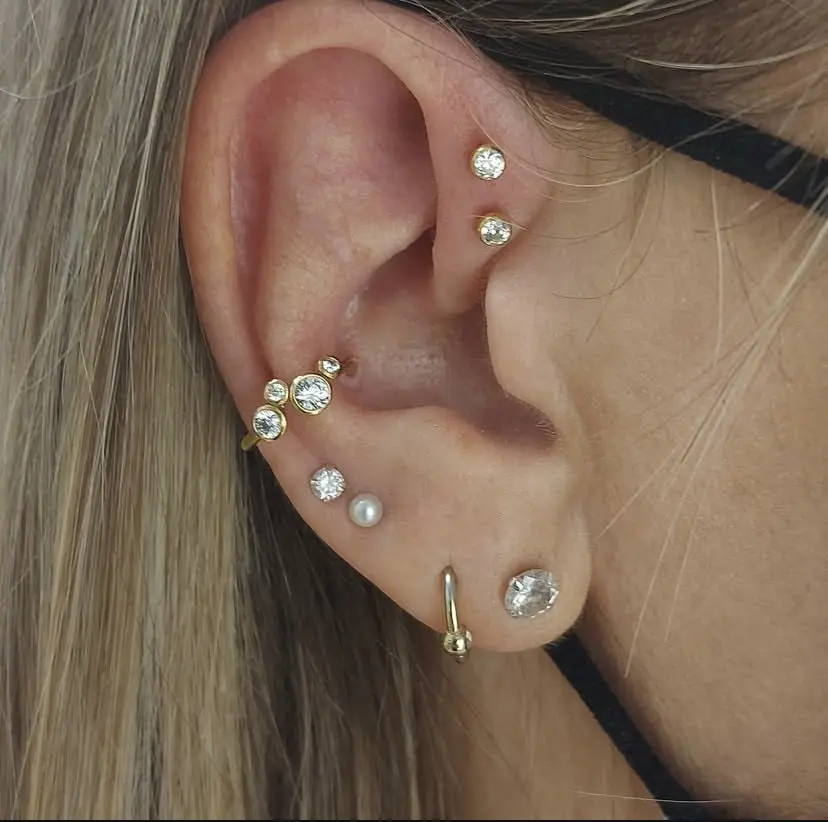
Photo by Sean Dubss via Wikimedia Commons, CC BY 4.0.
Standard, second, third and beyond
The first lobe piercing sits in the centre of the fleshy part, low enough to look natural and high enough not to drag. Above it there is usually room for a second and a third, sometimes a fourth, depending on how much lobe you have.
| Placement | Where | Notes |
|---|---|---|
| First lobe | Centre of the fleshy pad | The default |
| Second lobe | 6-8 mm above the first | Can usually be done at the same appointment |
| Third lobe | Above that, near the crease | Depends on lobe size |
| Stacked lobe | Deliberately close together, vertically | The current trend, needs a piercer with a good eye |
| Transverse lobe | Horizontally through the lobe, entering and exiting on the edges | A different piercing entirely, slower and more complicated |
Piercers can usually do several lobes in one session, since they heal quickly and do not compete for sleeping space the way cartilage does.
Needle or gun
You can get a lobe pierced with a gun at a mall counter in five minutes, often free with the purchase of a starter set. It is worth understanding what you are trading.
A needle is hollow, single use, sterile out of the packet, and removes a clean channel of tissue. The piercer controls the angle exactly, and can place it where you actually want it.
A gun pushes a blunt stud through the lobe using spring force. The stud is designed to be an earring, not a piercing instrument. The plastic housing cannot be sterilised in an autoclave, the butterfly backs trap discharge against the skin, and the operator has far less control over the angle. The Association of Professional Piercers recommends against guns for any piercing.
For a lobe the outcome is usually fine either way. For anything above the lobe, the difference is serious. If you are going to a studio anyway, use the needle.
The gun versus needle guide explains exactly what a gun does to tissue and why no professional uses one.
Pain
About 2 out of 10. A quick sharp pinch, then a warm ache for an hour or two. Almost everyone describes it as easier than they expected.
Healing
Six to ten weeks. Soft tissue with a good blood supply heals in a fraction of the time cartilage takes. That speed is also the trap: at three weeks it feels finished, and people swap into a costume pair, react to the metal, and end up with a sore lobe they blame on the piercing.
Wait the full six to ten weeks, then change into implant-grade titanium or solid gold. Ear piercing healing time compares the lobe with every cartilage placement.
Downsize at four to six weeks if your initial post was long. Lobes swell less than cartilage, so this comes around sooner. Piercing downsizing explains it for every placement.
How long it can be left empty, which depends far more on how long you have had it than on where it is, is in how long a piercing takes to close.
Aftercare
Sterile saline twice a day, hands off, no twisting. That is it. Full detail in the aftercare guide.
Lobe-specific practicalities:
- Keep shampoo and conditioner rinsed away.
- Do not let long hair wrap the jewelry.
- Sleeping on a fresh lobe is not as damaging as sleeping on cartilage, but it still slows healing.
- Phones press directly on the lobe. Wipe your screen, or use the other ear.
Jewelry
Start with a flat-back labret, 16 or 18 gauge, in ASTM F136 implant-grade titanium, with a post around 8 mm. Flat backs are more comfortable to sleep on than butterfly backs and they do not trap discharge the way a butterfly clutch does.
A note on gauge: most costume earrings are 20 gauge, which is thinner than a piercing done at 16 or 18. If you are pierced at 16 gauge and then wear 20 gauge posts for months, the channel gradually shrinks toward the thinner size and you may struggle to get thicker jewelry back in. If you plan to wear heavier or thicker styles later, ask to be pierced at 16 gauge and stay there.
Once healed, lobes take almost anything: hoops, huggies, chains, drops, stacked sets. This is the part of the ear where you can wear whatever you like. Materials still matter for anything worn all day, so see the jewelry material guide.
The flat back guide covers post lengths and gauges by placement. If you are thinking about going up in gauge rather than just changing style, the ear stretching guide covers how to do it without a blowout.
Piercing a child’s ears
This comes up constantly and deserves a straight answer.
There is no medically established minimum age, and US state laws differ on consent. What piercers generally agree on is practical rather than moral: a child who asks for the piercing, can sit still for it, and can follow an aftercare routine will have a far better experience than a baby who cannot do any of those things.
If you decide to go ahead:
- Choose a studio that uses needles, not a retail counter with a gun.
- Insist on implant-grade titanium, since nickel sensitivity often begins with early exposure.
- Expect a consultation, marking, and the child’s own agreement before the piercing.
- Some studios pierce both lobes simultaneously with two piercers, which avoids a distressed child after the first side.
For infants, baby ear piercing covers what pediatricians advise on age, earrings and aftercare.
Problems
Lobes are resilient, but three things come up:
Reactions to cheap jewelry. Redness, itching and weeping that starts days after a jewelry change is usually nickel, not infection. Swap to titanium.
Stretched or torn holes from heavy earrings worn in a fresh or thin lobe. Weight is cumulative; a heavy hoop worn daily elongates a hole over years.
Trapped discharge behind butterfly backs. Another reason to use flat backs.
Anything hot, spreading, thickly discharging or accompanied by fever needs a doctor. See piercing bump vs keloid if a lump appears; lobes are one of the few places where true keloids do occur, particularly in people with a family history.
A lump that spreads beyond the piercing and keeps growing over months is a different problem: see the keloid guide.
Cost
$20 to $40 per lobe at a professional studio, plus jewelry from about $20 for titanium. Many studios price a pair together. Free piercings advertised with a jewelry purchase are nearly always gun piercings.
Frequently asked questions
How long does an earlobe piercing take to heal?
Six to ten weeks, the fastest of any ear piercing, because the lobe is soft tissue with a good blood supply rather than cartilage. Wait the full time before changing jewelry even though it will feel fine after a fortnight.
Does an earlobe piercing hurt?
About 2 out of 10. A quick pinch and it is done. It is the piercing most people start with for exactly that reason.
Is a needle better than a gun for earlobes?
Yes. A needle removes a clean core of tissue, comes sterile and single use, and can be placed precisely. A gun forces a blunt stud through with spring pressure and the plastic body cannot be autoclaved. The difference matters less on a lobe than on cartilage, but it still matters.
When can I change my earlobe earrings?
After six to ten weeks, and only if there is no tenderness, redness or discharge. Change into implant-grade titanium or solid gold, not a costume pair, or you may find the piercing reacts.
How old should a child be to get their ears pierced?
There is no single right answer, and laws vary by state. Many piercers prefer the child to be old enough to ask for it themselves and to sit still and follow aftercare, which is usually around school age. Choose a studio that uses needles and implant-grade jewelry rather than a gun at a mall counter.
How much do earlobe piercings cost?
$20 to $40 per lobe at a professional studio, plus jewelry. Many studios discount a pair. Free or very cheap piercings at retail counters are usually gun piercings with low-grade jewelry included.
Sources
- Association of Professional Piercers - Suggested aftercare for body piercingshttps://safepiercing.org/aftercare/
- Association of Professional Piercers - Why piercing guns are a problemhttps://safepiercing.org/piercing-guns/
- American Academy of Dermatology - Caring for pierced earshttps://www.aad.org/public/everyday-care/skin-care-basics/tattoos/caring-for-pierced-ears
This article is for education only and is not medical advice. If a piercing is hot, swollen, spreading redness, oozing yellow or green discharge, or you have a fever, see a doctor today.