On this page
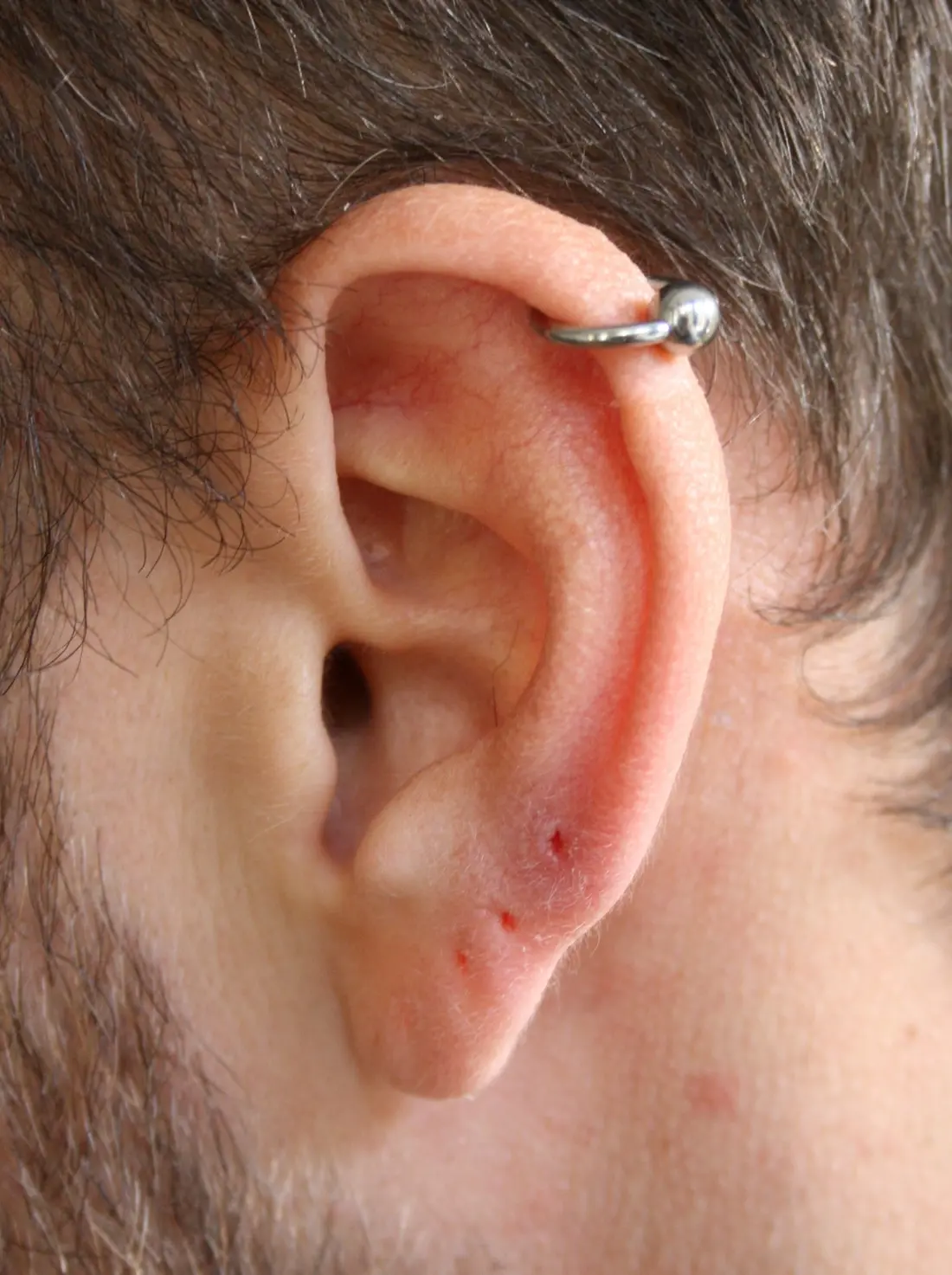
If you have a helix, conch, flat or any other cartilage piercing, there is a fair chance you will see a bump beside it at some point in the first year. That is not a sign of anything going wrong with you. It is what cartilage does when something keeps pressing on a wound that heals slowly.
The bump is the symptom. The cause is almost always something you can find and stop.
Why cartilage, specifically
Two things make cartilage piercings bump more than anything else on the body.
They heal slowly. Cartilage has almost no blood supply of its own, so a channel through it takes six to twelve months to mature. The cartilage guide explains why. That is a long window in which every knock sets the tissue back.
They sit where things press. The ear is where pillows, headphones, hair, glasses arms, hats and mask loops all land. A lobe hangs clear of most of it; the rim and the bowl of the ear do not.
Repeated pressure on a slow-healing wound produces a small, firm, pink or skin-coloured lump at the hole. That is the bump.
What it is not
Not an infection, unless it is hot, the redness is spreading, or there is thick coloured discharge. Cartilage infection is serious and needs a doctor the same day, jewelry left in. See infected ear piercing.
Almost never a keloid. A keloid grows beyond the piercing onto normal skin and keeps growing. A bump stays at the hole and stays small. The bump-versus-keloid guide has the comparison table, and the keloid guide covers what to do if it really is one.
The causes, ranked
In order of how often each turns out to be the answer.
| # | Cause | Fix |
|---|---|---|
| 1 | Sleeping on it | Switch sides, or a travel pillow |
| 2 | Post never downsized | Downsize at 6–10 weeks |
| 3 | Headphones and earbuds | Bone-conduction or open headphones |
| 4 | Hair, masks, glasses, hats | Tie back, loop behind the head, check fit |
| 5 | Wrong jewelry | Implant-grade titanium, threadless, studs only |
| 6 | The angle | See a piercer; not fixable at home |
| 7 | Over-cleaning | Saline twice daily, nothing else |
1. Sleeping on it. Eight hours a night of pressure. This is the cause more often than everything else together, and the one people most often rule out too quickly. Sleep on the other side, and if you roll over, use a travel pillow with the hole positioned under your ear.
2. The post was never downsized. The initial post is long to allow for swelling. Once the swelling has gone, that extra length lets the jewelry slide and tilt, and it catches on everything. Downsize at six to ten weeks. Most cartilage bumps that appear around month two or three are this.
3. Headphones and earbuds. Over-ear cups press on the rim and the flat; in-ear buds press on the tragus and the conch. Bone-conduction or open headphones for the first six months.
4. Hair, masks, glasses and hats. Long hair catches a stud dozens of times a day. Mask loops sit over the helix and forward helix. Glasses arms cross the same spot. Tie hair back, loop masks behind your head, and check where your frames sit.
5. The wrong jewelry. Externally threaded posts scrape the channel every time they move. Plated or mystery-metal jewelry irritates tissue directly. A hoop worn before the piercing has healed drags through the channel on every movement. Implant-grade titanium, threadless or internally threaded, studs until healed. See the materials guide.
6. The angle. A piercing made at an angle that does not suit the anatomy keeps the jewelry under constant tension. Nothing you do at home fixes this; it needs a piercer to look.
7. Over-cleaning. Scrubbing, soaking, tea tree oil, alcohol, peroxide and ointments all damage healing tissue and cause bumps of their own. Sterile saline twice a day is the routine, and it is the whole routine.
The protocol
- Work out which cause it is. Be honest about the pillow and the headphones.
- Remove the cause. Change sides, downsize, switch headphones, tie hair back, swap jewelry.
- Sterile saline twice a day, patted dry with clean paper towel.
- Put nothing else on it.
- Wait two to eight weeks. The bump shrinks after the cause goes, not before.
If it is still there eight weeks after you are sure the cause is gone, see your piercer. Angle problems and jewelry that is slightly the wrong size are things they can see in a minute.
What makes it worse
Tea tree oil, aspirin paste, apple cider vinegar, toothpaste, hydrogen peroxide, antibiotic ointment, hot compresses with anything added, and squeezing. Each of these appears constantly in online advice, and each of them irritates the tissue you are trying to calm. The bump is a reaction to irritation; adding more irritation does not help it.
Taking the jewelry out is the other common mistake. The bump is not caused by the jewelry’s presence, and an empty cartilage channel closes fast.
When to see someone
Your piercer if the bump persists after you have removed the cause, or if you cannot find the cause.
A doctor, the same day, for heat, spreading redness, thick coloured discharge or fever. Untreated cartilage infection can permanently deform the ear, and it does not wait.
If the bump is hot, spreading or leaking thick coloured discharge, it may be an infection rather than irritation: see irritated or infected piercing. Ask your piercer whether a downsize is due, too. Piercing downsizing has the timing for every placement.
Frequently asked questions
Why do cartilage piercings get bumps so often?
Because they take six to twelve months to heal and sit exactly where things press on them: pillows, headphones, hair, glasses, mask loops. Cartilage also has a poor blood supply, so it recovers slowly from each knock. A bump is the tissue responding to repeated irritation, and cartilage gets more of it than anywhere else.
Is a bump on my helix a keloid?
Almost never. A keloid spreads beyond the piercing onto healthy skin and keeps growing for months. A cartilage bump sits at the hole, stays roughly pea-sized or smaller, and shrinks when the cause is removed. If it is spreading, see the keloid guide and a dermatologist.
How do I get rid of a cartilage piercing bump?
Find and remove the cause, then wait. The APP's aftercare advice is to avoid friction, pressure from clothing, excessive motion, playing with the jewelry and vigorous cleaning, and to avoid sleeping directly on a healing cartilage piercing. Check for those, including headphones, a mask loop, hair catching and a post that was never downsized, and clean with sterile saline and nothing else. If it is hot, spreading or leaking thick coloured discharge, or symptoms last a week or get worse, see a doctor.
Should I take the jewelry out if my cartilage piercing has a bump?
No. The bump is not caused by the jewelry being there, and removing it lets the channel close over tissue that is still healing. Change the jewelry if it is the wrong length, shape or material; do not leave the piercing empty.
How long does a cartilage bump take to go away?
Two to eight weeks after the cause is gone. It will not go while the cause is still there, which is why bumps that have been treated for months without result are usually bumps whose cause was never identified.
When is a cartilage bump actually an infection?
When it comes with heat, spreading redness, thick yellow or green discharge or fever. Cartilage infections are serious because the tissue has a poor blood supply; those signs mean a doctor the same day, with the jewelry left in.
Sources
- Association of Professional Piercers - Suggested aftercare for body piercingshttps://safepiercing.org/aftercare/
- Association of Professional Piercers - Troubleshootinghttps://safepiercing.org/troubleshooting/
- American Academy of Dermatology - Caring for pierced earshttps://www.aad.org/public/everyday-care/skin-care-basics/tattoos/caring-for-pierced-ears
This article is for education only and is not medical advice. If a piercing is hot, swollen, spreading redness, oozing yellow or green discharge, or you have a fever, see a doctor today.