On this page
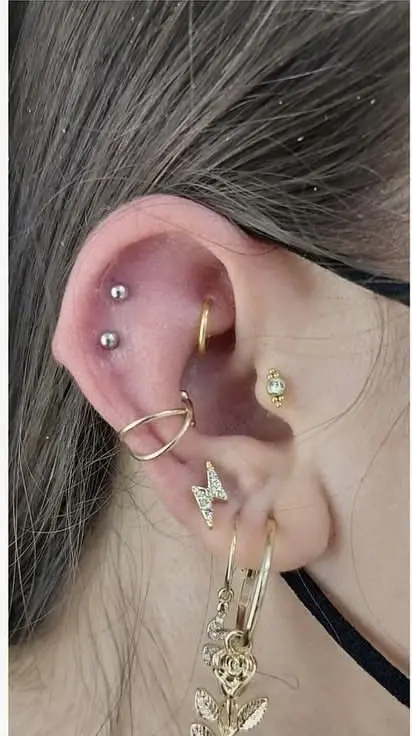
A double helix is two helix piercings stacked one above the other along the curved outer rim of the ear. Three is a triple helix. Each one is an independent piercing with its own channel, its own jewelry and its own healing.
Nothing about the individual piercing changes. What changes is the planning, and the practicalities of healing two cartilage wounds on the same ear.
Spacing is what you are paying for
Two studs on a rim look right or they do not, and the difference is a couple of millimetres.
Too close and the jewelry touches, which keeps both channels permanently irritated. Too far apart and they stop reading as a pair. The correct gap depends on the length and curve of your rim and on the size of the ends you plan to wear, which is why it is a judgement rather than a measurement.
Have your piercer mark both, hand you a mirror, and look before anything happens. If you might eventually want a third, say so now: spacing for a triple has to be planned as a triple.
Both at once, or one at a time
Either works. The trade-off is worth understanding.
Both at once is how most people do it. A piercer marks the spacing in a single sitting, which is the most reliable way to get it even, and you go through the healing period once instead of twice.
Staggering has one real advantage: sleep. Two healing cartilage piercings on the same ear means that side is unavailable for months, and if you already have something healing on the other side you have nowhere to go. If you are building a curated ear over time, alternating sides is worth planning around.
What most piercers will discourage is more than two or three cartilage piercings in one session, on either ear. Healing several cartilage wounds at once is a real load, and the practical problem of sleeping is the one people underestimate.
Pain
About 4 out of 10 each, the same as a single helix. The rim is relatively thin cartilage and the needle passes quickly.
Two in a row is not double the pain, though the second is generally noticed more because the ear is already tender. A triple in one sitting is a longer session but not a dramatically worse one.
Healing
Six to twelve months, healing in parallel, so two does not take longer than one.
- Weeks 1-2: swelling and tenderness across both.
- Weeks 2-12: crusting, itching, an outside that looks finished long before it is.
- Months 3-12: internal maturing.
Downsize both at six to ten weeks, in one visit. Two long posts on a rim knock into each other as well as into hairbrushes and pillows, so this matters a little more than with a single. Helix piercing healing time compares the double helix with the other helix placements. Piercing downsizing explains it for every placement.
Why cartilage takes this long, and the four rules that prevent most of its problems, are in the cartilage piercing guide.
The cartilage bump guide ranks the causes by how often each turns out to be the answer.
The sleeping problem, doubled
One healing helix means not sleeping on that side. Two means the same thing, for the same six to twelve months, with twice as much to knock if you roll over.
The standard fix is a travel pillow with the hole positioned under your ear, which lets you lie on that side without any pressure on the rim. It is worth buying one before the appointment rather than after the first bad night.
Otherwise: sterile saline twice a day, hands off, no rotating, hair tied back for the first few weeks. The ear cleaning guide has the routine.
Jewelry
Two flat-back labret studs, 16 gauge, implant-grade titanium, downsized to 6 to 8 mm. Threadless or internally threaded only. See the materials guide.
Match the end sizes to the spacing. Two large gems on a tight pair will touch, and jewelry that touches keeps both piercings irritated. If you want statement ends, tell your piercer before they mark, so the gap accounts for it.
Hoops are for after both are fully healed, not at three months. A ring moves far more than a stud, and on a rim that means it moves in a channel that is still maturing.
The flat back guide covers post lengths and gauges by placement.
Not an orbital
A orbital is two holes joined by a single ring, planned as one piercing from the start with both holes angled to suit the ring.
A double helix is two separate piercings, each sitting at its own natural angle. Threading one ring through both pulls on each channel from a direction it was not pierced for. If you want the single-ring look, ask for an orbital and have it planned that way.
Cost
$60 to $140 for the pair in a US studio, plus jewelry for each. Studios almost always discount the second piercing in the same session, so a double together costs less than two visits. A triple runs roughly $90 to $200 plus jewelry. Tip 15 to 20 percent.
Frequently asked questions
What is a double helix piercing?
Two helix piercings stacked one above the other on the curved outer rim of the ear. A triple helix is three. Each is an independent piercing with its own jewelry, and each heals on its own timetable.
Does a double helix hurt more than a single?
Not per piercing. Each is about 4 out of 10, the same as a single helix. Two in a row means sitting through it twice, and the second is usually felt slightly more because the ear is already tender.
Should I get both at once or one at a time?
Both at once is fine and is how most people do it, because a piercer can mark the spacing properly in one go. The argument for staggering is sleep: two healing cartilage wounds on the same ear means one side is off limits for months.
How long does a double helix take to heal?
Six to twelve months, the same as a single. They heal alongside each other, so two does not take twice as long, but two sites means twice as much to knock.
How far apart should double helix piercings be?
Close enough to read as a set, far enough that the jewelry does not touch. Your piercer judges it against the length and curve of your rim rather than a fixed measurement, and jewelry size affects it.
Can I wear one ring through both holes?
No. That would be an orbital, which is a different piercing planned as one from the start. Two helix piercings sit at their own angles and a single ring through both would pull on each.
Sources
- Association of Professional Piercers - Suggested aftercare for body piercingshttps://safepiercing.org/aftercare/
- Association of Professional Piercers - Jewelry for initial piercingshttps://safepiercing.org/jewelry-for-initial-piercings/
- American Academy of Dermatology - Caring for pierced earshttps://www.aad.org/public/everyday-care/skin-care-basics/tattoos/caring-for-pierced-ears
This article is for education only and is not medical advice. If a piercing is hot, swollen, spreading redness, oozing yellow or green discharge, or you have a fever, see a doctor today.