On this page
A vertical tragus, also called a surface tragus, is easy to confuse with a standard tragus piercing because they sit in the same general area. They are not the same piercing, and the difference matters more than the name suggests.
A standard tragus passes through the flap of cartilage. A vertical tragus sits on the front surface of the tragus, entering and exiting through skin on the same flat plane, with a small bar bridging the gap under the surface. It never touches the cartilage flap itself.
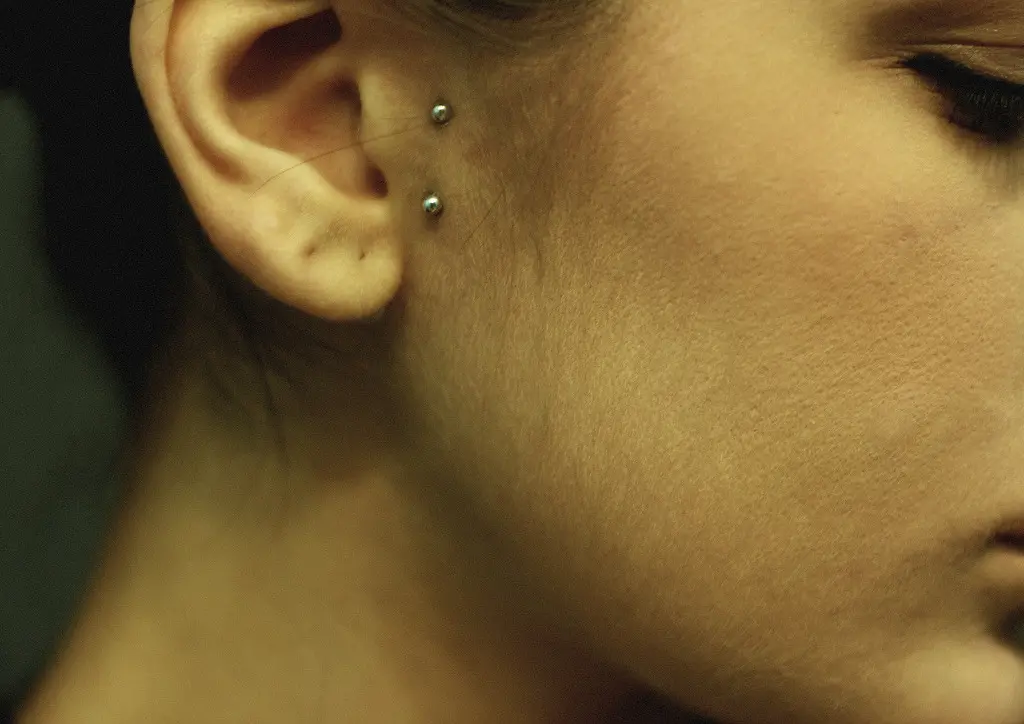
Photo by Maria Casacalenda via Wikimedia Commons, CC BY-SA 2.0.
Why “surface” changes the risk
Anything pierced through a structure, a fold, a flap, a channel, tends to be held in place by that structure. A surface piercing has no structure to anchor it. The jewelry sits in a shallow channel through skin, and the body can treat it as something to work back out over time.
That process is migration, and it is important to understand before getting a vertical tragus. It is not a sign anything was done wrong; it is a known characteristic of surface piercings, shared with the eyebrow and the anti-eyebrow. Correct depth, a well-fitted curved bar and avoiding snags keep the odds in your favour, but they do not remove the risk entirely.
The anatomy check
The front of the tragus needs enough flat surface and enough depth of tissue for a bar to sit comfortably under the skin without excess tension on either end. A tragus that curves sharply or sits very close to the ear canal may not offer enough room.
A piercer should assess this the same way they would check a standard tragus for thickness, only here they are checking surface area and curvature rather than flap depth. Being told your anatomy does not suit it is a legitimate outcome, not a formality.
Pain
About 3 out of 10, milder than a standard tragus. The skin on the front of the tragus is thin, so the needle passes quickly with a sharp but brief pinch, rather than the dense pressure of piercing straight through the cartilage flap.
Healing
Two to four months to settle. Because it is a shallow skin channel rather than a piercing through thick cartilage, it settles faster on paper than a standard tragus does. That speed does not offset the migration risk, which can appear at any point, including well after the initial healing window.
- Week 1: swelling and tenderness, similar to any surface piercing.
- Weeks 2-8: crusting, less tenderness, looks stable.
- Months 2-4: settled, if the depth and jewelry were right from the start.
Downsize once swelling has gone, generally around four to six weeks, so there is no spare bar length to catch and lever the piercing. Piercing downsizing explains it for every placement.
Why cartilage takes this long, and the four rules that prevent most of its problems, are in the cartilage piercing guide.
Aftercare
The same core routine as everywhere else: sterile saline twice a day, hands off, no rotating. Full detail in the aftercare guide.
Two things matter more here than on a standard tragus:
- Earbuds and headphones press directly on this piercing, exactly as they do on a standard tragus, and pressure is a common trigger for migration on any surface piercing. Avoid them on that side for the first few months.
- Sleeping position matters even more than usual. Any pressure on a surface bar pushes one end closer to the surface.
Jewelry
Start with a micro curved barbell or a small surface bar, 16 gauge, around 6 mm, in ASTM F136 implant-grade titanium. The bar needs to be sized to the exact depth of tissue: too long and it sits loosely and shifts; too short and it presses the skin from underneath.
This is not a piercing to buy generic jewelry for. Have your piercer supply and fit the bar, and go back to them for any change while it is settling. See the material guide for why titanium matters even more on a piece this small.
A retainer keeps the channel open when you need to hide it, or to remove metal for a scan.
Watching for migration
Check periodically for:
- The visible gap between the two ends narrowing.
- The skin over the bar looking thin, shiny, or letting the bar show through.
- Renewed tenderness after the piercing had settled.
- The bar sitting at a different angle than when it was fitted.
Any of these means see your piercer promptly. Caught early, a change of bar length or position can sometimes save the piercing. Left alone, migration ends in rejection, usually with a smaller scar if the jewelry is removed in time than if it is left to migrate all the way out.
Problems
Migration and rejection, covered above, are the main risk specific to this placement.
Irritation bumps from pressure or snagging respond the same way as anywhere else: remove the cause, keep up saline, and read piercing bump vs keloid before assuming the worst.
Infection is less common on surface piercings than on cartilage, but the same rules apply: spreading redness, heat, thick coloured discharge or fever needs a doctor the same day.
The cartilage bump guide ranks the causes by how often each turns out to be the answer.
A lump that spreads beyond the piercing and keeps growing over months is a different problem: see the keloid guide.
Cost
$35 to $80 for the piercing, plus $30 to $80 for a properly fitted titanium bar. Because the jewelry needs to be sized precisely to your anatomy, this is not a piercing to shop for the cheapest quote.
Frequently asked questions
What is the difference between a tragus and a vertical tragus piercing?
A standard tragus goes through the flap of cartilage, so the two ends of the jewelry sit on either side of it. A vertical tragus, also called a surface tragus, sits on the front skin of the tragus instead, entering and exiting on the same flat surface. It never passes through the flap.
Is a vertical tragus a surface piercing?
Yes, and that changes everything about it compared with a standard tragus. Surface piercings can migrate, meaning the body gradually pushes the jewelry toward the surface until it rejects, which a through-the-flap tragus does not do.
Does a vertical tragus piercing hurt?
About 3 out of 10. The skin on the front of the tragus is thin, so the needle passes quickly. It is milder than a standard tragus, which has to cross the thicker cartilage flap.
How long does a vertical tragus take to heal?
Two to four months to settle, similar to an eyebrow piercing, since it is a shallow surface channel through skin rather than a piercing through dense cartilage.
Can every ear take a vertical tragus?
No. It needs enough flat surface and depth on the front of the tragus for a bar to sit under the skin without excessive tension. A very small or very curved tragus may not have room, and a piercer should check before agreeing.
Sources
- Association of Professional Piercers - Suggested aftercare for body piercingshttps://safepiercing.org/aftercare/
- Association of Professional Piercers - Troubleshootinghttps://safepiercing.org/troubleshooting/
- Association of Professional Piercers - Jewelry for initial piercingshttps://safepiercing.org/jewelry-for-initial-piercings/
This article is for education only and is not medical advice. If a piercing is hot, swollen, spreading redness, oozing yellow or green discharge, or you have a fever, see a doctor today.