On this page
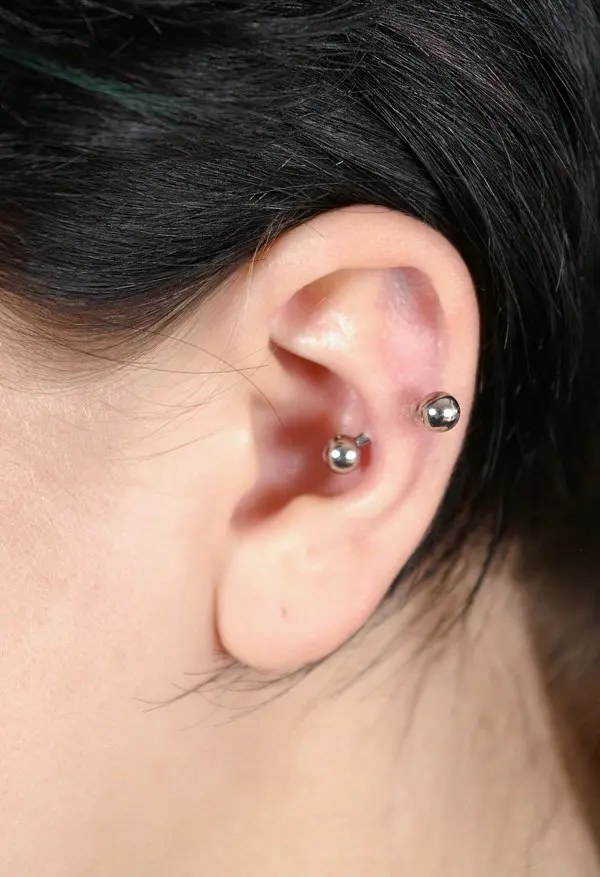
A snug passes through the antihelix, the inner ridge of cartilage running roughly parallel to the outer rim, about halfway down the ear. Both ends of a curved barbell sit on the front face of that ridge, which is why it reads as a short bar tucked into the middle of the ear rather than something on an edge.
It is also called an antihelix piercing. It is the most painful placement on this site, the slowest to heal, and the one a good piercer refuses most often. All three facts come from the same source.
Your ear probably decides this, not you
The snug needs a pronounced antihelix ridge with real depth behind it, so the curved bar can seat inside the fold without pressing against tissue at either end.
Plenty of ears do not have that. A shallow or flat antihelix leaves nothing for the jewelry to sit in, and a bar forced into it is under constant tension from day one. That produces migration, persistent bumps, and eventually a rejected piercing with a scar in a conspicuous place.
Feel the ridge in the middle of your ear. If it is a distinct, raised fold you can pinch, you may be a candidate. If it is a gentle swell that blends into the surrounding cartilage, you almost certainly are not.
A piercer who examines your ear and says no is doing the job correctly. This is the placement where that refusal happens most, and it is worth accepting rather than shopping around until someone agrees.
Pain
About 7 out of 10. The needle passes through a thick double thickness of dense cartilage, so the pressure builds and lasts several seconds rather than passing in an instant.
It is a firm, deep, grinding pressure rather than a sharp sting, and the crunch is loud. People who have sat through a helix and a conch generally describe the snug as a clear step up from both.
The soreness afterwards also lasts longer than most ear piercings, often a good week of genuine tenderness rather than two or three days.
Healing
Six to twelve months, and frequently longer. Snugs have a reputation for being the ear piercing that never quite settles, and there are two reasons.
The first is tissue: dense cartilage with almost no blood supply of its own. The second is position. The jewelry sits proud on a ridge in the middle of your ear, which puts it directly in the path of pillows, headphones, hair, hats and the arms of glasses.
- Weeks 1-3: swelling, real tenderness, warmth. Sleeping on that side is impossible anyway.
- Weeks 3-16: crusting and intermittent irritation. Expect flare-ups where other placements would be settling.
- Months 4-12: slow internal maturing, still easy to set back with one knock.
Downsize at eight to twelve weeks, later than most ear piercings because the swelling takes longer to go. Do not skip it. An over-long bar on a ridge is exactly what catches. Piercing downsizing explains it for every placement.
Why cartilage takes this long, and the four rules that prevent most of its problems, are in the cartilage piercing guide.
Living with one
This placement demands more than the others, and going in knowing that is most of the battle:
- No in-ear headphones for the first six months, and be careful with over-ear cups, which press on the middle of the ear. Bone-conduction or open headphones are the easiest answer.
- Sleep on the other side, without exception. A travel pillow with the hole under your ear helps if you move in your sleep.
- Tie hair back for the first few weeks and be deliberate with a brush.
- Glasses and masks both reach this area. Check before you book.
Aftercare itself is unremarkable: sterile saline twice a day, hands off, no rotating. The ear cleaning guide covers it. What matters here is the mechanical protection, not the cleaning.
Jewelry
Curved barbell, 16 gauge, implant-grade titanium, sized specifically to your ridge. The curve is what lets the bar follow the fold; a straight bar in a curved path presses on both openings and will not settle. Threadless or internally threaded only. See the materials guide.
Keep the ends small. A large decorative end on a snug adds leverage to a piercing that is already catching on everything, and leverage is what produces bumps here.
Problems
Bumps are near-universal on snugs at some stage, and they are almost always mechanical: something is pressing on it. Find and remove the cause before treating the bump, because treatment without removing the cause does nothing. See piercing bumps.
Migration is a real risk if the anatomy was marginal. Jewelry sitting closer to the surface, or thinning tissue over the bar, means see your piercer rather than wait.
Infection in cartilage is serious. Heat, spreading redness, thick coloured discharge or fever means a doctor the same day, with the jewelry left in. See infected ear piercing.
The cartilage bump guide ranks the causes by how often each turns out to be the answer.
If your ear cannot take one
The look people usually want from a snug is a small bar sitting in the middle of the ear. Two placements get close on ears that will not take a snug:
- Conch: the bowl just below and inside the antihelix, far more forgiving anatomically.
- Rook: the same ridge higher up, which some ears have well defined even where the lower section is flat.
Cost
$40 to $90 in a US studio, plus $30 upwards for jewelry, and expect to pay toward the top of that for a piercer with real experience of the placement. On this one, that is worth paying for. Tip 15 to 20 percent.
Frequently asked questions
What is a snug piercing?
A piercing through the antihelix, the inner ridge of cartilage that runs roughly parallel to the outer rim, about halfway down the ear. Both ends of a curved barbell show on the front of that ridge. It is also called an antihelix piercing.
Does a snug piercing hurt?
About 7 out of 10, and it is the most painful ear placement on this site. The needle passes through a thick fold of dense cartilage, so the pressure lasts noticeably longer than a helix or a flat.
Can everyone get a snug piercing?
No, and this is the placement piercers decline most often. It needs a pronounced antihelix ridge with enough depth for a curved bar to sit inside it. Many ears have a shallow or flat antihelix and simply cannot take one safely.
How long does a snug piercing take to heal?
Six to twelve months at best, and snugs are known for taking the full year or longer. It is dense cartilage in a spot that catches on everything, which is a slow combination.
Why do snug piercings get so many bumps?
Because the jewelry sits proud on a ridge in the middle of your ear, where headphones, pillows, hair and glasses all reach it. Almost every snug bump is mechanical irritation rather than infection, and the fix is removing whatever is knocking it.
What is the difference between a snug and a rook?
Both go through the antihelix, at different heights. A rook passes through the upper fold above the inner ear. A snug passes through the same ridge lower down, roughly level with the middle of the ear, above the anti-tragus.
Sources
- Association of Professional Piercers - Suggested aftercare for body piercingshttps://safepiercing.org/aftercare/
- Association of Professional Piercers - Jewelry for initial piercingshttps://safepiercing.org/jewelry-for-initial-piercings/
- American Academy of Dermatology - Caring for pierced earshttps://www.aad.org/public/everyday-care/skin-care-basics/tattoos/caring-for-pierced-ears
This article is for education only and is not medical advice. If a piercing is hot, swollen, spreading redness, oozing yellow or green discharge, or you have a fever, see a doctor today.