On this page
The helix is the curved outer rim of your ear, running from just above the lobe all the way up and around to where the ear meets your head. A helix piercing goes through that rim. It is the most requested cartilage piercing in the world, and it is also the one people most often ruin, almost always for the same three reasons: a hoop too early, sleeping on it, and a post that is the wrong length.
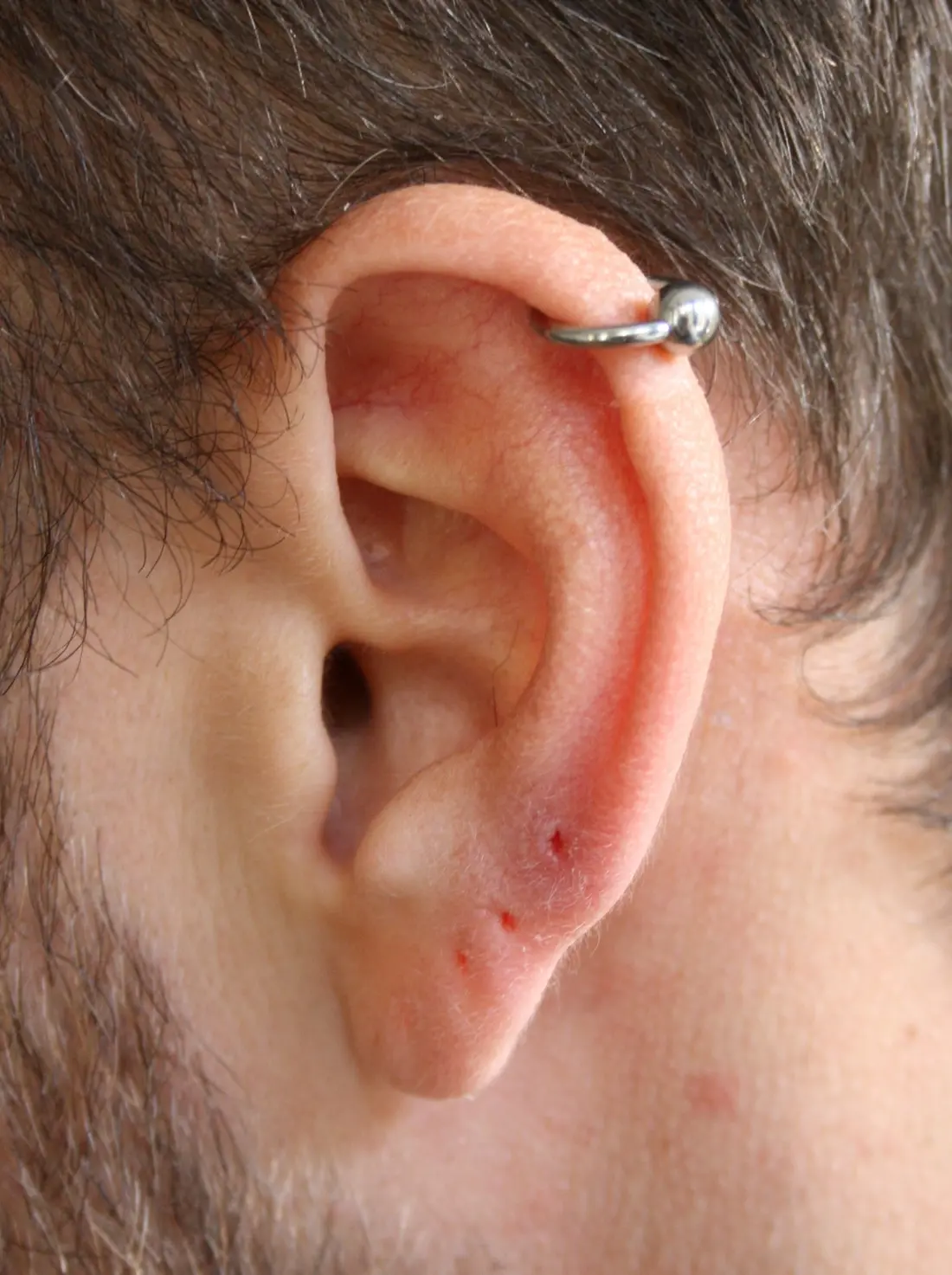
Photo by Nicor via Wikimedia Commons, CC BY-SA 3.0.
Where a helix piercing sits
“Helix” describes a zone, not a single point, which is why the same word covers so many different looks.
| Name | Where it sits | Notes |
|---|---|---|
| Standard helix | Upper outer rim, roughly level with the top of the ear canal | The default if you just ask for “a helix” |
| Forward helix | Front of the rim, right where the ear meets the face | Tighter tissue, slightly more pain, harder to sleep on |
| Mid helix | Halfway down the outer rim | Often crushed by over-ear headphones |
| Double or triple helix | Two or three holes stacked along the rim | Can be done in one session if your anatomy allows |
| Flat helix | Technically the flat, not the rim, but often sold as helix | Look for the wide flat area inside the rim |
If you want a specific final look, say so at the consultation rather than after the marking. Where a piercer can place the hole is limited by the thickness and fold of your rim, and a millimetre changes how the jewelry sits.
Who it suits
Nearly everyone has enough rim to take a helix. The real constraints are practical rather than anatomical.
- Glasses. A forward helix or a high standard helix can sit exactly where the arm of your glasses rests. Bring your glasses to the appointment and try them on while the piercer marks you.
- Headphones. Over-ear cups press directly on a mid helix. If you wear them all day for work, pick a placement further up or plan on earbuds for the first six months.
- Sleeping side. If you can only sleep on your right side, pierce the left ear first.
- Keloid history. If you or a close relative have formed keloids from previous wounds, talk to a dermatologist before piercing cartilage.
What actually happens
A professional piercer will clean and mark your ear, then have you look in a mirror and approve the mark before anything else happens. They pierce with a single-use hollow needle, which removes a clean core of tissue, and follow the needle straight through with the jewelry. It takes about a second.
The needle is not optional. A piercing gun forces a blunt earring stud through cartilage using spring pressure. Cartilage does not part cleanly under blunt force, it fractures, and the plastic gun body cannot go in an autoclave. Every professional body in the field, including the Association of Professional Piercers, says needles only above the lobe.
Pain, honestly
Around 4 out of 10. Sharper than a lobe, milder than a rook or an industrial. You get a bright, precise pinch for a second, a rush of heat, then a dull throb for the rest of the day. Expect it to be sore when you brush it for one to three weeks.
Eat beforehand and do not hold your breath. Most of the people who feel faint in a piercing chair skipped lunch.
The healing timeline
| Stage | When | What is normal |
|---|---|---|
| Inflammatory | Days 0-7 | Redness, swelling, warmth, clear or straw-coloured fluid |
| Proliferative | Weeks 2-12 | Swelling drops, crusting on the jewelry, itching, looks finished |
| Maturation | Months 3-12 | The channel thickens and toughens, still fragile if snagged |
The gap between “looks healed” and “is healed” is where helix piercings go wrong. At eight weeks the outside has closed over, but the channel inside is a thin, new tube of tissue. Swapping jewelry, catching it in a jumper or sleeping on it at that point tears the channel and restarts the clock. Ear piercing healing time shows how the helix compares with every other ear placement.
Downsize at six to ten weeks. Your initial post is deliberately long to leave room for swelling. Once the swelling has gone, that extra length lets the jewelry lever and catch, and the APP advises avoiding friction and excessive motion of a healing piercing. Go back to your piercer for a shorter post. Many studios do the first downsize free. How long a helix piercing takes to heal follows it week by week. Piercing downsizing explains it for every placement.
Why cartilage takes this long, and the four rules that prevent most of its problems, are in the cartilage piercing guide.
How long it can be left empty, which depends far more on how long you have had it than on where it is, is in how long a piercing takes to close.
Aftercare in four lines
- Spray sterile saline wound wash on both sides, twice a day.
- Do not touch, twist or rotate it. There is no reason to move a piercing, ever.
- Do not sleep on it.
- Leave the crust alone. It softens in the shower and washes away.
Skip the alcohol, hydrogen peroxide, tea tree oil, antibacterial soap and ointments. All of them either kill the new cells doing the healing or trap moisture against the wound. Our full aftercare guide covers products, showering, swimming and travel.
Jewelry
Start with a flat-back labret in ASTM F136 implant-grade titanium, 16 gauge, with a 6 to 8 mm post. The flat disc sits behind the ear against your head, so there is nothing to press into your skull when your head touches a pillow. Cartilage earrings covers what the sources say about studs, hoops and materials.
Choose threadless (press-fit) or internally threaded jewelry. Both give you a smooth post. Externally threaded jewelry has the screw thread on the outside of the bar, so every insertion drags a sharp spiral through your fresh channel. It is cheap, it is common in mall shops, and it should never go in a new piercing.
Once fully healed you can wear a hoop, a huggie, a chain, or a stack of decreasing sizes up the rim. See our jewelry material guide for what titanium, gold and steel each do to a healing piercing.
The flat back guide covers post lengths and gauges by placement.
What goes wrong, and why
Irritation bumps are the classic helix problem: a small, soft, pink lump right beside the jewelry, sometimes weeping clear fluid. The APP describes an irritation bump as a small, slightly elevated pustule that is red and inflamed but contained locally. Rule out what the APP says to avoid: friction, pressure, excessive motion, sleeping directly on it and playing with the jewelry, including a post that needs downsizing. If it is hot, spreading or leaking thick coloured discharge, it may be an infection: see irritated or infected piercing. Read piercing bump vs keloid before you touch it.
Infection is less common but more serious in cartilage than in soft tissue, because the poor blood supply that makes cartilage slow to heal also makes it slow to fight bacteria. Hot skin, spreading redness, thick yellow or green discharge, throbbing pain or a fever means see a doctor the same day. Leave the jewelry in until they tell you otherwise; taking it out can seal an infection inside the channel.
Embedding happens when swelling outgrows a post that was too short to begin with, and the disc sinks into the skin. That needs a piercer or a clinician, not tweezers at home.
The cartilage bump guide ranks the causes by how often each turns out to be the answer.
A lump that spreads beyond the piercing and keeps growing over months is a different problem: see the keloid guide.
Cost
Expect $30 to $80 for the piercing itself in a US studio, plus the jewelry. Independent studios usually price the two separately, so a titanium end at $30 to $60 and a gold end at $80 upwards. Chain and mall studios bundle a basic stud into a single price, which looks cheaper but often means lower-grade jewelry and, at some chains, a gun.
Tipping your piercer 15 to 20 percent is standard in the US, the same as any other appointment-based service.
Frequently asked questions
How long does a helix piercing take to heal?
Six to twelve months. It will look and feel healed at around two to three months, which is exactly when people change the jewelry and set themselves back. Cartilage has almost no blood supply of its own, so it repairs slowly from the edges inward.
Does a helix piercing hurt?
Most people put it at 4 out of 10. The needle itself is a sharp pinch lasting about a second. The ear then feels hot and throbs for a few hours, and stays tender to the touch for one to three weeks.
How much does a helix piercing cost?
In the US, $30 to $80 for the piercing service, plus $30 to $120 for implant-grade titanium or solid gold jewelry. Budget $60 to $200 in total. Studios that quote one low price usually include a basic titanium end.
Can I sleep on a new helix piercing?
No. The APP says sleeping directly on a healing cartilage piercing can cause irritation and even shift the piercing's angle. Sleep on the other side, or place a travel pillow on top of your pillow and put your ear in the opening.
When can I put a hoop in my helix?
Not until it is fully healed, which means six to twelve months and no tenderness, discharge or redness for several weeks. A hoop moves every time you turn your head, and a moving piercing does not heal.
What is the difference between a helix and a cartilage piercing?
"Cartilage piercing" is the general term for any piercing through ear cartilage, including the conch, rook, tragus and daith. A helix piercing is one specific kind: through the outer rim of the upper ear.
Can I get a helix piercing with a gun?
You should not. Guns force a blunt stud through cartilage rather than removing a clean channel of tissue, which shatters the cartilage and raises the risk of scarring and infection. The Association of Professional Piercers opposes gun use anywhere on the ear.
Sources
- Association of Professional Piercers - Suggested aftercare for body piercingshttps://safepiercing.org/aftercare/
- Association of Professional Piercers - Why piercing guns are a problemhttps://safepiercing.org/piercing-guns/
- Association of Professional Piercers - Jewelry for initial piercingshttps://safepiercing.org/jewelry-for-initial-piercings/
- American Academy of Dermatology - Caring for pierced earshttps://www.aad.org/public/everyday-care/skin-care-basics/tattoos/caring-for-pierced-ears
This article is for education only and is not medical advice. If a piercing is hot, swollen, spreading redness, oozing yellow or green discharge, or you have a fever, see a doctor today.