On this page
Is your piercing healed?
Tick everything that is true right now. All four have to hold, and the calendar has to agree, before a jewelry change is a good idea.
Tick the boxes above to see where you stand.
This is a guide, not a clearance. Even with all four true, having your piercer look at it and make the first change is the safer route, and it is usually quick and cheap. If anything is hot, spreading, producing thick or coloured discharge, or you have a fever, see a doctor rather than a piercer.
The honest answer is six to twelve months for most cartilage piercings, including helix, conch, tragus, rook and daith. That is a long wait, and it is longer than the piercing will feel like it needs.
Cartilage has almost no blood supply of its own. It is fed only by the thin membrane covering it, so it repairs slowly and from the edges inward. The outside of the piercing looks calm and settled by two or three months. The channel through the cartilage itself is still thin, new tissue for many months after that, and it is exactly as easy to tear as it sounds.
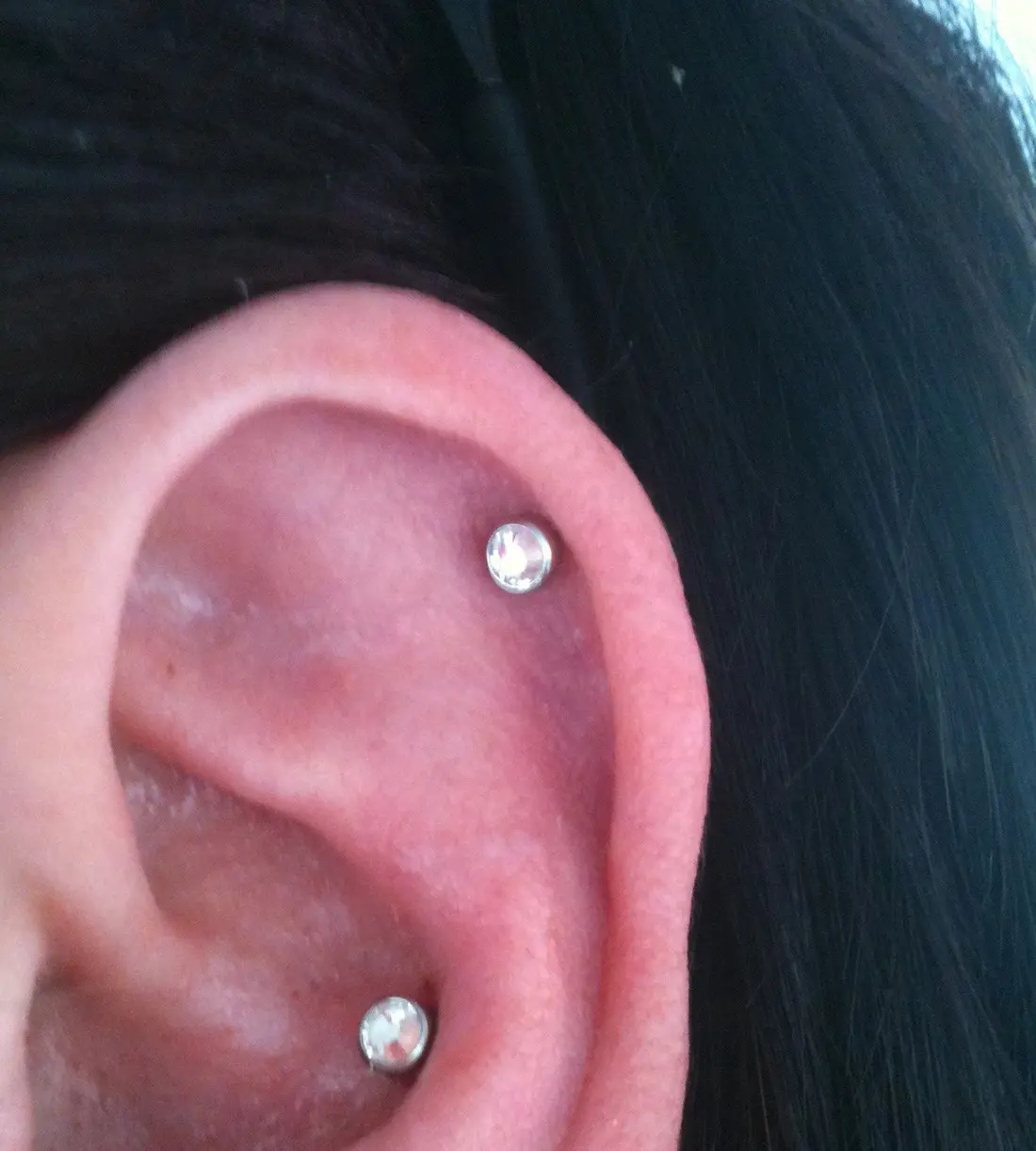
Photo by Fiona Henderson via Wikimedia Commons, CC BY 2.0.
The four tests
Do not go by the calendar alone. A cartilage piercing is ready for a jewelry change only when all four of these are true:
- No tenderness when you press gently beside the jewelry.
- No discharge or crusting for at least two weeks.
- No redness or pink tinge around either opening.
- The jewelry moves freely, with no tugging or resistance.
If even one of these fails, wait another month and check again. Most people who develop a bump right after a jewelry change skipped this check and went by feel or by the calendar instead.
Downsizing is a different thing
There is one jewelry change that should happen early, and it is not the same as swapping styles.
Your initial post or barbell is deliberately longer than your final size, to leave room for swelling. Once that swelling has gone, usually at six to ten weeks, the spare length becomes a lever that catches on hair, pillows and clothing. That is a downsize: a shorter piece of the same basic jewelry, ideally fitted by your piercer.
Downsizing is routine and expected during healing. A full change to a different style, a hoop instead of a stud, or different jewelry entirely, is what needs to wait for the full six to twelve months.
Doing the change yourself, once you have passed all four tests
- Wash your hands and clean the piercing with saline first.
- Do it after a warm shower, when the tissue is more pliable.
- Have the new jewelry ready, cleaned, and to hand before you start.
- Do not force anything. If it resists, stop.
- Go in threadless or internally threaded, never externally threaded, so nothing sharp drags through the channel.
Rook and daith need extra care
Even once fully healed, the angle of a rook or a daith makes self-changes fiddly. The channel does not run in a straight, easy-to-see line the way a helix or a lobe does. Many people ask their piercer to do the first several changes on these two placements specifically, and there is no downside to continuing to do that indefinitely if you find it easier.
If it will not go back in
This happens more with cartilage than with soft tissue, because cartilage channels can tighten within hours of jewelry being removed, and cartilage scars more readily than soft tissue if forced.
Do not push against resistance. Forcing jewelry against a tightened channel creates a false path through the tissue beside the real one, which is painful, bleeds, and heals badly.
Instead:
- Try again after a warm shower.
- Approach at the same angle the original jewelry sat at, not a guess.
- Go to a piercer. They reinsert jewelry into a tightened cartilage channel with a taper routinely, and it is quick.
If jewelry has been out for more than a few hours, treat reinsertion as something to get help with rather than something to force at home.
What to change into
Implant-grade titanium (ASTM F136) or solid 14k or higher nickel-free gold, threadless or internally threaded. See the jewelry material guide and the gauge and size chart for sizing each placement correctly.
Avoid gold-plated, unspecified “surgical steel,” and sterling silver in a piercing that is less than a year old.
If something goes wrong after a change
A bump appearing within days of a jewelry change points to the change itself: the timing, the fit, or the new jewelry. If you still have the original piece and it is clean, putting it back and giving the piercing more time is often the simplest fix. Read piercing bump vs keloid to work out what you are looking at before doing anything else.
Heat, spreading redness, thick coloured discharge, or fever is different and needs a doctor the same day, with the jewelry left in. See infected ear piercing.
Frequently asked questions
When can I change my cartilage piercing?
Six to twelve months for most cartilage, including helix, conch, tragus, rook and daith. It will look and feel finished at two to three months, which is when most early changes happen and most problems start.
How do I know if my cartilage piercing is actually healed?
Four tests, and all four need to be true: no tenderness when you press beside the jewelry, no discharge or crusting for at least two weeks, no redness at either opening, and the jewelry moves freely with no tugging sensation.
Is downsizing the same as changing my cartilage piercing?
No. Downsizing swaps a long initial post for a shorter one once swelling has gone, usually at six to ten weeks, and is a routine step in healing. A full jewelry change to a different piece is what needs to wait for full healing, six to twelve months later.
What happens if I change cartilage jewelry too early?
The channel is a thin, new tube of tissue at two or three months, even though it looks settled. Forcing jewelry through it tears the lining, which usually causes an irritation bump and can set healing back by weeks or months.
Why won't my jewelry go back into my cartilage piercing?
Cartilage channels can tighten if jewelry is out for even a few hours, and they scar more readily than soft tissue if forced. Do not push against resistance. See a piercer, who can usually reinsert it with a taper.
Can I change a rook or daith piercing myself?
It is harder than most cartilage changes because of the angle, even once fully healed. Many people have a piercer do the first few changes on these two placements rather than risk forcing jewelry in at the wrong angle.
Sources
- Association of Professional Piercers - Suggested aftercare for body piercingshttps://safepiercing.org/aftercare/
- Association of Professional Piercers - Jewelry for initial piercingshttps://safepiercing.org/jewelry-for-initial-piercings/
- Association of Professional Piercers - Troubleshootinghttps://safepiercing.org/troubleshooting/
This article is for education only and is not medical advice. If a piercing is hot, swollen, spreading redness, oozing yellow or green discharge, or you have a fever, see a doctor today.