On this page
The conch is the deep, shell-shaped bowl in the middle of your ear. It takes its name from the conch shell, and it is the largest single expanse of cartilage you have to work with, which is why it can carry either a tiny stud or a hoop big enough to wrap the whole outer ear.
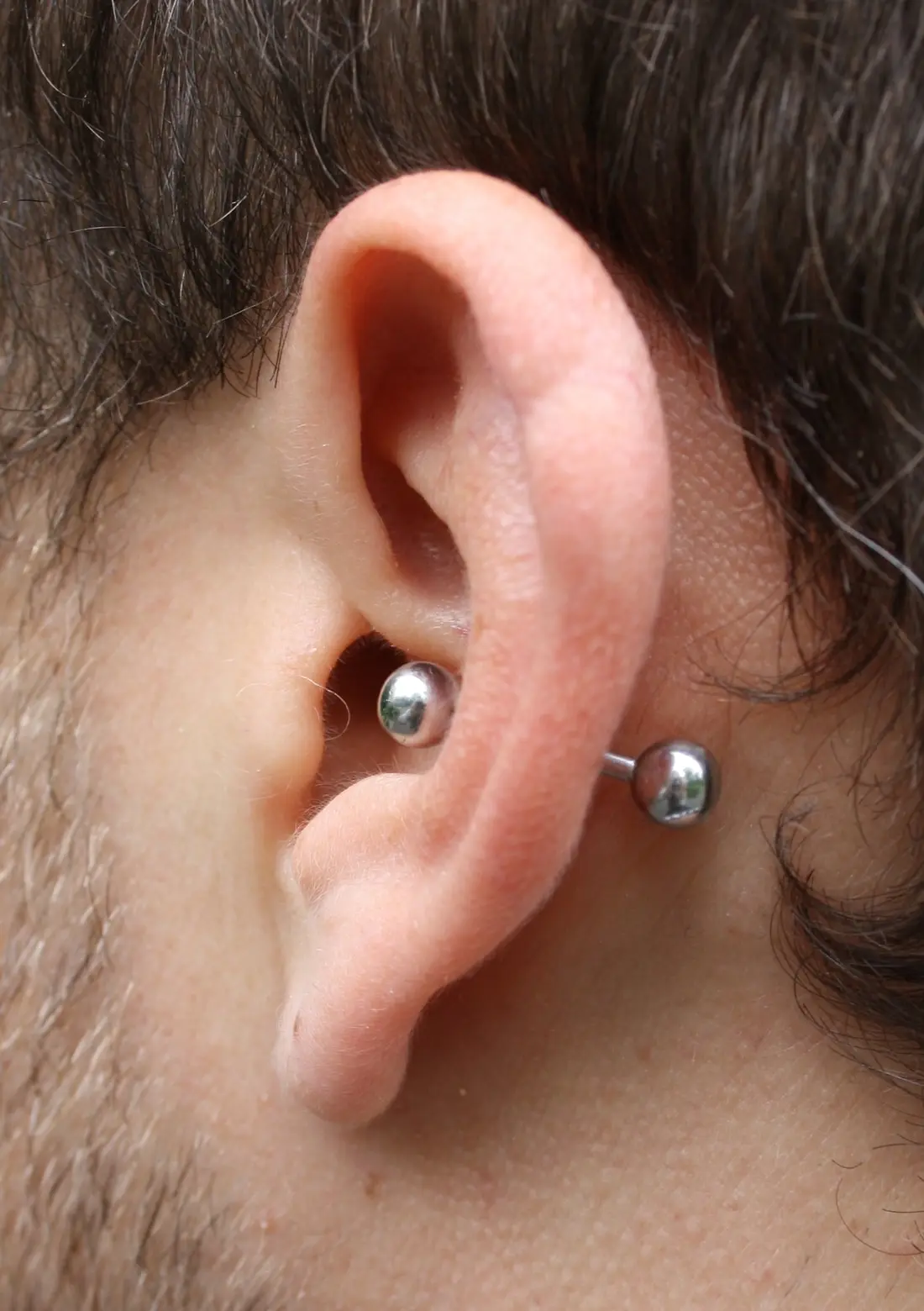
Photo by Nicor via Wikimedia Commons, CC BY-SA 3.0.
Inner conch or outer conch
The two names describe two different places and two very different final looks.
| Inner conch | Outer conch | |
|---|---|---|
| Where | The cupped bowl beside the ear canal | The flatter shelf between the bowl and the outer rim |
| Healed jewelry | Studs, small flat backs | Large hoops that wrap the rim, or studs |
| Thickness | Thickest cartilage in the ear | Slightly thinner |
| Headphone conflict | High, buds sit right on it | Moderate |
If you have seen a photo of a wide ring circling the edge of an ear, that is an outer conch with a healed hoop. If you want that look, say so before the marking, because the placement has to leave enough rim for the hoop to clear.
Who it suits
Almost every ear can take a conch, but a few things are worth raising at the consultation.
- Earbuds. If you use in-ear buds all day, the inner conch is the worst placement you can pick during healing. Plan for six months of over-ear or open headphones, or choose a different piercing.
- Ear shape. A shallow conch bowl narrows the safe zone. A good piercer will tell you if a stud will sit at an angle.
- Existing piercings. A conch sits well in a curated ear alongside a helix and a lobe stack, and it can be pierced in the same session as one other cartilage placement. Do not do three cartilage piercings at once. You need somewhere to sleep.
The procedure
The piercer cleans and marks, you approve the mark in a mirror, and they pass a single-use hollow needle through the cartilage and follow it with the jewelry. Because conch cartilage is thick, the pass is a little slower than a helix, which is where the extra point of pain comes from. It is still over in a couple of seconds.
Some piercers use a receiving tube behind the ear to support the tissue. That is normal and it improves the angle.
Pain
About 5 out of 10. A firm, deep pressure that builds as the needle crosses the cartilage, then heat. It throbs for a few hours afterwards and is tender for two to three weeks. Most people find the anticipation worse than the event.
Healing
Six to twelve months. Conch piercings follow the same three-stage cartilage timeline as a helix: a week of swelling, a couple of months of crusting and itching, then many months of quiet internal strengthening.
Two things extend that timeline more than anything else:
- Pressure. Sleeping on it, earbuds, phone against the ear, tight hats and helmets.
- Jewelry that moves. A hoop fitted before the channel is mature drags the tissue open every time you move your head.
Downsize at six to ten weeks, when the swelling has gone. Your first post is long on purpose and the spare length becomes a lever once you no longer need it. Piercing downsizing explains it for every placement.
Why cartilage takes this long, and the four rules that prevent most of its problems, are in the cartilage piercing guide.
How long it can be left empty, which depends far more on how long you have had it than on where it is, is in how long a piercing takes to close.
Aftercare
Sterile saline twice a day, hands off, no rotating, no sleeping on it, no earbuds. That is the whole routine. Full detail is in the aftercare guide, including how to shower and how to travel with a fresh piercing.
The one conch-specific tip: a travel pillow with the hole over your ear genuinely works, and it is the cheapest insurance you can buy for a cartilage piercing.
Jewelry
Start with a flat-back labret, 16 or 14 gauge, in ASTM F136 implant-grade titanium, with an 8 to 10 mm post to allow for swelling. The flat disc behind the ear is what makes this comfortable to sleep near later. Cartilage earrings covers what the sources say about studs, hoops and materials.
Do not start with a hoop, even if the studio offers one. A conch hoop is heavy, and its weight sits on the bottom of the channel all day. It is the right jewelry for month twelve and the wrong jewelry for week one.
Threadless or internally threaded only, so the post that passes through your ear is smooth. See the jewelry material guide for why titanium is the default and where solid gold fits in.
The conch jewelry guide covers studs, hoops, and how a conch hoop is sized.
The flat back guide covers post lengths and gauges by placement.
Problems specific to the conch
Pressure bumps. Because the conch is a bowl, the jewelry sits in a dish that collects contact from every direction. If a bump appears, work through the list: what touches it at night, what goes in your ear during the day, and how long the post is. Our bump guide explains how to tell an irritation bump from a keloid, which matters because the treatments are opposites.
Angled jewelry. If the disc will not sit flat against the back of the ear, the angle of the channel is wrong or the post is too short. See your piercer. Do not force it.
Infection. Rare, but cartilage infections need medical attention quickly. Heat, spreading redness, thick coloured discharge or fever means a doctor today.
The cartilage bump guide ranks the causes by how often each turns out to be the answer.
A lump that spreads beyond the piercing and keeps growing over months is a different problem: see the keloid guide.
Cost
$35 to $90 for the piercing in most US studios, plus jewelry from around $30 for a plain titanium end to well over $100 for gold. Conch piercings are often quoted slightly above a helix because the tissue is thicker and the jewelry is longer.
Tip 15 to 20 percent, as with any appointment service.
Frequently asked questions
What is the difference between an inner and an outer conch piercing?
The inner conch goes through the cupped bowl in the middle of the ear, next to the ear canal, and takes a stud. The outer conch goes through the flat shelf between that bowl and the outer rim, and once healed it can take a large hoop that wraps around the edge of the ear.
Does a conch piercing hurt more than a helix?
Slightly. Most people say 5 out of 10 against 4 for a helix, because the conch is one of the thickest pieces of cartilage in the ear so the needle takes marginally longer to pass through.
Does a conch or daith piercing cure migraines?
There is no good evidence that either one treats migraines. The claim comes from an acupuncture pressure point, but the controlled research does not support it. Do not get pierced as a medical treatment.
How long before I can wear a conch hoop?
Six to twelve months, and only once the piercing has been completely calm for several weeks. Conch hoops are heavy and they lever on the channel, which is why fitting one early is the most common way people wreck this piercing.
Can I wear earbuds with a conch piercing?
Not for the first few months. In-ear buds press directly against an inner conch, and over-ear cups press on the whole area. Use open or bone-conduction headphones while it settles.
Sources
- Association of Professional Piercers - Suggested aftercare for body piercingshttps://safepiercing.org/aftercare/
- Association of Professional Piercers - Jewelry for initial piercingshttps://safepiercing.org/jewelry-for-initial-piercings/
- American Academy of Dermatology - Caring for pierced earshttps://www.aad.org/public/everyday-care/skin-care-basics/tattoos/caring-for-pierced-ears
This article is for education only and is not medical advice. If a piercing is hot, swollen, spreading redness, oozing yellow or green discharge, or you have a fever, see a doctor today.