The anti-tragus is the small ridge of cartilage roughly opposite the tragus, sitting just above where the earlobe begins. Anatomically it is one of the smallest useful landmarks on the ear, which is exactly why it is one of the pickier placements to get right.
The anatomy check
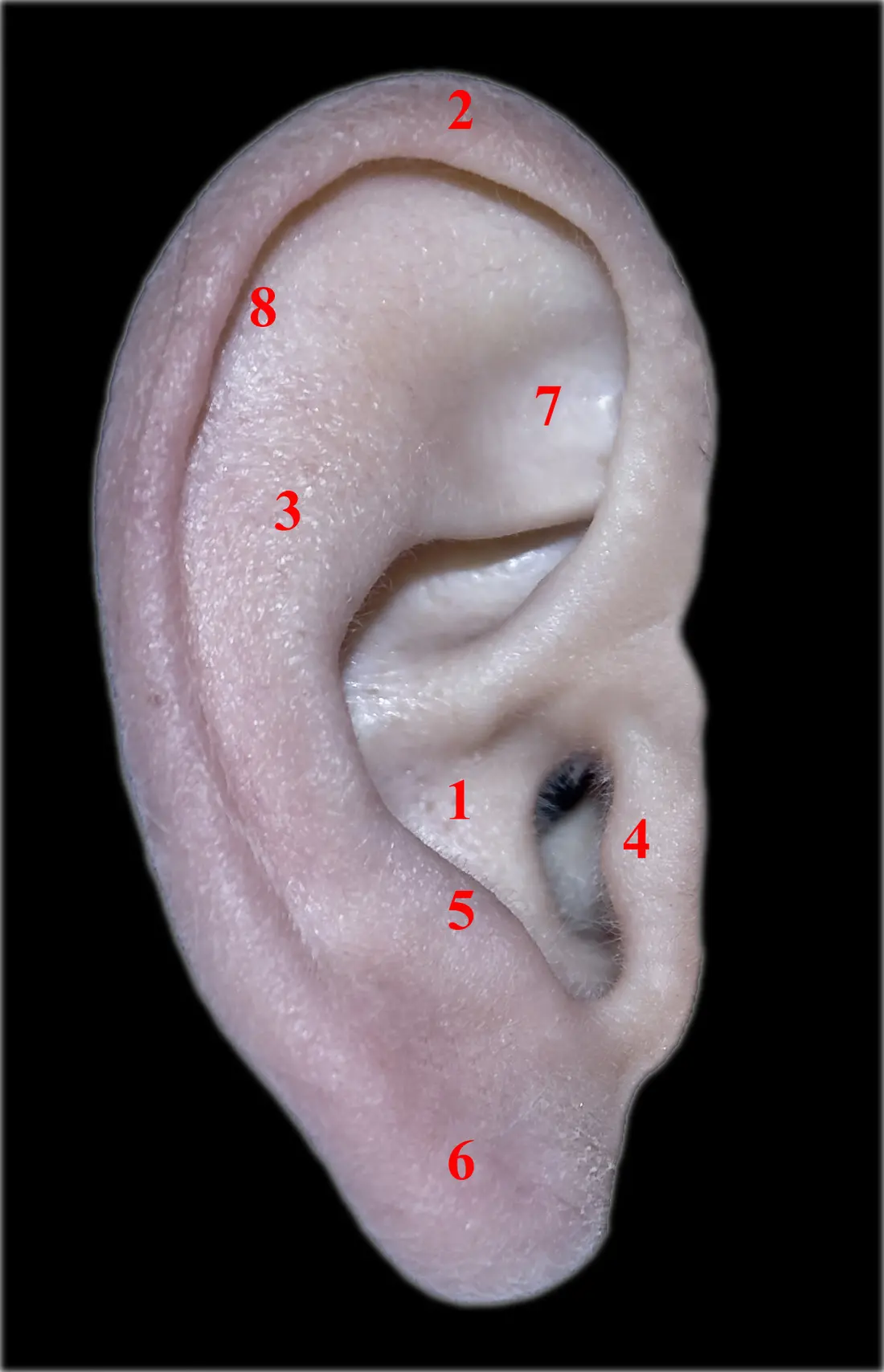
Photo by Didier Descouens via Wikimedia Commons, CC BY-SA 3.0. 1 concha, 2 helix, 3 anti-helix, 4 tragus, 5 anti-tragus, 6 lobule, 7 triangular fossa, 8 scapha.
Feel the notch between your earlobe and the rest of your ear. The small bump or ridge just above that notch, opposite the tragus across the ear canal, is the anti-tragus.
Some ears have a well-defined, slightly raised ridge here. Others have almost nothing: the tissue is flat and blends smoothly into the lobe below and the antihelix above. A flat anti-tragus cannot safely hold jewelry, because there is nothing for the curve of a barbell to rest against without pressing on the lobe on one side or the ear canal on the other.
A piercer will pinch and examine the area before agreeing. Being turned away here is common and is the right call, not an inconvenience.
Pain
About 5 out of 10, a little more than a standard tragus. The ridge is thick and dense, and the angle needed to pass a needle through it cleanly is tighter than most ear placements, so the pressure builds for a moment before it releases. It is still over in a second or two.
Healing
Six to twelve months. Like every ear piercing above the lobe, the anti-tragus is cartilage, fed only by the thin membrane covering it rather than by its own blood supply, so repair happens slowly from the edges inward.
- Week 1: swelling, warmth, tenderness, some clear discharge.
- Weeks 2-12: crusting, occasional itching, starts to look finished.
- Months 3-12: the channel matures internally while looking healed from the outside.
Downsize at six to ten weeks, once the swelling has gone. A curved barbell left too long after swelling drops presses unevenly on the ridge and is a common cause of irritation here. Piercing downsizing explains it for every placement.
Why cartilage takes this long, and the four rules that prevent most of its problems, are in the cartilage piercing guide.
Aftercare
The standard cartilage routine: sterile saline twice a day, hands off, no rotating, no sleeping on that side. Full detail in the aftercare guide.
Because the anti-tragus sits right beside the lobe, earrings worn in the lobe below can catch on it. Keep lobe jewelry simple and close-fitting while the anti-tragus heals, and be careful pulling clothing over your head.
Jewelry
Start with a small curved barbell, 16 gauge, 6 to 8 mm, in ASTM F136 implant-grade titanium. The curve is what lets it sit against the ridge without digging into the lobe or the ear canal side.
Once fully healed, a small captive bead ring or a clicker is the usual look, but sizing is unforgiving: too large and it presses on the tragus opposite it every time you move your jaw; too small and it pinches the lobe. Have a piercer size it rather than guessing. See the material guide.
Problems
Irritation bumps here usually trace back to a barbell that needed downsizing, or the curve pressing unevenly because the ridge was thinner than ideal. See piercing bump vs keloid before treating anything as an infection.
Snagging from the earlobe is specific to this placement. Simplify lobe jewelry until the anti-tragus is fully healed.
Infection in cartilage escalates faster than in soft tissue and needs prompt attention: heat, spreading redness, thick coloured discharge or fever means a doctor the same day, jewelry left in. See infected ear piercing.
The cartilage bump guide ranks the causes by how often each turns out to be the answer.
A lump that spreads beyond the piercing and keeps growing over months is a different problem: see the keloid guide.
Cost
$35 to $90 for the piercing in a US studio, plus $30 to $100 for a curved barbell in implant-grade titanium. It is priced in the same range as a tragus or a rook, reflecting the precision the placement needs.
Frequently asked questions
Where exactly is an anti-tragus piercing?
On the small ridge of cartilage on the outer ear, roughly opposite the tragus, just above where the earlobe begins and below the antihelix. It sits at the notch between the lobe and the rest of the ear.
Does an anti-tragus piercing hurt?
About 5 out of 10, slightly more than a standard tragus, because the ridge is thicker and the angle is trickier to reach cleanly. It is a firm, dense pressure rather than a sharp sting.
Can everyone get an anti-tragus piercing?
No. The ridge needs to be reasonably defined and thick enough to hold jewelry without pressing on the ear canal side or the lobe side. Some ears have a very shallow anti-tragus with little to work with, and a piercer should decline rather than force a placement that will migrate.
How long does an anti-tragus piercing take to heal?
Six to twelve months, the same cartilage timeline as a tragus, rook or conch. It often looks settled well before that and is still a fragile new channel underneath.
What jewelry goes in an anti-tragus piercing?
A small curved barbell to start, so the curve follows the ridge rather than pressing straight through it. Once fully healed, a small captive ring or a clicker is the classic look, sized carefully so it does not pinch the lobe or the tragus opposite it.
Sources
- Association of Professional Piercers - Suggested aftercare for body piercingshttps://safepiercing.org/aftercare/
- Association of Professional Piercers - Jewelry for initial piercingshttps://safepiercing.org/jewelry-for-initial-piercings/
- Association of Professional Piercers - Troubleshootinghttps://safepiercing.org/troubleshooting/
This article is for education only and is not medical advice. If a piercing is hot, swollen, spreading redness, oozing yellow or green discharge, or you have a fever, see a doctor today.