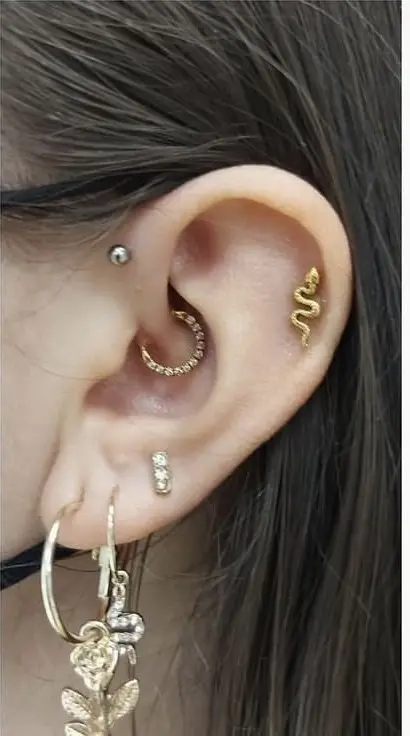
The flat is the wide, smooth panel of cartilage on the upper inner ear, sitting between the curved outer rim and the ridge of the antihelix. A flat piercing goes straight through it, so a stud sits on that plane facing outward.
It is the placement most curated ears are built around, and the reason is simple: it is the only part of the ear with real room.
Why it anchors a curated ear
Most ear placements are defined by a single feature. There is one daith fold, one tragus flap, one rook ridge. You get one piercing, in one spot, and the anatomy decides where.
The flat is a plane rather than a landmark. That means a piercer can place two or three studs in a row across it, arrange a small cluster, or leave space for something you have not decided on yet. Almost every “curated ear” photograph you have seen has its centre of gravity here.
If you are planning several piercings, plan the flat first and work outward. Where the first flat stud sits determines what fits around it.
Pain
About 5 out of 10, a step above a helix. The cartilage here is thick and dense, so the sensation is a firm, slow pressure rather than a quick sting.
The sound catches people out more than the pain. Dense cartilage gives an audible crunch, and it is loud inside your own head because it is happening a few centimetres from your ear canal. It is entirely normal.
Healing
Six to twelve months. This is dense cartilage with almost no blood supply of its own, fed only by the thin membrane over it, so it follows the same slow schedule as a conch.
- Weeks 1-2: swelling, warmth, tenderness. Sleeping on that side is out.
- Weeks 2-12: crusting, occasional itching, and an outside that looks finished. It is not.
- Months 3-12: quiet internal strengthening, still vulnerable to a knock.
Downsize at six to ten weeks. The initial post is long to allow for swelling. Left in place afterwards, it catches on hairbrushes, headphones and jumpers, and every one of those knocks restarts the irritation clock. More flat piercings are ruined by a skipped downsize than by anything else. Piercing downsizing explains it for every placement.
Why cartilage takes this long, and the four rules that prevent most of its problems, are in the cartilage piercing guide.
Getting several done
If you want two or three across the flat, the usual advice is one or two at a time, not all of them.
Two reasons. Healing several cartilage wounds at once taxes your body more than people expect, and you only have two sides to sleep on. A piercer who suggests staggering is giving you good advice rather than trying to sell you a second appointment.
Give each one two to three months before adding the next, and let your piercer mark the whole plan at the first appointment even if you are only having one done. That way the spacing works when the set is finished.
Aftercare
Sterile saline twice a day, hands off, no rotating, and nothing else. The ear cleaning guide has the routine.
The two things that actually go wrong with a flat:
- Sleeping on it. The APP says sleeping directly on a healing cartilage piercing can cause irritation and even shift the piercing’s angle. If you cannot train yourself to sleep on the other side, place a travel pillow on top of your pillow and put your ear in the opening.
- Hair. Long hair catches on a fresh flat stud constantly. Tie it back for the first few weeks, and be careful with a brush.
Jewelry
Flat-back labret stud, 16 gauge, implant-grade titanium, 6 to 8 mm post after downsizing. Threadless or internally threaded only, so the post passing through the channel is smooth. See the materials guide.
Hoops do not work here. A ring needs an edge to sit around, and the flat has none, so a hoop in a flat piercing hangs oddly and pulls at the channel. This is a stud placement, permanently.
Once healed it takes decorative ends well: clusters, bezels, marquise shapes. It is the most jewelry-friendly cartilage placement on the ear precisely because the flat plane shows the piece front-on.
The flat back guide covers post lengths and gauges by placement.
Problems
Irritation bumps here are nearly always mechanical: sleeping on it, a post left too long, or hair catching. Fix the cause before treating the bump. See piercing bumps.
Infection in cartilage needs prompt medical attention. Heat, spreading redness, thick coloured discharge or fever means a doctor the same day, jewelry left in. See infected ear piercing.
The cartilage bump guide ranks the causes by how often each turns out to be the answer.
Cost
$40 to $90 in a US studio, plus $30 upwards for jewelry. Multiple flats in one session are usually discounted after the first. Tip 15 to 20 percent.
Frequently asked questions
What is a flat piercing?
A piercing through the flat panel of cartilage on the upper inner ear, between the outer helix rim and the ridge of the antihelix. It is one of the few ear placements with room for more than one piercing in the same spot.
Does a flat piercing hurt?
About 5 out of 10. It is thick cartilage, so it is a firm, slow pressure rather than a sharp sting, and slightly more than a helix. The crunch is audible, which surprises people more than the pain does.
How long does a flat piercing take to heal?
Six to twelve months. It is dense cartilage with a poor blood supply, so it follows the same slow timetable as a conch or a rook, and it looks finished on the outside long before the channel is mature.
Can you get more than one flat piercing?
Yes, and this is the main reason the placement is popular. The panel is wide enough to take two or three studs in a row or a small cluster, which is why curated ears are usually built around it.
What jewelry goes in a flat piercing?
A flat-back labret stud, 16 gauge, implant-grade titanium, on a longer post to start and downsized at six to ten weeks. Hoops do not suit the placement, because there is no rim for a ring to sit around.
Is a flat piercing the same as a helix?
No. A helix goes through the curved outer rim of the ear. A flat goes through the wide plane of cartilage inside that rim. They sit next to each other and behave similarly, but they are different placements.
Sources
- Association of Professional Piercers - Suggested aftercare for body piercingshttps://safepiercing.org/aftercare/
- Association of Professional Piercers - Jewelry for initial piercingshttps://safepiercing.org/jewelry-for-initial-piercings/
- American Academy of Dermatology - Caring for pierced earshttps://www.aad.org/public/everyday-care/skin-care-basics/tattoos/caring-for-pierced-ears
This article is for education only and is not medical advice. If a piercing is hot, swollen, spreading redness, oozing yellow or green discharge, or you have a fever, see a doctor today.