On this page
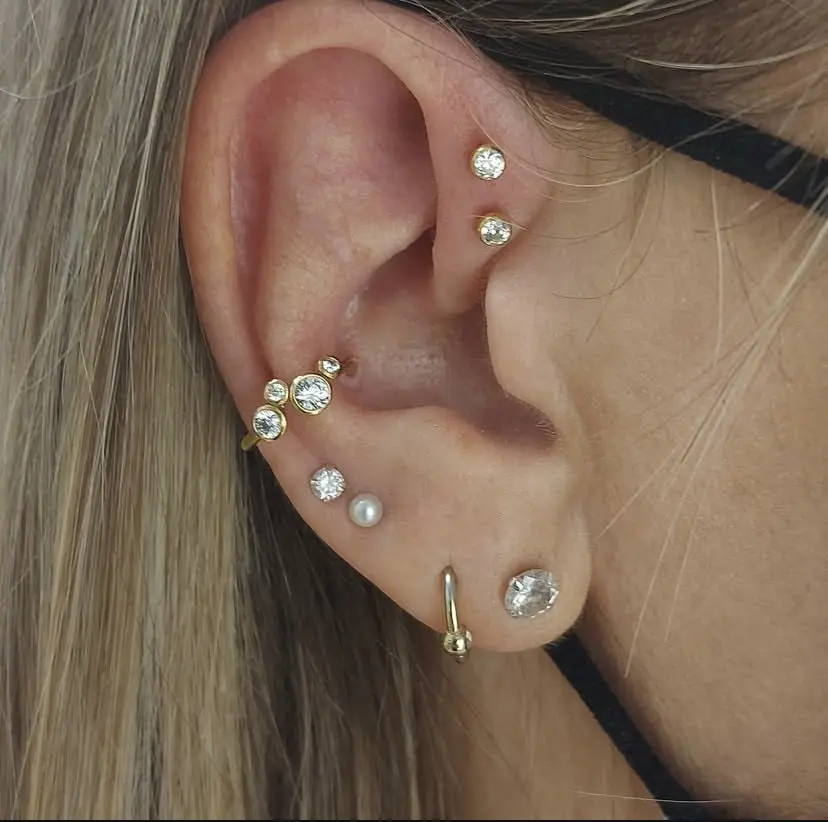
Stacked lobes are two or more lobe piercings placed deliberately close together, usually running vertically up the lobe, so they read as a tight cluster rather than a row of evenly spaced holes.
Each individual piercing is an ordinary lobe piercing: same tissue, same pain, same six to ten weeks. The placement is the entire difference, and it is the part worth getting right.
Spacing is the whole piercing
A stack works when the jewelry almost touches. Get that wrong in either direction and the look falls apart.
Too far apart and it is not a stack, it is three lobe piercings.
Too close and two problems arrive at once. The jewelry actually touches, which keeps both channels irritated indefinitely, and the bridge of tissue between the two holes is left too thin to be stable. A thin bridge under pressure from both sides is where migration and, in the worst case, two holes merging come from.
The right gap depends on your lobe and on the exact ends you intend to wear. Tell your piercer what jewelry you have in mind before they mark, because a stack spaced for small flat backs will not take larger gems.
Your lobe has to have the height
This is the constraint people do not anticipate. A stack of three or four needs a lobe with enough vertical height to fit that many channels with real tissue between each.
Lobes vary a lot. A long, full lobe may take four comfortably. A small or thin one may take two, and a piercer who says so is reading your anatomy rather than being unhelpful. Attached lobes, where the lobe joins the jawline without a free hanging edge, have less usable height than free lobes.
Have the whole set marked at once even if you are building it over time, so the spacing works when it is finished.
Pain
About 2 out of 10 each. The lobe is soft tissue with a good blood supply and each needle passes in an instant.
Three or four in one sitting is more sitting still than it is more pain, though the later ones are noticed a little more as the lobe becomes tender.
Healing
Six to ten weeks, healing in parallel. Soft tissue, so several does not take longer than one.
- Days 1-5: mild tenderness across the stack, a little swelling.
- Weeks 1-4: crusting, occasional itching.
- Weeks 4-10: the channels finish maturing.
Downsize all of them at four to six weeks, in one visit. This matters more on a stack than on a single lobe: long posts sitting a few millimetres apart knock into each other, and that is exactly the irritation you are trying to avoid. Piercing downsizing explains it for every placement.
Living with a stack
- Sleeping. Several fresh channels in one lobe means that side is uncomfortable for a few weeks. A travel pillow with the hole under your ear solves it.
- Hair. A stack of posts catches hair far more effectively than a single stud. Tie it back for the first few weeks.
- Do not change the jewelry early. A stack stops hurting around week two and is not healed until week six at the earliest. Early changes are the most common way an easy set of lobes becomes an irritated one.
Aftercare is otherwise ordinary: sterile saline twice a day, hands off, no rotating. The ear cleaning guide has the routine.
Jewelry
Flat-back labret studs, 18 or 16 gauge, implant-grade titanium, downsized to 5 or 6 mm. Threadless or internally threaded only. See the materials guide.
Keep initial ends small and uniform. The decorative arrangement comes later, once everything is healed and you can see the finished spacing.
When you do change them, weight is the thing to watch. Several heavy pieces in one lobe pull downward together, and over years that stretches channels that will not shrink back.
The flat back guide covers post lengths and gauges by placement.
Related placements
- Second lobe: conventionally spaced rather than stacked, and the usual starting point.
- Transverse lobe: horizontally through the lobe, a genuinely different piercing.
- Orbital: two holes joined by one ring, which can be done in the lobe and heals fast there.
Cost
$50 to $120 for a set in a US studio depending on how many, plus jewelry for each. Studios discount additional piercings in the same session, so a stack done together costs considerably less than building it over several visits. Tip 15 to 20 percent.
Frequently asked questions
What is a stacked lobe piercing?
Two or more lobe piercings placed deliberately close together, usually vertically, so they read as a tight cluster rather than evenly spaced holes. The individual piercings are ordinary lobe piercings; the placement is what makes it stacked.
Does a stacked lobe hurt?
About 2 out of 10 each, the same as any lobe piercing. Several in one sitting means sitting through it several times, but no single one is notable.
How close together can stacked lobe piercings be?
Close enough that the jewelry almost touches without actually touching. That distance depends on your lobe and on the ends you plan to wear, which is why it needs judgement rather than a fixed measurement.
Can everyone get stacked lobes?
No. It needs a lobe with enough height to fit several channels with a stable bridge of tissue between each. A small or thin lobe may only take two, and crowding them is the main way this goes wrong.
How long do stacked lobes take to heal?
Six to ten weeks, healing in parallel. They are soft tissue, so the timetable is the same as a single lobe even with three or four of them.
Can I get all my stacked lobes done at once?
Usually yes, and it is generally better. Marking the whole set at one time is how a piercer gets the spacing even, and lobes are the one part of the ear where several at once is genuinely fine.
Sources
- Association of Professional Piercers - Suggested aftercare for body piercingshttps://safepiercing.org/aftercare/
- Association of Professional Piercers - Jewelry for initial piercingshttps://safepiercing.org/jewelry-for-initial-piercings/
- American Academy of Dermatology - Caring for pierced earshttps://www.aad.org/public/everyday-care/skin-care-basics/tattoos/caring-for-pierced-ears
This article is for education only and is not medical advice. If a piercing is hot, swollen, spreading redness, oozing yellow or green discharge, or you have a fever, see a doctor today.