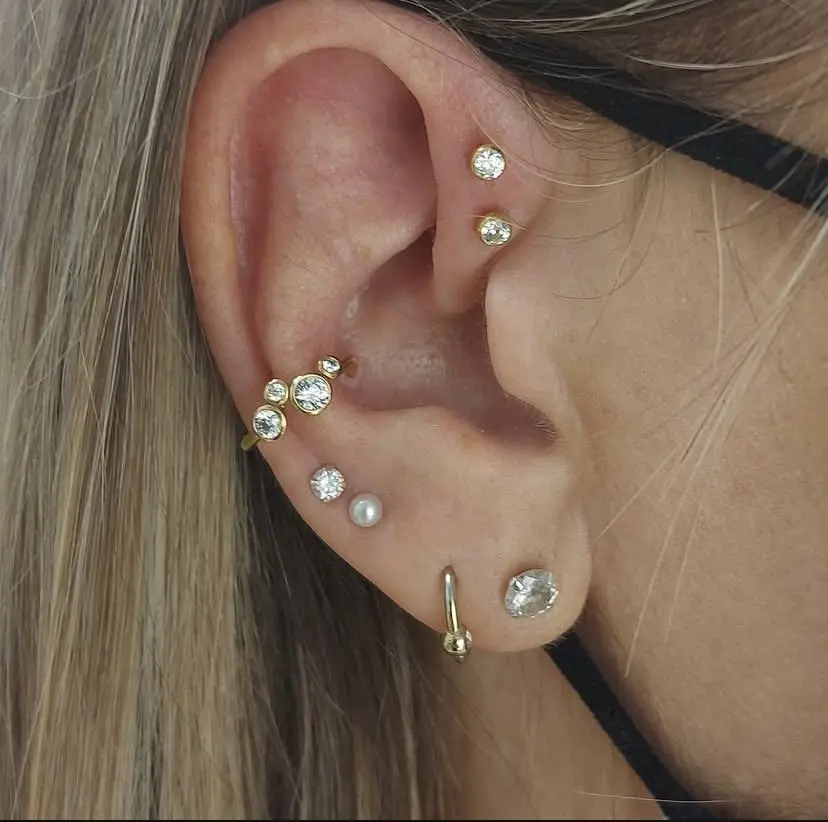
The helix is the whole curved outer rim of your ear. Where that rim turns forward at the top and meets the side of your head, above the tragus, it forms a short vertical ridge. A forward helix goes through that ridge, so the jewelry faces forward out of the front of your ear rather than sideways.
It is a small, precise placement, and it is the one people most often want in multiples.
Singles, doubles and triples
A single forward helix is one stud on that front ridge. A double stacks two, and a triple stacks three, evenly spaced up the same ridge.
Whether you can have two or three is decided entirely by your anatomy. The forward ridge varies enormously in length and definition: some are a long, clean run with obvious room for three, and some are barely a centimetre before the rim curves away.
Your piercer should mark the full set before piercing any of them, even if you only want one today. Spacing that works for a triple has to be planned as a triple; adding a second later to an existing single often means the two do not line up with room for a third.
Almost every ear can take a single. Fewer can take a triple. Being told two is your limit is anatomy, not a lack of skill.
Pain
About 5 out of 10, a step above a standard helix. The cartilage at the front of the ear is thin but tightly curved and firm, so the needle passes through a small, dense section.
A double or triple in one sitting means three of those in a row, and the later ones are felt more than the first. Many piercers will happily do all three at once; some prefer to split them, and if your ridge is tight that is worth listening to.
Healing
Six to nine months, slightly quicker than the inner-ear placements because the cartilage is thinner. Still cartilage, still months.
- Weeks 1-2: swelling and tenderness at the front of the ear.
- Weeks 2-12: crusting, occasional itching, an outside that looks finished.
- Months 3-9: internal maturing, still vulnerable to a knock.
Downsize at six to ten weeks. This matters more here than on most cartilage placements, because a long post at the front of your ear is directly in the path of everything listed below. Helix piercing healing time compares the forward helix with the other helix placements. Piercing downsizing explains it for every placement.
Why cartilage takes this long, and the four rules that prevent most of its problems, are in the cartilage piercing guide.
The glasses problem
This is the practical issue with a forward helix, and it is worth knowing before you book rather than after.
The arms of glasses, the loops of face masks and the band of over-ear headphones all cross the ear at exactly this point. A fresh forward helix in that path gets knocked several times a day, and repeated knocking is what produces irritation bumps.
Before booking:
- Try your glasses on and note where the arm sits against the front of your ear.
- Switch to a mask that ties behind your head, or use an extender, for the first few months.
- Use over-ear headphones whose band clears the ear, or bone-conduction ones.
If you wear glasses every day and the arm sits directly on the ridge, talk to your piercer about placement before agreeing. Sometimes a few millimetres of adjustment solves it.
Aftercare
Sterile saline twice a day, hands off, no rotating, and do not sleep on that side. The ear cleaning guide has the routine.
One placement-specific note: hair products, dry shampoo and hairspray drift straight onto the front of the ear. Shield it with your hand when you spray, and rinse with saline afterwards.
Jewelry
Flat-back labret stud, 16 gauge, implant-grade titanium, 6 to 8 mm post after downsizing. The flat disc sits behind the ridge where it is comfortable and out of sight. Threadless or internally threaded only. See the materials guide.
Keep ends small, especially on a double or triple. Three large gems on a short ridge crowd each other, and jewelry that touches its neighbour keeps both channels irritated.
Once healed, small gems and bezels suit the placement. Hoops are possible on a single forward helix but catch far more, which on a placement already in the path of your glasses is asking for trouble.
The flat back guide covers post lengths and gauges by placement.
Problems
Irritation bumps here are nearly always mechanical: glasses, a mask loop, a headphone band, or a post that needed downsizing. Fix the cause first. See piercing bumps.
Infection in cartilage needs a doctor the same day if there is heat, spreading redness, thick coloured discharge or fever, with the jewelry left in. See infected ear piercing.
The cartilage bump guide ranks the causes by how often each turns out to be the answer.
Cost
$35 to $80 for a single in a US studio, plus jewelry. Doubles and triples are usually priced per piercing with a discount after the first, so budget roughly $90 to $200 for a triple with jewelry. Tip 15 to 20 percent.
Frequently asked questions
What is a forward helix piercing?
A piercing through the small ridge of cartilage at the front of the ear, where the outer rim meets the side of your head, above the tragus. It faces forward rather than sideways, which is what distinguishes it from a standard helix.
Does a forward helix piercing hurt?
About 5 out of 10, slightly more than a standard helix. The cartilage at the front of the ear is thin but tightly curved, so the needle passes through a small, firm section and the pressure is noticeable.
What is a double or triple forward helix?
Two or three piercings stacked along the same front ridge, one above the other. Whether there is room for two or three depends entirely on how long your forward ridge is, which varies a lot between people.
Can everyone get a forward helix?
Not everyone can take a double or triple. Almost all ears can take a single one, but the ridge needs enough length and definition to space two or three without crowding, and plenty of ears do not have it.
How long does a forward helix take to heal?
Six to nine months. It is slightly quicker than the inner-ear placements because the cartilage is thinner, but it is still cartilage and it is measured in months.
Why does my forward helix keep getting caught?
Because it sits exactly where the arms of glasses, face-mask loops and headphone bands cross the ear. That is the main practical difficulty with this placement, and it is worth checking your glasses before booking.
Sources
- Association of Professional Piercers - Suggested aftercare for body piercingshttps://safepiercing.org/aftercare/
- Association of Professional Piercers - Jewelry for initial piercingshttps://safepiercing.org/jewelry-for-initial-piercings/
- American Academy of Dermatology - Caring for pierced earshttps://www.aad.org/public/everyday-care/skin-care-basics/tattoos/caring-for-pierced-ears
This article is for education only and is not medical advice. If a piercing is hot, swollen, spreading redness, oozing yellow or green discharge, or you have a fever, see a doctor today.