The daith is the small fold of cartilage that curls over the entrance to your ear canal, the innermost ridge where the helix begins. A daith piercing passes through that fold, so a ring sits nested inside the ear rather than on its edge. It is subtle from the front and striking from the side.
The name is usually traced to a Hebrew word for knowledge, reportedly coined by a client of the piercer Erik Dakota in the early 1990s. It is pronounced either “doth” or “dayth” depending on who you ask, and no one will correct you.
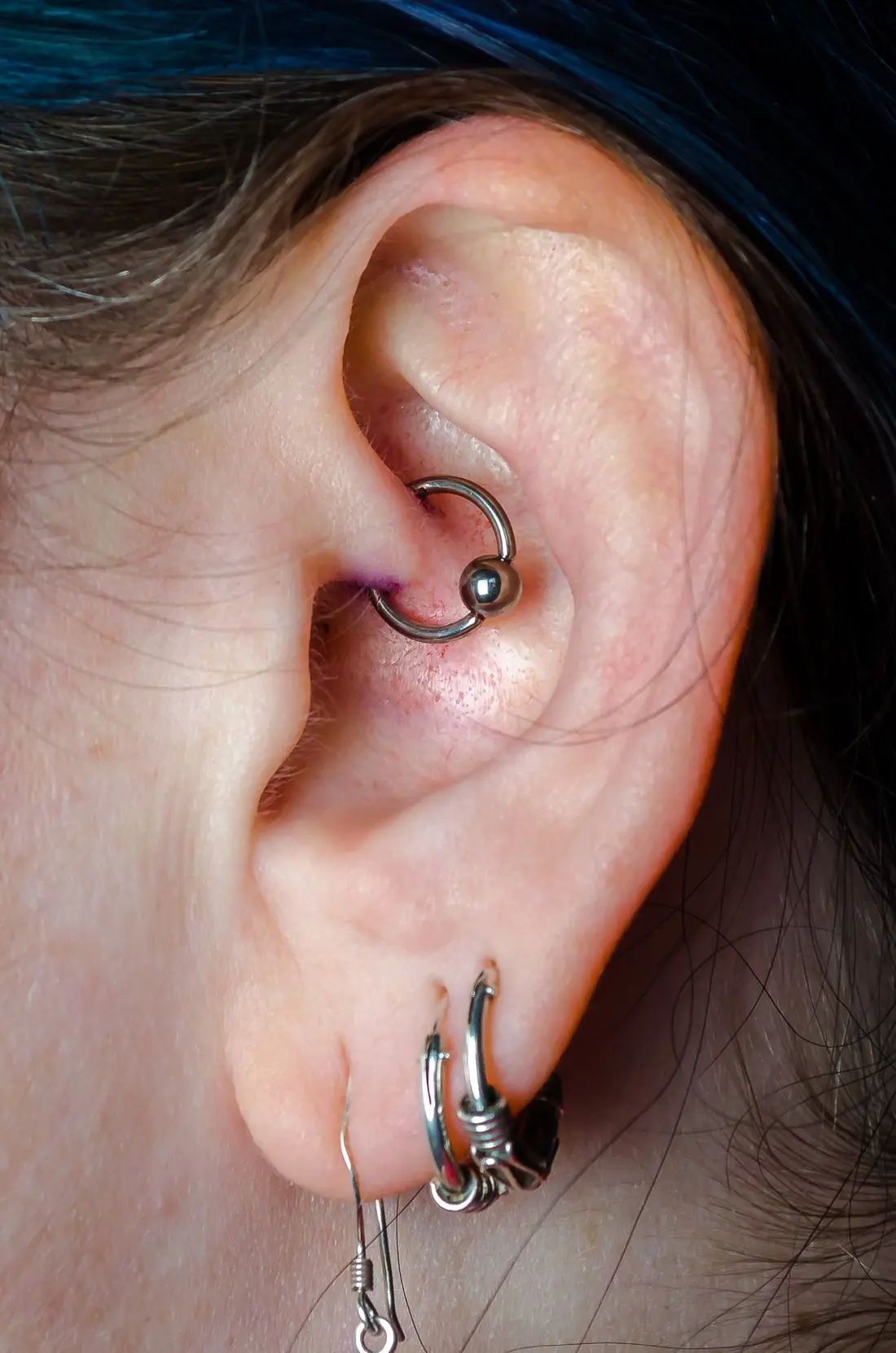
Photo by Carnivoredaddy via Wikimedia Commons, CC BY-SA 4.0.
About the migraine claim
You will find thousands of posts claiming a daith piercing cures migraines. It is worth being direct: the evidence does not support it.
The theory borrows from acupuncture, where a point in that region is associated with headache relief. The studies that have looked at daith piercings specifically have been small, uncontrolled, or have found effects consistent with placebo, which is powerful and real but not the same as treatment. Headache specialists do not recommend piercing as migraine management.
If you have migraines, see a neurologist. If you like how a daith looks, get a daith. Do not spend $90 and nine months of healing on a medical outcome nobody can promise you.
The full picture, including where the claim came from and why personal accounts of improvement are honest but do not show what they appear to, is in daith piercing for migraine.
Anatomy
The daith goes through the crus of the helix, the ridge where the outer rim tucks into the inner ear. That ridge varies a lot. Some people have a deep, well-defined fold that takes a needle easily; others have a shallow crus with very little room to work, or an ear canal shaped in a way that leaves no safe angle.
This is a technically demanding piercing. The needle has to enter and exit at a precise angle in a confined space, which is why an experienced cartilage piercer matters here more than on a lobe or a helix. Ask to see healed daith work in their portfolio, not just fresh photos.
Pain
Around 5 out of 10. The tissue is thick and the angle is awkward, so it is a deep, building pressure rather than a bright pinch. Like a tragus, it is loud from the inside because it is happening right next to your eardrum.
Aftwards it throbs for a few hours and is tender for two to three weeks, particularly when you sleep on it or press a phone to your ear.
Healing
Six to nine months.
- Week 1: swelling and warmth. It may feel like the whole ear canal is full.
- Weeks 2-12: crusting, some itching, discharge that collects in the fold.
- Months 3-9: the channel matures internally while looking healed.
The daith’s particular problem is drainage. It sits in a pocket, so the lymph fluid that any healing piercing produces has nowhere to go and dries into the fold. Aim your saline spray directly into the crevice twice a day and it stays clean; skip that and it crusts hard.
Downsize at six to ten weeks if you started with a barbell. A clicker sized correctly at the start usually does not need changing, which is one reason many piercers prefer them here. Piercing downsizing explains it for every placement.
Why cartilage takes this long, and the four rules that prevent most of its problems, are in the cartilage piercing guide.
Aftercare
Saline twice a day, aimed into the fold. No twisting, no touching, no sleeping on it. The full aftercare routine applies as written.
Two daith-specific points: rinse the ear thoroughly after swimming or heavy sweating, since the fold traps water, and keep hairspray out of it.
Jewelry
Two good options to start:
- A small clicker ring, 16 gauge, typically 8 mm, in ASTM F136 implant-grade titanium. It nests in the fold, it does not lever, and it gives you the finished look immediately.
- A curved barbell, 16 gauge, 8 to 10 mm, which some piercers prefer because it allows for swelling and is easy to downsize.
Avoid anything heavy, anything gold plated, and anything externally threaded. See the jewelry material guide for what to check before buying.
Problems
Trapped discharge and crusting is the most common complaint, and it is a rinsing problem rather than a healing problem.
Irritation bumps here usually come from sleeping on the ear or from a ring diameter that is slightly too small, so the jewelry presses on the fold. Read piercing bump vs keloid before you act on one.
Infection in this location is uncomfortable and needs prompt care. Heat, spreading redness, thick coloured discharge, severe pain or fever means see a doctor the same day and leave the jewelry in.
The cartilage bump guide ranks the causes by how often each turns out to be the answer.
A lump that spreads beyond the piercing and keeps growing over months is a different problem: see the keloid guide.
Cost
$35 to $90 for the piercing, plus $30 to $120 for the jewelry. Daith piercings often sit at the top of that range because the placement is difficult and studios price for the skill it takes.
Frequently asked questions
Does a daith piercing help with migraines?
There is no reliable evidence that it does. The idea comes from an acupuncture pressure point, but studies have not shown a real effect beyond placebo, and headache specialists do not recommend it. Get a daith because you like it, not as a treatment.
Does a daith piercing hurt?
About 5 out of 10. The fold is thick and the needle has to travel at an awkward angle deep inside the ear, so it is a slow, heavy pressure rather than a quick sting. It is over in a couple of seconds.
How long does a daith piercing take to heal?
Six to nine months. Discharge can collect in the fold because it sits in a pocket, so the twice-daily saline rinse matters more here than on an exposed piercing.
Can everyone get a daith piercing?
No. The crus of the helix, the ridge the daith passes through, has to be prominent enough to take a needle at the right angle. Some ears are too tight or too shallow, and a piercer will say so.
What jewelry goes in a daith?
A curved barbell or a small clicker ring, usually 16 gauge and 8 mm, in implant-grade titanium. Clickers are the classic daith look because the ring nests inside the fold.
Sources
- Association of Professional Piercers - Suggested aftercare for body piercingshttps://safepiercing.org/aftercare/
- Association of Professional Piercers - Troubleshootinghttps://safepiercing.org/troubleshooting/
- American Academy of Dermatology - Caring for pierced earshttps://www.aad.org/public/everyday-care/skin-care-basics/tattoos/caring-for-pierced-ears
This article is for education only and is not medical advice. If a piercing is hot, swollen, spreading redness, oozing yellow or green discharge, or you have a fever, see a doctor today.