An industrial is two cartilage piercings through the upper ear joined by a single straight barbell. The classic version runs from a forward helix at the top front of the ear diagonally down to a helix at the back. It is one of the most recognisable piercings there is, and one of the least forgiving.
Everything difficult about a helix applies twice, plus one thing that is unique to this piercing: the two holes are physically connected, so they cannot heal independently.
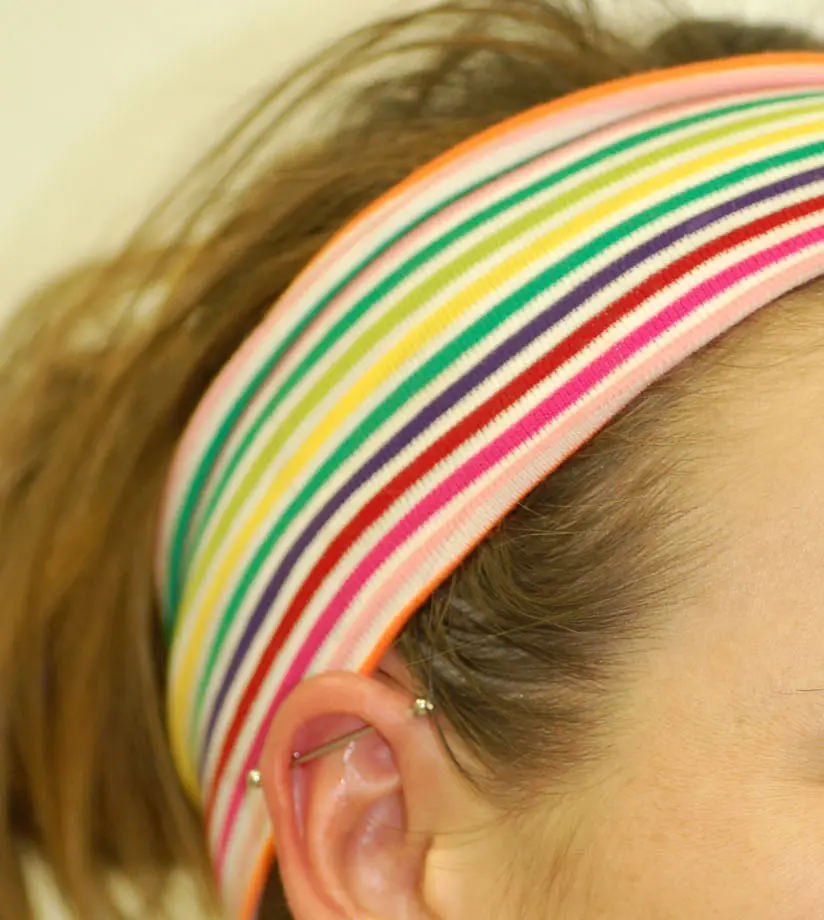
Photo by Tommy T via Wikimedia Commons, CC BY-SA 3.0.
Your ear decides
An industrial needs a straight line. The bar has to pass between two points on your rim without pressing against any cartilage in between, and without forcing either hole to sit at an angle.
That requires:
- A reasonably flat, wide upper ear rather than a tightly curled rim.
- Two placements that line up naturally, not two placements forced into alignment.
- Enough clearance that the bar floats above the ear rather than resting on it.
A piercer will mark both points and hold a straight edge across them before agreeing. If the line does not work on your ear, no technique fixes it, and being told no is the right outcome. Forcing an industrial onto the wrong ear produces two migrating holes and a scar across the top of the ear.
If your anatomy will not allow it, ask about a faux industrial: two separate piercings with individual studs, positioned to give a similar look without a connecting bar.
Pain
About 7 out of 10, and the highest of the common ear piercings. Not because either pass is unusually painful on its own, but because you get two of them in a row, and the second one lands on an ear that is already flooded with adrenaline and starting to swell.
Expect the entire upper ear to throb for the rest of the day, and to be genuinely sore for two to four weeks.
Healing
Nine to twelve months, often longer. Plan for a full year.
The linked-channel problem is what makes it slow. Catch the bar on a jumper and both holes tear. Sleep on it and both holes get levered. Knock one end and the other end moves. Two cartilage piercings healing separately would each take six to twelve months; joined together they take longer than either would alone.
Swelling in the first two weeks is significant, which is why the initial bar is longer than the final one.
Downsize at eight to twelve weeks. An overlong bar sticking out past the rim is a hook for everything you own. Piercing downsizing explains it for every placement.
Why cartilage takes this long, and the four rules that prevent most of its problems, are in the cartilage piercing guide.
The one-at-a-time approach
Many experienced piercers now recommend piercing the two holes separately, months apart, each with its own flat-back labret. Once both are fully healed, you fit the connecting barbell.
It takes longer, and it costs a little more in jewelry, but it turns an industrial from a piercing with a high failure rate into two ordinary helix piercings. If you have a year of patience and want the look to last, this is the better route. Ask your piercer for their view on your ear specifically.
Aftercare
Standard cartilage routine from the aftercare guide: sterile saline twice a day on all four openings, hands off, no rotating.
Practical rules that matter more here than anywhere else:
- Do not sleep on that side. Use a travel pillow with the hole over your ear.
- Watch your clothing. Anything you pull over your head can hook the bar. Unbutton shirts, and be careful with towels and scarves.
- No over-ear headphones for the first several months.
- Tie long hair back while it settles. Hair wraps around a straight bar constantly.
Jewelry
A straight barbell, 14 gauge, usually 32 to 38 mm long, in ASTM F136 implant-grade titanium. Industrials are pierced at 14 gauge rather than 16 because a longer bar needs the extra rigidity to avoid flexing in the channels.
Titanium matters more here than on a small stud simply because of weight. A long steel bar is noticeably heavier than the same bar in titanium, and that weight hangs on two healing channels all day.
Decorative bars with shapes soldered in the middle are for healed piercings only. Read the jewelry material guide before you buy.
Problems
Migration is the main risk, especially if the placement was forced. You will see the channels shortening as the skin over them thins. Get a piercer to look early; removing the bar and letting the holes close is better than letting them tear out.
Irritation bumps at one end can be caused by an angle problem or by a bar that is too long or too short. Ask your piercer to check the fit. The APP says ointments prevent the air circulation a piercing needs. See piercing bump vs keloid.
Infection in cartilage escalates faster than in soft tissue. Heat, spreading redness, thick coloured discharge or fever means a doctor the same day, jewelry left in.
The cartilage bump guide ranks the causes by how often each turns out to be the answer.
A lump that spreads beyond the piercing and keeps growing over months is a different problem: see the keloid guide.
Cost
$50 to $100 for the piercing, since you are paying for two placements, plus $40 to $150 for the barbell. Splitting it into two sessions costs a little more overall but greatly improves your odds.
Frequently asked questions
Can everyone get an industrial piercing?
No, and this is the piercing most often refused. The bar has to run in a straight line between two points on your ear rim. If your ear is shallow, or the rim is angled so the bar would press on the cartilage between the holes, it will not heal. A good piercer checks with a marker and a straight edge before agreeing.
How painful is an industrial piercing?
Around 7 out of 10, because it is two cartilage piercings performed back to back in one sitting. Each pass on its own is comparable to a helix, but doing both leaves the whole upper ear throbbing for the rest of the day.
How long does an industrial take to heal?
Nine to twelve months, sometimes longer. You are healing two cartilage channels that are physically linked, so any knock to one end transmits straight to the other.
Can I sleep on an industrial piercing?
Not for months. A rigid bar across the top of the ear turns any pillow pressure into leverage on both holes at once. This is the piercing where a travel pillow with a hole in it earns its keep.
Can I get an industrial pierced one hole at a time?
Yes, and many piercers now prefer it. You heal each hole separately with its own flat-back stud, then fit the connecting bar once both are settled. It takes longer overall but the failure rate is much lower.
Sources
- Association of Professional Piercers - Suggested aftercare for body piercingshttps://safepiercing.org/aftercare/
- Association of Professional Piercers - Jewelry for initial piercingshttps://safepiercing.org/jewelry-for-initial-piercings/
- Association of Professional Piercers - Troubleshootinghttps://safepiercing.org/troubleshooting/
This article is for education only and is not medical advice. If a piercing is hot, swollen, spreading redness, oozing yellow or green discharge, or you have a fever, see a doctor today.