The rook is the ridge of cartilage that runs above the inner ear, between the bowl of the conch and the outer rim. Anatomically it is the upper part of the antihelix. A rook piercing passes through that ridge from the front to the back, so both ends of the jewelry show along the top of the fold.
It photographs beautifully. It is also the ear piercing most likely to be refused by a good piercer, and that refusal is the piercer doing their job.
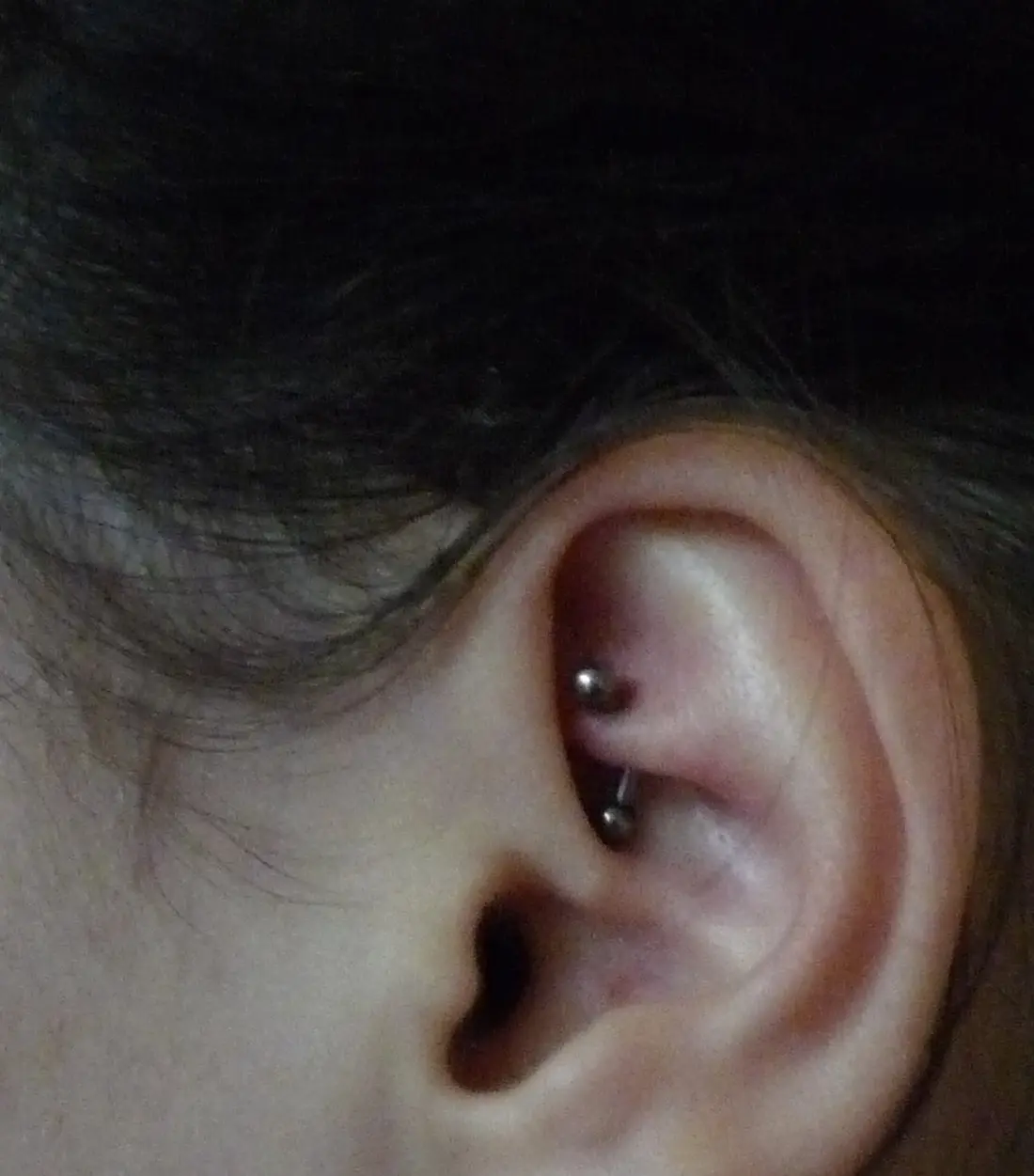
Photo by Anavrine via Wikimedia Commons, CC BY-SA 3.0.
The anatomy question comes first
A rook is not a placement you choose, it is a placement your ear either has or does not have. The needle has to pass through a fold, and it needs a defined ridge with enough depth for the jewelry to seat inside without pressing on either wall.
Look in a mirror at the ridge above your ear canal. If it stands proud and you can feel a clear lip of cartilage, you are a candidate. If the area is flat or barely raised, a rook will sit under tension, migrate outward over months, and leave a scar.
A piercer who checks your anatomy and says no is protecting you from spending a year on a piercing that was never going to work. A piercer who says yes to every ear is not checking.
Pain
Around 6 out of 10, above a helix and a conch. Two reasons. The needle crosses a folded double layer of cartilage, so the pass takes longer, and the rook sits deep in the ear where you feel the pressure through your skull rather than just at the skin. It is a heavy, dull, expanding pressure rather than a bright sting.
The soreness afterwards lasts longer than most ear piercings too. Two to four weeks of tenderness when you brush it is normal.
Healing
Six to twelve months. Even by cartilage standards a rook is slow, because the fold is thick, poorly supplied with blood and constantly in contact with pillows, headphones and phones.
The stages follow the usual cartilage pattern: about a week of swelling, two to three months of crusting and occasional itching, then a long quiet period where the channel toughens internally while looking completely finished from the outside.
Downsize at six to ten weeks. This matters more on a rook than almost anywhere else. The initial barbell is deliberately long to leave room for swelling, and once the swelling drops that spare length turns the jewelry into a lever that catches on hair, towels and headphones. Most rook bumps trace back to a barbell nobody shortened. Piercing downsizing explains it for every placement.
Why cartilage takes this long, and the four rules that prevent most of its problems, are in the cartilage piercing guide.
Aftercare
The routine is the same as any cartilage piercing: sterile saline twice a day, no touching, no twisting, no sleeping on that side. The full aftercare guide covers products and daily practicalities.
What makes a rook harder is contact. It sits exactly where the cushion of an over-ear headphone lands and exactly where a phone rests against your head. For the first three months, use the other ear for calls and use earbuds or open headphones rather than cups.
Jewelry
Start with a curved barbell, 16 gauge, 8 to 10 mm, in ASTM F136 implant-grade titanium. The curve follows the natural shape of the fold, which keeps pressure off both walls of the channel. Cartilage earrings covers what the sources say about studs, hoops and materials.
Once fully healed, a small hoop or a hinged clicker looks excellent in a rook and is the reason many people get one. Fit either only after twelve months of calm, and have the piercer size it, because a ring that is a millimetre too small in diameter will press on the fold constantly.
Threadless or internally threaded, as always, so the post is smooth. Our jewelry guide covers what to look for in a mill certificate and why “surgical steel” is a meaningless label.
What goes wrong
Migration. If the rook was pierced through insufficient cartilage, the body pushes the jewelry outward over months. You will see the channel getting shorter and the skin over it thinning. That needs removal before it tears through, and a piercer will tell you honestly if that is what is happening.
Irritation bumps. Common, and almost always mechanical. Work through the causes in order: pressure at night, headphones, a barbell that needs downsizing, and jewelry that is not implant grade. Read piercing bump vs keloid so you do not treat an irritation bump as if it were a keloid.
Trapped fluid. Because the rook sits in a fold, discharge can collect rather than drain. A saline spray twice a day, aimed into the fold, prevents most of it.
The cartilage bump guide ranks the causes by how often each turns out to be the answer.
A lump that spreads beyond the piercing and keeps growing over months is a different problem: see the keloid guide.
Cost
$35 to $90 for the piercing in a US studio, plus $30 to $120 for the barbell depending on material and ends. Rook piercings sit at the upper end of ear pricing because the placement demands more skill and a longer, better-fitted piece of jewelry.
Budget for a downsize appointment too, though many studios include the first one.
Frequently asked questions
Can everyone get a rook piercing?
No. A rook needs a pronounced antihelix fold, the ridge above the inner ear. If your fold is shallow the jewelry has nothing to seat against, it will migrate and it will not heal. A piercer should turn you away rather than pierce a flat rook.
How much does a rook piercing hurt?
About 6 out of 10, among the more painful ear piercings. The needle passes through a folded double thickness of cartilage, so the pressure lasts longer than a helix. It is a few seconds, not a few minutes.
How long does a rook piercing take to heal?
Six to twelve months. Because the fold is thick and tucked away, a rook is slower to settle than most and stays tender for longer. Many people find month three is when it finally stops reminding them it is there.
What jewelry goes in a rook?
A curved barbell to start, 16 gauge and 8 to 10 mm long, in implant-grade titanium. Once healed, a small hoop or a clicker also works, but the curve is what suits the fold best day to day.
Why does my rook keep getting a bump?
Almost always pressure or leverage. The fold sits deep in the ear where headphones, pillows and phone screens press on it, and a barbell that was not downsized after swelling will catch on everything. Fix the cause rather than treating the bump.
Sources
- Association of Professional Piercers - Suggested aftercare for body piercingshttps://safepiercing.org/aftercare/
- Association of Professional Piercers - Troubleshootinghttps://safepiercing.org/troubleshooting/
- American Academy of Dermatology - Caring for pierced earshttps://www.aad.org/public/everyday-care/skin-care-basics/tattoos/caring-for-pierced-ears
This article is for education only and is not medical advice. If a piercing is hot, swollen, spreading redness, oozing yellow or green discharge, or you have a fever, see a doctor today.