On this page
Gauge converter
Gauge runs backwards, so a smaller number means thicker jewelry. Convert a gauge to millimetres and inches, or measure a piece you already own and find the nearest standard size.
Gauge to measurement
Measurement to gauge
Measuring at home needs a digital caliper. A ruler is not precise enough at these sizes, and any studio will measure a piece for you in a minute.
Body jewelry is sized by gauge for thickness and by millimetres for length or diameter, which trips almost everyone up the first time. Gauge runs backwards: a smaller number means thicker jewelry.
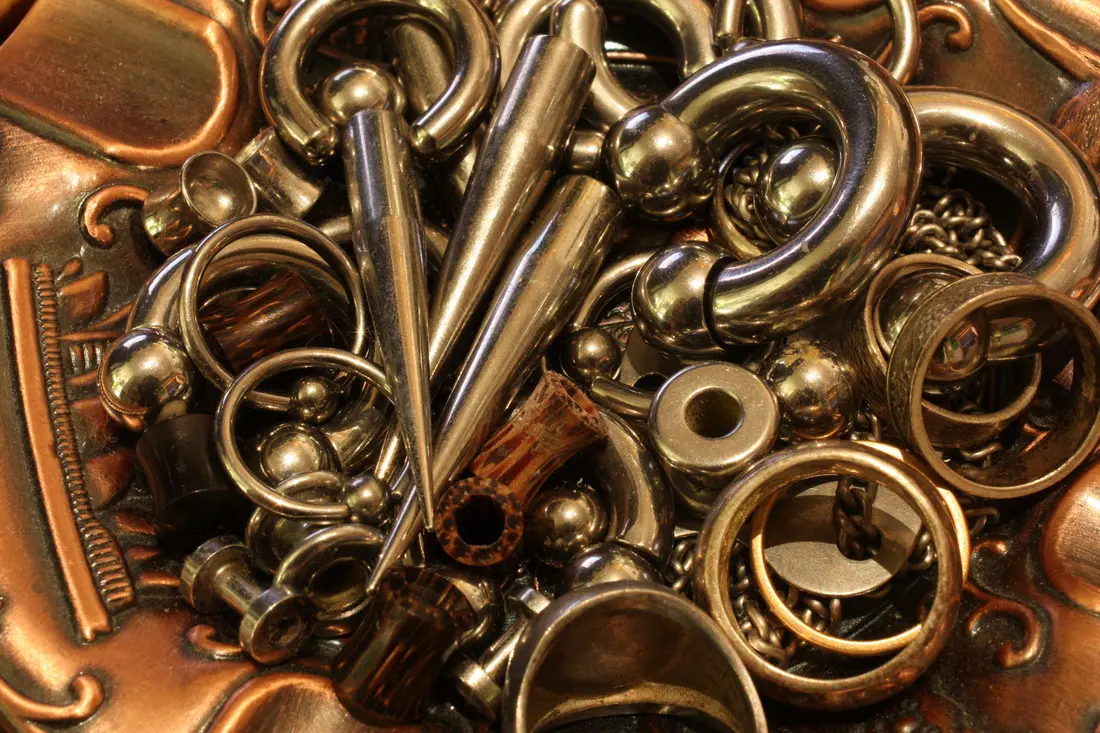
Photo by Pikku-Mikko via Wikimedia Commons, CC BY-SA 2.0.
For nose jewelry specifically, see nose ring sizes; for stud post lengths by placement, flat back earrings.
Gauge to millimetres
| Gauge | Millimetres | Inches | Typically used for |
|---|---|---|---|
| 20g | 0.8 mm | 0.032” | Thin lobe studs, some nostrils |
| 18g | 1.0 mm | 0.040” | Nostril, some lobes |
| 16g | 1.2 mm | 0.047” | Cartilage, septum, eyebrow, lip, lobes |
| 14g | 1.6 mm | 0.064” | Navel, nipple, tongue, industrial, septum |
| 12g | 2.0 mm | 0.081” | Stretched lobes, some nipples |
| 10g | 2.4 mm | 0.094” | Stretched lobes |
| 8g | 3.2 mm | 0.128” | Stretched lobes |
| 6g | 4 mm | 0.160” | Stretched lobes |
| 4g | 5 mm | 0.200” | Stretched lobes |
| 2g | 6 mm | 0.250” | Stretched lobes |
| 0g | 8 mm | 0.325” | Stretched lobes |
| 00g | 10 mm | 0.400” | Stretched lobes |
Above 00g, sizes are quoted in millimetres or inches only.
Standard gauge by piercing
| Piercing | Usual gauge | Notes |
|---|---|---|
| Earlobe | 16g or 18g | 16g holds better long term and takes more jewelry |
| Helix, forward helix, flat | 16g | |
| Conch | 16g or 14g | 14g for larger jewelry |
| Rook, daith, tragus | 16g | |
| Industrial | 14g | A long bar needs the rigidity |
| Nostril | 18g | 20g is thinner and more prone to migration |
| Septum | 16g or 14g | Decide before piercing; changing later means stretching |
| Eyebrow | 16g | |
| Lip, labret, medusa | 16g or 14g | |
| Tongue | 14g | |
| Navel | 14g | |
| Nipple | 14g | Some piercers prefer 12g |
| Dermal anchor | 14g | Anchor post size |
If you care about the gauge you will be wearing long term, say so before the needle. Going thicker later means stretching; going thinner means the channel shrinks and may not accept the original size again.
Length and diameter
Post length on a labret or barbell
Measure the wearable length: the straight section between the two ends, not including the ends themselves.
Your initial jewelry is deliberately longer than your final size to leave room for swelling. Once the swelling has gone you should downsize, typically at four to six weeks for soft tissue and six to ten weeks for cartilage. A long post left in has more room to move and catch, and the APP advises avoiding friction and excessive motion. See irritation bumps.
Typical wearable lengths after downsizing:
| Piercing | Initial | After downsize |
|---|---|---|
| Earlobe | 8 mm | 6 mm |
| Helix and most cartilage | 6-8 mm | 5-6 mm |
| Conch | 8-10 mm | 6-8 mm |
| Nostril | 8 mm | 6-6.5 mm |
| Eyebrow (curved) | 10-12 mm | 8-10 mm |
| Navel (curved) | 10-12 mm | 8-10 mm |
These are starting points. Anatomy varies, and a piercer measuring your actual piercing beats any table.
Ring diameter
Diameter is measured across the inside of the ring, not the outside.
| Piercing | Typical inside diameter |
|---|---|
| Helix hoop | 6-8 mm |
| Lobe hoop | 8-12 mm |
| Conch hoop | 10-14 mm |
| Septum | 8-10 mm |
| Daith | 8 mm |
| Nostril hoop | 6.5-8 mm |
Too small and the ring presses on the channel constantly. Too large and it swings and catches. Have a piercer size a hoop the first time.
Ball and end size
Ends are sized in millimetres across: 2 mm, 2.5 mm, 3 mm, 4 mm and upward. Small flat ends are better while healing because they catch less. Large or spiky ends belong in healed piercings.
Measuring your own jewelry
A digital caliper is inexpensive and is the only accurate way to measure at home. Rulers are not precise enough at these sizes.
To measure a piece you already own:
- Gauge: measure the thickness of the post in millimetres, then put that figure into the converter at the top of this page.
- Length: measure the straight wearable section only.
- Diameter: measure the inside gap of a ring at its widest point.
If you are ordering jewelry for an existing piercing and you are unsure, take the piece to a studio. Most will measure it for you in a minute.
A note on stretching
Going up in gauge from a healed piercing is stretching, and it needs to be done slowly: one size at a time, fully healed and settled between each, with a taper and lubricant, never forced.
Stretching too fast tears tissue and can cause a blowout, where the channel lining pushes out through the back of the hole, which is largely permanent. The full method, the waiting times by size, and what a blowout actually looks like are in the ear stretching guide.
What to buy
The right size in the wrong material still causes problems. Read the material guide for what to look for, and the threading guide for why the assembly matters as much as the metal.
The rest of the jewelry guides cover materials, threading, sizing and retainers.
Frequently asked questions
What gauge is a nose piercing?
18 gauge, which is 1.0 mm, is the professional standard for a nostril piercing. Some studios use 20 gauge (0.8 mm), which is thinner and more prone to irritation and migration. Septum piercings are usually 16 gauge or 14 gauge.
What gauge is a cartilage piercing?
16 gauge, which is 1.2 mm, for most cartilage piercings including helix, tragus, rook, daith and conch. An industrial is usually 14 gauge because a long bar needs more rigidity.
Does a smaller gauge number mean thicker jewelry?
Yes. Gauge runs backwards: the smaller the number, the thicker the jewelry. 20 gauge is 0.8 mm and 00 gauge is 10 mm. It is the single most confusing thing about buying body jewelry.
How do I measure post length?
Measure the wearable section, the straight part between the two ends, not the total length including the ends. A digital caliper is the reliable way, and any piercer will measure for you.
What size hoop do I need?
Diameter is measured across the inside of the ring. For a helix, 6 to 8 mm is typical; for a septum, 8 to 10 mm; for a daith, usually 8 mm. Fit depends on your anatomy, so have a piercer size it.
Can I go from 20 gauge to 18 gauge jewelry?
That is a small stretch rather than a swap. Going up one gauge in a fully healed piercing is usually straightforward with a taper and lubricant, but it should not be done on a healing piercing and should not be forced.
Sources
- Association of Professional Piercers - Jewelry for initial piercingshttps://safepiercing.org/jewelry-for-initial-piercings/
- Association of Professional Piercers - Stretchinghttps://safepiercing.org/stretching/