On this page
An eyebrow piercing passes through the ridge of skin at the outer end of the brow, usually at an angle, with both ends of a curved barbell visible. It came out of the 1990s, disappeared for a decade, and is now firmly back.
It is quick, it is one of the least painful facial piercings, and it has one honest drawback that studios do not always mention: it is a surface piercing, and surface piercings can migrate.
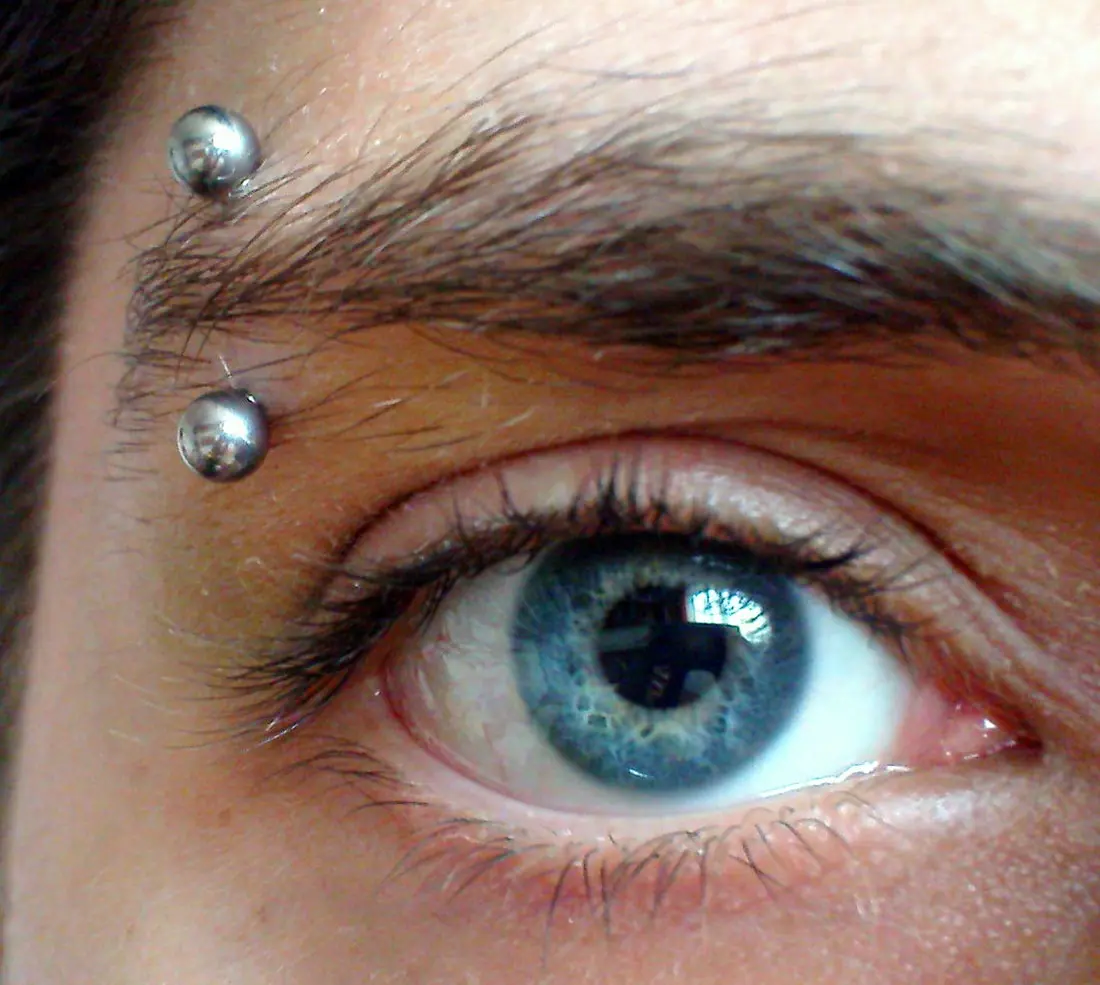
Photo by Lukas Stavek via Wikimedia Commons, CC0.
What “surface piercing” means here
Most piercings pass through a structure, such as a lobe, a cartilage fold or the sweet spot of a septum. An eyebrow piercing passes through a pinch of skin, entering and exiting on the same plane.
The body treats a shallow channel through skin differently. Over months or years it can gradually push the jewelry toward the surface, thinning the tissue above it, until the piercing migrates out. That is rejection, and it is not a sign that you did anything wrong.
You reduce the risk substantially by:
- Going deep enough. A piercer who takes a good pinch of tissue is doing it right.
- Using a curved barbell sized to your anatomy, not a straight bar or a ring.
- Not snagging it. Towels, hoodies, hairbrushes and pillows are the enemies.
- Downsizing on time so there is no spare length to catch.
Placement
The standard placement sits at the outer third of the brow, angled so the barbell follows the brow line. That angle is not decorative: it puts the channel across the direction of skin movement, which is more stable.
Placements to be aware of:
- Vertical eyebrow: one end above the brow, one below, crossing the brow line.
- Horizontal eyebrow: along the brow, both ends visible on the same plane. Higher migration risk.
- Anti-eyebrow: on the upper cheekbone below the eye, not on the brow at all. A different piercing with a different risk profile, usually done with a surface bar.
Your piercer should avoid the supraorbital nerve and the vessels near the inner brow. This is why placement sits toward the outer end rather than near the nose.
Pain
About 3 out of 10. The skin is thin and the pass is quick. Expect a sharp pinch and a little more bleeding than you might anticipate, since the area is well supplied with small blood vessels. A few drops is normal.
Healing
Two to four months.
- Week 1: swelling, sometimes bruising around the eye, which is unnerving but ordinary.
- Weeks 2-8: crusting on the ends, less tenderness.
- Months 2-4: settled, but still snaggable.
Downsize at four to six weeks. Eyebrows swell noticeably at first, so the initial barbell is long. Once the swelling drops, that spare length is exactly what a towel catches. How long an eyebrow piercing takes to heal covers the stages. Piercing downsizing explains it for every placement.
Aftercare
Sterile saline twice a day, hands off, no rotating. The full aftercare guide covers the rest.
Practicalities specific to the eyebrow:
- Makeup: none on or near the piercing until healed. This includes brow pencil, gel, powder and foundation.
- Face washing: work around it, rinse with saline after.
- Towels: pat, never rub. Better still, use paper towel on that area for the first few weeks.
- Hair: a fringe that sweeps over the brow drags on the jewelry all day. Pin it back while healing.
- Sunglasses and glasses can knock the outer end. Check the fit.
Jewelry
Start with a curved barbell, 16 gauge, 10 to 12 mm, in ASTM F136 implant-grade titanium. The curve distributes pressure along the channel instead of concentrating it at the two openings, which is what keeps a surface piercing stable.
Rings are possible in a fully healed eyebrow but they increase movement and therefore migration risk. If you want a ring, wait until month four at the earliest and accept the trade-off.
Small, flat, lightweight ends are better than large spikes or gems, which get caught. See the material guide for what to check. Eyebrow piercing jewelry covers sizes, materials and when a ring is safe.
A retainer keeps the channel open when you need to hide it, or to remove metal for a scan.
Signs of migration
Catch this early and you can save the piercing or remove it before it scars.
- The visible distance between the two ends is getting shorter.
- The skin over the bar looks thin, shiny, or you can see the bar through it.
- The piercing feels tender again after being settled.
- The jewelry sits at a noticeably different angle than it did.
Any of those means see your piercer. Sometimes a different bar size or a change of habits stops it. If the tissue is very thin, removing the jewelry before it tears through leaves a far smaller mark. Eyebrow piercing scar explains what the marks look like and what helps them fade.
Other problems
Bruising in the first week is normal and can spread under the eye.
Irritation bumps on an eyebrow usually come from snagging, makeup, or a bar that needs downsizing. Read piercing bump vs keloid.
Infection near the eye should be taken seriously. Heat, spreading redness, swelling of the eyelid, thick coloured discharge or fever means a doctor the same day.
A lump that spreads beyond the piercing and keeps growing over months is a different problem: see the keloid guide.
Cost
$30 to $70 for the piercing, plus $25 to $80 for a titanium curved barbell. Budget for a downsize, though many studios include the first one. How much is an eyebrow piercing adds up the first-year total.
Frequently asked questions
Does an eyebrow piercing hurt?
About 3 out of 10, one of the milder facial piercings. The skin above the eye is thin and mobile, so the needle passes quickly. It bleeds a little more than most piercings, which looks worse than it is.
How long does an eyebrow piercing take to heal?
Two to four months. It is a surface piercing, so it heals as a shallow channel through skin rather than deep tissue, and it stays vulnerable to snagging for the whole time.
Do eyebrow piercings reject?
They can. Any surface piercing carries a migration and rejection risk because the body can gradually push a shallow channel out. Correct depth, a well-fitted curved barbell and avoiding snags keep the odds low.
Will an eyebrow piercing leave a scar?
If it rejects or is removed after long wear, it usually leaves two small marks and sometimes a faint line between them. Removing it early and cleanly leaves very little.
Which side should I get pierced?
Either. There is no rule. Consider which side you sleep on, whether you wear glasses, and how you style your hair and brows.
Can I wear makeup with an eyebrow piercing?
Not on or around the piercing while it heals. Foundation, concealer and brow products push into the channel and cause irritation. Work around it and rinse with saline afterwards.
Sources
- Association of Professional Piercers - Suggested aftercare for body piercingshttps://safepiercing.org/aftercare/
- Association of Professional Piercers - Troubleshootinghttps://safepiercing.org/troubleshooting/
- Association of Professional Piercers - Jewelry for initial piercingshttps://safepiercing.org/jewelry-for-initial-piercings/
This article is for education only and is not medical advice. If a piercing is hot, swollen, spreading redness, oozing yellow or green discharge, or you have a fever, see a doctor today.