On this page
Jewelry size finder
Pick a placement to see the gauge and length or diameter it actually takes, fresh and once healed. These are the same figures used throughout the jewelry guides, not a separate estimate.
Not sure which gauge a measurement corresponds to? The gauge convertergoes the other way, from a millimetre measurement to the nearest standard size.
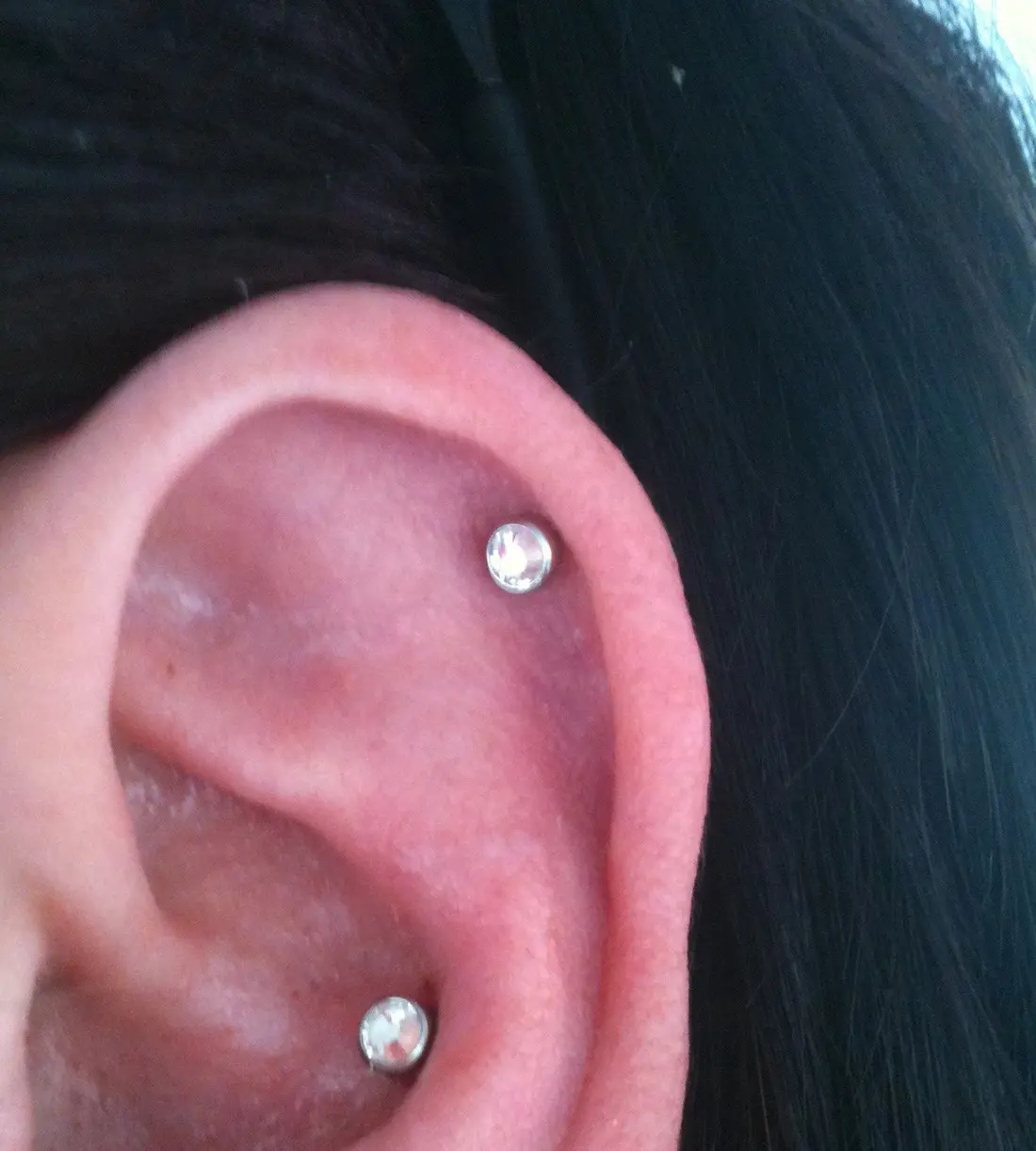
A flat back earring is a straight post with a smooth, flat disc on the back and a decorative end on the front. The disc sits flush against your skin, and the end is either pushed into the post or screwed into it. That is the whole design, and it is the reason professional piercers use it for almost everything.
If you have been pierced in a studio in the last decade, you were almost certainly given one. If you have been searching for why your studio jewelry has no butterfly clasp, this is why.
Two names for one thing
In a studio it is a labret stud, because the design was first used for lip piercings, where a flat disc inside the mouth was the only comfortable option. When the same jewelry became the standard for ears, the mainstream name flat back caught on.
They are the same object. A shop selling “labret studs” and a shop selling “flat back earrings” are selling the same thing, and the sizing below applies to both.
Why piercers stopped using butterfly backs
A traditional stud earring has a post and a butterfly clasp that grips it. That design has four problems for a piercing that is healing, and two that persist forever.
The clasp digs in. A butterfly has edges and a spring. Sleep on it and it presses into the skin behind your ear. A flat disc has nothing to press with.
It traps debris. The folds of a butterfly collect skin, dried discharge and product, and sit against the wound. A disc wipes clean.
The post cannot be sized. Stud earrings come in one length. A flat back comes in every length from 5 to 12 mm, so the post can match your tissue exactly, with room for swelling at the start and none once it has gone.
The end can be changed without removing the post. With a flat back, the decorative front comes off and the post stays in the piercing. Swapping a butterfly stud means taking the whole thing out and threading it back through a channel that would rather you did not.
The two permanent advantages are comfort and headphones. A correctly sized flat back sits flush on both sides, so nothing catches on a pillow or presses under an over-ear cup. That is why people with fully healed lobes convert to them and never go back.
The three parts, and what each measurement means
The post. Measured in two ways: gauge (thickness) and length. Gauge runs backwards, so a smaller number is thicker. Length is the wearable section between the disc and the end.
The disc. The flat back itself, usually 3 to 5 mm across. Larger discs spread pressure and are used in the mouth; smaller ones are neater behind an ear or inside a nostril.
The end. The decorative front, which either has a thin pin that pushes into the post (threadless) or a small screw thread that turns into it (internally threaded). Both keep the outside of the post smooth, which matters more than most people realise. The threading guide explains why, and why externally threaded jewelry should never go through a healing piercing.
Sizes by placement
These are the usual ranges. Your own anatomy can sit outside them, and the right answer for a healing piercing is whatever your piercer measured.
| Placement | Gauge | Initial post (swelling) | Downsized post |
|---|---|---|---|
| Lobe | 20g or 18g | 8 mm | 6 mm |
| Helix, forward helix | 16g | 8–10 mm | 6 mm |
| Flat, conch | 16g | 10–12 mm | 8 mm |
| Tragus | 16g | 8 mm | 6 mm |
| Nostril | 18g | 7–8 mm | 5–6 mm |
| Lip placements | 16g | 10–12 mm | 8 mm |
The downsize is not a style choice. A post left at its initial length after swelling goes down moves in the channel and catches on everything, and the APP advises avoiding friction and excessive motion of a healing piercing. Downsize at four to six weeks for a lobe, six to ten for cartilage, two to four for a lip. See when to change your jewelry.
Working out what size you have
Take the end off, and measure the post from the disc to the tip with a ruler marked in millimetres. That is your length. Gauge is harder to eyeball; if your piercer did not tell you, the gauge chart converts the common thicknesses, and a studio will measure it in seconds.
Do not buy by “small, medium, large.” A seller who cannot give you gauge and length in millimetres is not selling body jewelry.
Changing the end
Threadless: bend the pin very slightly, about ten degrees, push it into the post, and twist gently as it seats. Tug lightly to check. If it falls out, bend a fraction more; if it will not go in, straighten a fraction.
Internally threaded: line the end up square and screw it in until it stops. Do not force a cross-threaded end.
Both are done from the front while holding the disc steady with a fingertip behind the piercing. Wash your hands, work over a towel rather than a sink, and only do this on a piercing that has finished healing. Changing the front does not disturb the channel the way changing the whole post does, which is another reason the design works.
Material matters as much as the design
A flat back in the wrong metal is a well-shaped piece of the wrong metal. For a healing piercing that means implant-grade titanium, ASTM F136, or solid 14k gold or higher. Plated jewelry sheds its coating into the wound, and “surgical steel” is a label with no standard behind it. The materials guide covers what the standards mean and which to ask for.
What to look for when buying
- Gauge and length in millimetres, not letters.
- Threadless or internally threaded, stated plainly.
- The alloy standard, not just the metal name.
- A polished disc with no visible seam or casting line.
- A brand you can look up, ideally one listed by the Association of Professional Piercers’ jewelry verification programme.
Walk away from anything described as “hypoallergenic” without a standard, anything with a visible screw thread on the outside of the post, and anything sold as a one-size set.
Converting healed lobes
If your lobes were pierced years ago with ordinary studs and you want to sleep on them, a 20 or 18 gauge flat back with a 6 mm post is the usual swap. Have a piercer check the gauge of your existing jewelry first; a lobe pierced with a thin stud may need a moment to accept an 18g post, and forcing it is not the answer.
The rest of the jewelry guides cover materials, threading, sizing and retainers.
Frequently asked questions
What are flat back earrings?
A straight post with a smooth flat disc on the back and a decorative end on the front. The disc sits flush against the skin instead of a butterfly clasp, and the end is either pushed in (threadless) or screwed in (internally threaded). In a studio they are usually called labret studs; it is the same object.
Are flat back earrings better for piercings?
For a healing piercing, yes. The disc does not dig in when you sleep, there is no butterfly to trap debris, the post can be sized exactly to your tissue, and it can be shortened once swelling goes down. Professional piercers use them as initial jewelry for almost every placement.
Can you sleep in flat back earrings?
Yes, and it is one of the main reasons people switch to them even in healed lobes. A correctly sized flat back sits flush on both sides, so nothing presses into the skin behind your ear on a pillow.
What size flat back earring do I need?
It depends on the placement and on whether the piercing is still healing. Healed lobes and helixes usually take a 6 mm post; conch and flat placements 8 mm; nostrils 5 to 7 mm. A fresh piercing needs a longer post to allow for swelling, then a shorter one at the downsize.
How do you put in a flat back earring?
For a threadless one, bend the pin very slightly, push it into the post and twist gently as it seats. For an internally threaded one, line the end up and screw it in. Both are done from the front, holding the disc steady behind the piercing. Wash your hands first and work over a towel.
Can I wear flat backs in a normal earlobe piercing?
Yes. They fit any standard piercing, and many people convert their lobes to flat backs so they can sleep and wear headphones comfortably. Pick a 20 or 18 gauge post to match a lobe pierced with a stud earring.
What is the difference between a flat back and a labret?
Nothing. Labret stud is the industry name, because the design was first used in lip piercings. Flat back earring is the name that reached the mainstream once the same jewelry became popular for ears. Shops use both.
Sources
- Association of Professional Piercers - Jewelry for initial piercingshttps://safepiercing.org/jewelry-for-initial-piercings/
- Association of Professional Piercers - Body Jewelry Verification Programhttps://safepiercing.org/body-jewelry-verification-program-2/
- Association of Professional Piercers - Suggested aftercare for body piercingshttps://safepiercing.org/aftercare/