On this page
A medusa piercing sits in the philtrum, the vertical groove that runs from the base of the nose to the centre of the upper lip. “Medusa” is the name most people search for; “philtrum” is the anatomical term a piercer or a medical professional is more likely to use. Both describe the same piercing.
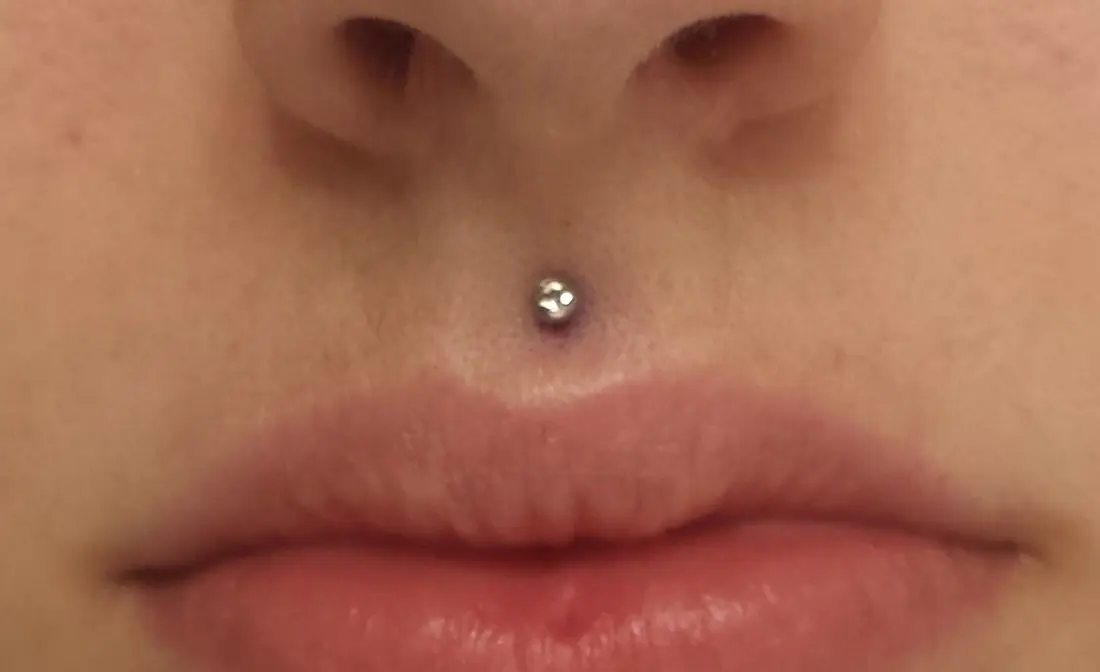
Photo by GorillaWarfare via Wikimedia Commons, CC BY-SA 4.0.
It is one of twelve lip placements, and types of lip piercings compares all of them side by side.
Medusa or philtrum piercing
Both names describe one placement. A philtrum piercing is the anatomical name, after the groove itself, and it is what you will hear in a studio consultation or read in a medical note. Medusa is the popular name and by far the more searched of the two.
There is no difference in placement, jewelry, pain or healing between them. If a studio price list says philtrum and you asked for a medusa, you are looking at the same thing.
Does your philtrum have the depth
The philtrum varies noticeably between people, both in how defined the groove is and how much tissue depth it offers. Some philtrums have a clear, pronounced groove that gives a piercer plenty to work with. Others are quite flat, which limits how securely jewelry can sit.
A piercer will look at your philtrum in profile as well as from the front before agreeing, since depth matters as much as the visible groove. A shallow philtrum is a legitimate reason to be offered a slightly different placement or told the piercing is not a good fit for your anatomy.
Pain
About 3 out of 10. The philtrum is thin tissue and the needle passes quickly, though the area is sensitive enough that most people feel a sharp, brief sting rather than nothing at all.
Healing
Two to three months, matching other piercings that exit inside the mouth.
- Days 1-5: swelling, tenderness, some difficulty with facial expressions and eating.
- Weeks 2-6: swelling drops, crusting on the outside, starts to look settled.
- Weeks 6-12: the channel finishes maturing internally.
Downsize once swelling has gone, generally within two to four weeks, so the flat back does not sit pressed against your gum any longer than necessary. Piercing downsizing explains it for every placement.
Protecting the upper gum
The same principle that applies to a labret applies here in reverse: the flat disc on the inside should rest against the inner lip, not push into the upper gum line. Sustained contact against the gum can cause recession over time.
- Downsize promptly once swelling allows.
- Choose a small, flat, smooth disc rather than a large decorative back.
- Have your piercer check the fit if your lip shape changes or the piercing feels tight against the gum.
- Mention the piercing to your dentist so the area gets checked at regular visits.
Aftercare
Both an inside and an outside routine, as with any piercing that exits in the mouth.
- Outside: sterile saline twice a day.
- Inside: rinse with alcohol-free mouthwash or saline after every meal, every drink other than water, and after smoking.
Avoid makeup and lip products directly on the piercing while it heals, and keep the jewelry away from your teeth. Full general routine in the aftercare guide.
Jewelry
Start with a flat-back labret stud, 16 gauge, 8 to 10 mm post, in ASTM F136 implant-grade titanium, downsized once swelling has gone. Threadless or internally threaded, so the post stays smooth. See the material guide.
Decorative gem tops are common for a healed medusa, but keep the initial jewelry simple and flat while healing; anything larger or textured is one more thing catching on food, drinks and your top lip.
The flat back guide covers post lengths and gauges by placement.
Problems
Upper gum irritation is the specific long-term risk here, covered above. Any gum sensitivity or visible recession near the piercing is worth a dentist visit.
Irritation bumps on the outside usually trace back to makeup, a post that needs downsizing, or the piercing being knocked. See piercing bump vs keloid.
Infection near the mouth and nose needs prompt attention: spreading redness, thick coloured discharge, swelling that increases after the first week, or fever means a doctor the same day.
A lump that spreads beyond the piercing and keeps growing over months is a different problem: see the keloid guide.
Cost
$30 to $70 for the piercing in a US studio, plus $20 to $60 for a titanium flat-back stud.
Frequently asked questions
What is a medusa piercing?
A piercing through the philtrum, the vertical groove in the centre of the upper lip below the nose. Medusa is the common name and philtrum is the anatomical one; they refer to the same piercing.
Is a philtrum piercing the same as a medusa piercing?
Yes. A philtrum piercing and a medusa piercing are the same placement under two names. Philtrum is the anatomical term for the groove between the nose and the upper lip, and it is what a piercer or a doctor is most likely to say. Medusa is the studio and social-media name, and it is what most people type into a search box.
Does a medusa piercing hurt?
About 3 out of 10. The philtrum is thin tissue and the needle passes quickly, though the area is sensitive enough that most people feel a sharp, brief sting.
Can everyone get a medusa piercing?
Not quite everyone. It needs a discernible groove with enough depth for jewelry to sit securely. A very flat or shallow philtrum gives a piercer less to work with, and they may recommend against it or suggest a slightly different placement.
How long does a medusa piercing take to heal?
Two to three months, the same as most lip-area piercings. It settles on the outside well before the channel is fully mature underneath.
Does a medusa piercing affect the upper teeth or gum?
It can over time if the flat back presses into the upper gum rather than sitting flush against the inside of the lip. A well-fitted disc and periodic checks with your piercer reduce that risk.
Sources
- Association of Professional Piercers - Oral aftercarehttps://safepiercing.org/oral-aftercare/
- Association of Professional Piercers - Suggested aftercare for body piercingshttps://safepiercing.org/aftercare/
- Association of Professional Piercers - Jewelry for initial piercingshttps://safepiercing.org/jewelry-for-initial-piercings/
This article is for education only and is not medical advice. If a piercing is hot, swollen, spreading redness, oozing yellow or green discharge, or you have a fever, see a doctor today.