On this page
A dermal piercing, also called a microdermal or a single-point piercing, is different from everything else on this site. There is no channel through tissue and out the other side. Instead a small anchor with a flat, perforated baseplate sits in a pocket under the skin, with a short post protruding through the surface. A decorative end screws onto that post.
The result is a gem or disc that looks like it is sitting directly on the skin. It can go almost anywhere flat: the chest, collarbones, back dimples, hips, nape, cheekbones, even a finger.
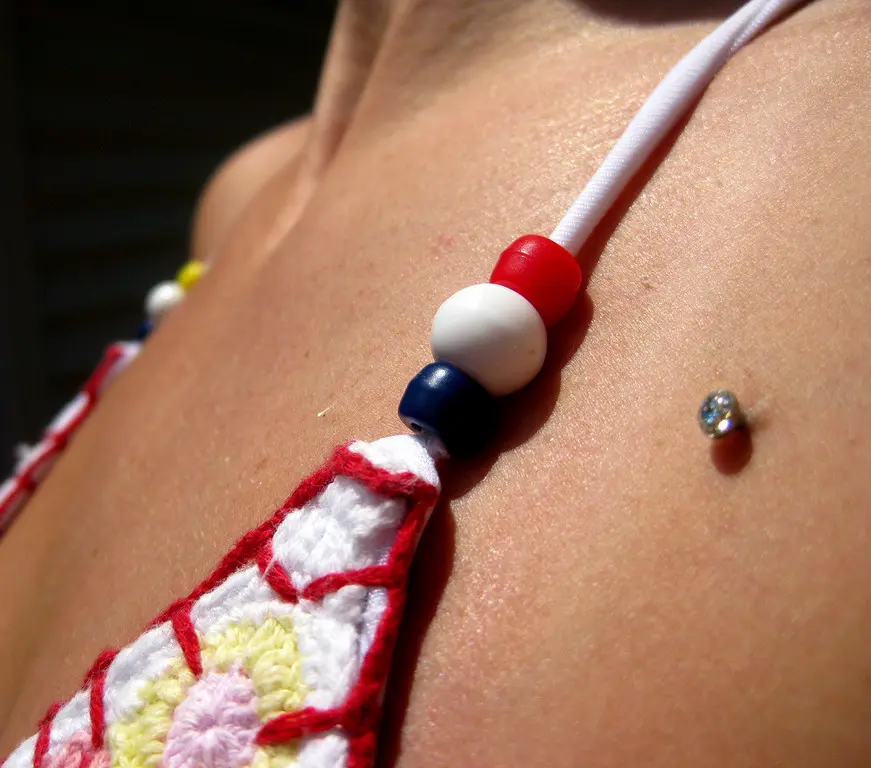
Photo by Melanie Tata via Wikimedia Commons, CC BY 2.0.
How it works, and why it is temporary
The baseplate has holes in it. As you heal, tissue grows through those holes and holds the anchor in place. That is the entire retention mechanism.
It also explains the honest limitation: dermals are not permanent. Your body treats the anchor as a foreign object in a shallow pocket and gradually works it toward the surface. Some last many years, some last months. Anywhere that flexes, rubs on clothing or gets knocked will fail sooner.
Anyone selling a dermal as a permanent piercing is overselling it. Go in expecting a piercing you will enjoy for a while and will eventually have professionally removed.
Placement decides everything
The success of a dermal depends more on where you put it than on anything else.
Better placements: flat, stable areas with reasonable tissue depth and little friction. Upper chest, collarbone, nape of the neck, cheekbone, hip (if clothing allows), back dimples.
Difficult placements: anywhere that bends (joints, waist), anywhere clothing rubs constantly (bra line, waistband), fingers and hands (used constantly, knocked constantly), and anywhere with very thin tissue over bone.
Finger dermals in particular have a very high failure rate. They look excellent and they rarely last, and a good piercer will tell you so before taking your money.
A pair placed close together just below the eye, on the cheekbone, is sometimes called a butterfly kiss — the same name given to the single-bar anti-eyebrow surface piercing it is standing in for. Two independent anchors avoid the migration risk that comes with a bar under the skin in that spot, at the cost of needing both points to heal and hold rather than one.
The procedure
Two methods are in common use:
- Dermal punch: a small circular blade removes a tiny core of tissue, creating the pocket. Note that dermal punches are restricted or prohibited for non-medical practitioners in some US states.
- Needle: the piercer uses a needle to lift and separate a pocket under the skin.
Either way, the anchor is then seated in the pocket with forceps and the top is screwed on. It takes a few minutes.
Pain
About 4 out of 10. Short, and more pressure than sting. The seating of the anchor is the odd part, since you feel it being pushed into place rather than passing through.
Healing
One to three months to settle, but the more useful framing is that a dermal never fully stops being a foreign object with a pocket under your skin.
- Weeks 1-2: swelling, tenderness, clear discharge around the post.
- Weeks 3-8: crusting, tissue growing through the baseplate.
- Months 2-3: stable, if placement and care were good.
Aftercare
Sterile saline twice a day around the base of the post. Do not pick at the crust, do not twist the top, and do not lever the jewelry to look under it. The full aftercare guide applies.
Two rules matter more here than anywhere else:
- Do not knock it. Towels, seatbelts, pets, doorframes, sports. A dermal that gets caught hard can be pulled straight out, taking skin with it.
- Do not change the top yourself early on. The top unscrews from the anchor, and unscrewing it while the pocket is healing can rotate or unseat the whole anchor. Have your piercer do the first change.
Cover it with a vented bandage during contact sports for as long as you keep it.
Jewelry
The anchor should be titanium, ideally ASTM F136 implant grade, with a 14 gauge post. Tops should be low profile while healing: a flat disc or a small, smooth gem. Tall or spiky ends catch on clothing and get knocked, and every knock shortens the life of the piercing.
Threading matters. The top screws into the anchor, and cheap anchors strip. A stripped anchor with a top that will not come off is a surgical removal rather than an unscrewing. Buy quality, see the material guide.
Rejection, and what it looks like
Rejection is expected eventually rather than exceptional. Signs:
- The top sits higher than it used to, or looks tilted.
- You can see the edge of the baseplate through the skin.
- The skin around the post is thinning, shiny, or red.
- The piercing becomes tender after being settled.
- It moves when you press it.
Get it looked at when you notice, not when it falls out. Timely professional removal leaves a small mark; a dermal that pushes its own way out over months leaves a bigger one.
Removal
Do not attempt it at home. The baseplate is anchored by tissue grown through it, and the usual professional method involves massaging the area to loosen it, sometimes with a small incision under local conditions, then lifting the anchor out and closing the site.
Experienced piercers do this routinely. Some anchors, particularly older or poor-quality ones, need a doctor. Either way, someone who has done it before should do it.
Problems
Migration and rejection are the main ones, covered above.
Irritation and redness at the base is usually friction from clothing or a top that is too tall. See piercing bump vs keloid.
Infection in a pocket under the skin needs prompt medical attention. Spreading redness, heat, thick coloured discharge, increasing pain or fever means a doctor the same day.
A top that will not unscrew is common with low-grade anchors. Do not force it; a piercer has the right tools.
A lump that spreads beyond the piercing and keeps growing over months is a different problem: see the keloid guide.
Cost
$70 to $100 per dermal in a US studio, including a basic titanium anchor and top. Decorative tops are extra. Removal typically costs $20 to $50, and is worth budgeting for from the start because you will need it one day.
Frequently asked questions
What is a dermal piercing?
A single-point piercing. Instead of going in one side and out the other, an anchor with a flat baseplate sits under the skin and a decorative top screws onto a post that comes through the surface. Only one end shows.
How long does a dermal piercing last?
Anywhere from several months to several years. Dermals are not permanent. The body gradually pushes the anchor toward the surface, and most are eventually rejected or need removal. Placement, jewelry quality and how often it gets knocked all affect the timeline.
Does a dermal piercing hurt?
About 4 out of 10. The piercer either uses a dermal punch to remove a small core of tissue or a needle to make a pocket, then seats the anchor. It is brief, and pressure rather than sharp pain.
Can I remove a dermal piercing myself?
No. The baseplate sits under the skin with tissue grown through it. Removal usually needs a small incision or a specific technique, done by an experienced piercer or a clinician. Pulling at it tears the skin and leaves a worse scar.
Do dermal piercings leave scars?
Usually a small mark, sometimes a slight indentation, particularly if it rejected slowly or was removed badly. Professional removal after a short wear leaves the least.
Where can you get a dermal piercing?
Almost any flat area with enough tissue: chest, collarbone, back dimples, hips, nape, cheekbone, finger, and the face. Placement matters enormously, because anywhere that bends, rubs against clothing or gets knocked will reject faster.
Sources
- Association of Professional Piercers - Suggested aftercare for body piercingshttps://safepiercing.org/aftercare/
- Association of Professional Piercers - Troubleshootinghttps://safepiercing.org/troubleshooting/
- Association of Professional Piercers - Jewelry for initial piercingshttps://safepiercing.org/jewelry-for-initial-piercings/
This article is for education only and is not medical advice. If a piercing is hot, swollen, spreading redness, oozing yellow or green discharge, or you have a fever, see a doctor today.