On this page
Material gets all the attention, but how a piece of jewelry is put together decides what actually passes through the inside of your piercing. There are three systems, and one of them should never go near a healing piercing.
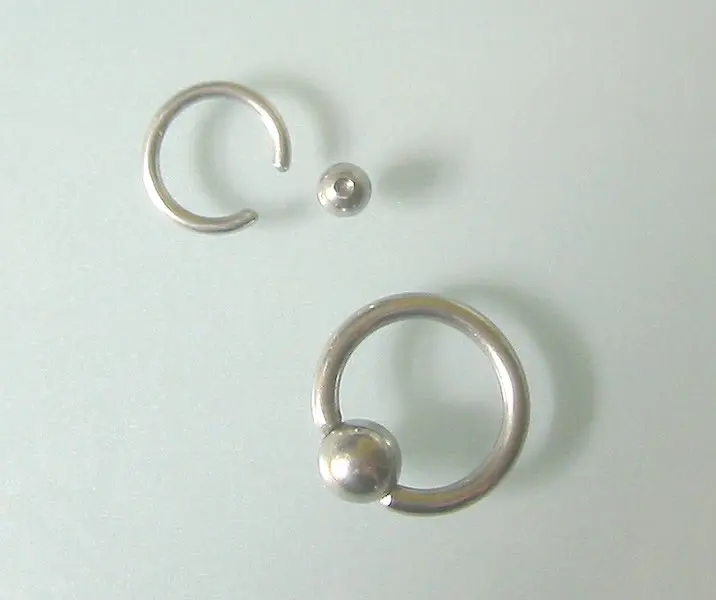
Photo by Nicor via Wikimedia Commons, CC BY-SA 3.0.
The three systems
| Threadless (press-fit) | Internally threaded | Externally threaded | |
|---|---|---|---|
| How it holds | A bent pin grips inside a hollow post | The end screws into the post | The end screws onto the post |
| What passes through you | A smooth post | A smooth post | A screw thread |
| Suitable for healing | Yes | Yes | No |
| Ease of changing ends | Easy | Moderate | Easy |
| Typical price | Higher | Higher | Cheapest |
| Where you find it | Professional studios | Professional studios | Mall shops, cheap online sellers |
Why externally threaded jewelry is the problem
On externally threaded jewelry, the screw thread is cut into the outside of the post. To insert it you push that threaded section through the piercing channel.
A screw thread is a sharp helical ridge. Dragging one through healing tissue does exactly what you would expect: it scrapes the channel lining, tears new tissue, and pulls surface bacteria along the length of the wound. Then you do it again in reverse when you change the end.
It is the cheapest of the three to manufacture, which is why it dominates inexpensive jewelry and why it is often what comes in a starter kit. If you have a persistent irritation bump and cheap jewelry, this is a likely culprit. See piercing bumps.
How to check yours: unscrew the end and look at the post. If you can see a threaded section at the tip, it is externally threaded.
Internally threaded
The thread is cut inside the post, and the decorative end carries a small male thread that screws into it. The post itself is completely smooth along its length.
Strengths: very secure, good for heavier ends, and nothing is passing through your tissue but polished metal.
Trade-off: you need two hands and reasonable dexterity to line up a small thread behind your ear. Practise over a table, not a sink.
Threadless, also called press-fit
The decorative end has a thin pin. You bend that pin very slightly, insert it into the hollow post, and the tension of the bend holds it against the inside wall.
Strengths: nothing screws, insertion is quick, and you can swap ends easily to restyle a healed piercing. It has become the standard for initial jewelry in most professional studios.
Trade-off: the bend needs to be right. Too little and the end falls out; too much and it will not seat.
Fitting a threadless end
- Wash your hands.
- Hold the pin and bend it very slightly, roughly ten degrees. This is much less than most people expect.
- Insert the pin into the post.
- Twist gently as you push. The twist is what makes the bend grip.
- Tug lightly to confirm it is seated.
To remove: hold the post steady, and pull the end straight out while twisting slightly in the opposite direction. Do not lever it sideways.
If it keeps falling out, add a few degrees to the bend. If it will not go in, straighten the pin a little. Pins tolerate being adjusted a handful of times before the metal fatigues, so aim to get it right rather than repeatedly re-bending.
Do this over a towel on a table. Threadless ends are small, and a bathroom sink is where they disappear.
Which to choose
Both threadless and internally threaded are appropriate for healing and healed piercings. In practice:
- Threadless for most ear and nostril piercings, where you may want to change the look and where one-handed insertion helps.
- Internally threaded for anything heavy, anything you never want to come loose, and for barbells in navel and nipple piercings.
- Externally threaded: not for a piercing you care about.
Other fittings you will meet
Captive bead rings hold a bead by tension between the ends of a ring. Secure, and fiddly to open and close without ring-opening pliers. Not ideal as initial jewelry because fitting them disturbs the piercing.
Clickers are hinged rings that snap shut. Easy to fit, popular in septum and daith piercings, and a good option once healed. Check the hinge quality; cheap hinges loosen and the ring falls out.
Seamless rings are opened by twisting the ends apart laterally. Never pull them apart in the plane of the ring, which deforms them permanently.
Fixed-bead rings have the bead welded on. Secure, and only removable by twisting the ring open.
What this means when you buy
Ask two questions before buying anything for a piercing that is still healing:
- What standard is the metal? See the material guide.
- How does it assemble? Threadless or internally threaded only.
Sellers who cannot answer both are not selling jewelry for healing piercings, whatever the listing says.
If you are buying flat-back studs, the flat back guide has post lengths by placement.
Frequently asked questions
What is threadless jewelry?
Also called press-fit. The decorative end has a thin pin that you bend very slightly and push into a hollow post. Tension holds it in place. Nothing screws, and nothing sharp passes through your piercing.
What is the difference between internally and externally threaded jewelry?
Internally threaded means the screw thread is inside the post and the end has a small male thread, so the surface passing through your piercing is smooth. Externally threaded means the thread is on the outside of the post, so a sharp spiral drags through the channel every time.
Why is externally threaded jewelry bad?
The exposed thread scrapes the inside of the channel on insertion and removal, tearing new tissue and dragging bacteria along it. It is the cheapest to manufacture, which is why it is common in mall shops and inexpensive online jewelry.
How do I put in threadless jewelry?
Bend the pin very slightly, about ten degrees, insert it into the post, then twist gently as you push so the bend grips the inside wall. If it falls out, the bend was too small. If it will not seat, straighten the pin slightly and try again.
Is threadless or internally threaded better?
Both are appropriate for healing piercings. Threadless is easier to insert one-handed and lets you swap ends easily. Internally threaded is more secure for heavy ends and for piercings you never want to come loose.
How do I know which type I have?
Look at the post with the end removed. A smooth post is threadless or internally threaded. A post with a visible screw thread along the tip is externally threaded.
Sources
- Association of Professional Piercers - Jewelry for initial piercingshttps://safepiercing.org/jewelry-for-initial-piercings/
- Association of Professional Piercers - Body Jewelry Verification Programhttps://safepiercing.org/body-jewelry-verification-program-2/