On this page
Stretching is the deliberate, gradual enlargement of an existing piercing, almost always a healed earlobe, moved up one standard gauge at a time until it reaches whatever size you are after.
Done slowly it is genuinely low-risk. Done at the pace that looks satisfying in a time-lapse video, it is the most common way people permanently damage a piercing that was otherwise perfectly healthy. The difference between the two is almost entirely about speed.
Start from fully healed, not from fresh
A piercing has to be completely healed before it is stretched, which for a lobe means at least six to ten weeks and, if you are at all unsure, longer. Healed means no tenderness, no discharge, no redness, and jewelry that has felt like nothing for weeks.
Stretching tissue that has not finished forming its own lining does not gently enlarge it, it tears it, and a torn channel usually needs to heal from scratch, at a size larger and messier than where it started. There is no way to shortcut this by starting to stretch “a little early.” Wait until it is actually healed.
The 10% rule
Each step up should be roughly 10% larger in diameter than the one before it. Moving one standard gauge at a time already gives you approximately this, which is why “one size at a time” and “the 10% rule” are really the same advice said two ways.
Looking at the gauge chart above, the reason skipping sizes is dangerous becomes visible rather than abstract: jumping from 16g (1.2 mm) to 12g (2.0 mm) is not one step, it is roughly a 65% increase in diameter in a single sitting. That is not stretching, it is tearing, whatever tool was used to do it.
How long to wait between sizes
There is no single number, because the honest answer is however long your tissue takes, and that varies. As a starting guide:
| Current size | Minimum wait before the next size |
|---|---|
| Up to 8g | 4–6 weeks |
| 6g to 2g | 6–8 weeks |
| 0g to 00g | 8–12 weeks |
| Larger than 00g | 3 months or more, often much more |
These are minimums, not targets. If the lobe still feels tight, thin, warm or the slightest bit tender at the end of the recommended wait, wait longer. Nothing about stretching rewards impatience, and nothing bad happens from taking an extra month.
Tapers, not tape
An insertion taper is a smooth, gradually widening rod, sized precisely to step from your current gauge to the next one. Lubricated and inserted slowly, it eases the tissue open rather than forcing it.
Taping is wrapping layers of PTFE tape around jewelry you already have to build it up in tiny increments, and it is popular for exactly the reason it is a bad idea: it feels gentler because each layer is thin. In practice tape cannot produce a smooth, even taper. It creates uneven pressure, ridges where the tape overlaps, and a rough surface dragging against the channel, which is a good description of how blowouts start. Use a proper taper, sized correctly, every time.
Dead stretching, forcing a larger size straight in with no taper and no patience, is the fastest route to tearing tissue outright. If it does not slide in with light, steady pressure and lubrication, it is the wrong size for today.
Signs you are going too fast
Stop and drop back a size, or pause entirely, if you notice:
- Sharp pain, as opposed to the mild pressure and warmth of a normal stretch.
- Bleeding, at the time or afterwards.
- Thinning, where the skin around the jewelry looks pale, shiny or stretched thin rather than a healthy, even thickness.
- A lobe that still feels tender or “not right” a full day after inserting.
- The beginning of a lump forming at the back of the lobe. This is the earliest sign of a blowout, and it is far easier to prevent than to fix.
None of these are a normal part of stretching. They are all signs to slow down, and sometimes to see a piercer.
Blowouts
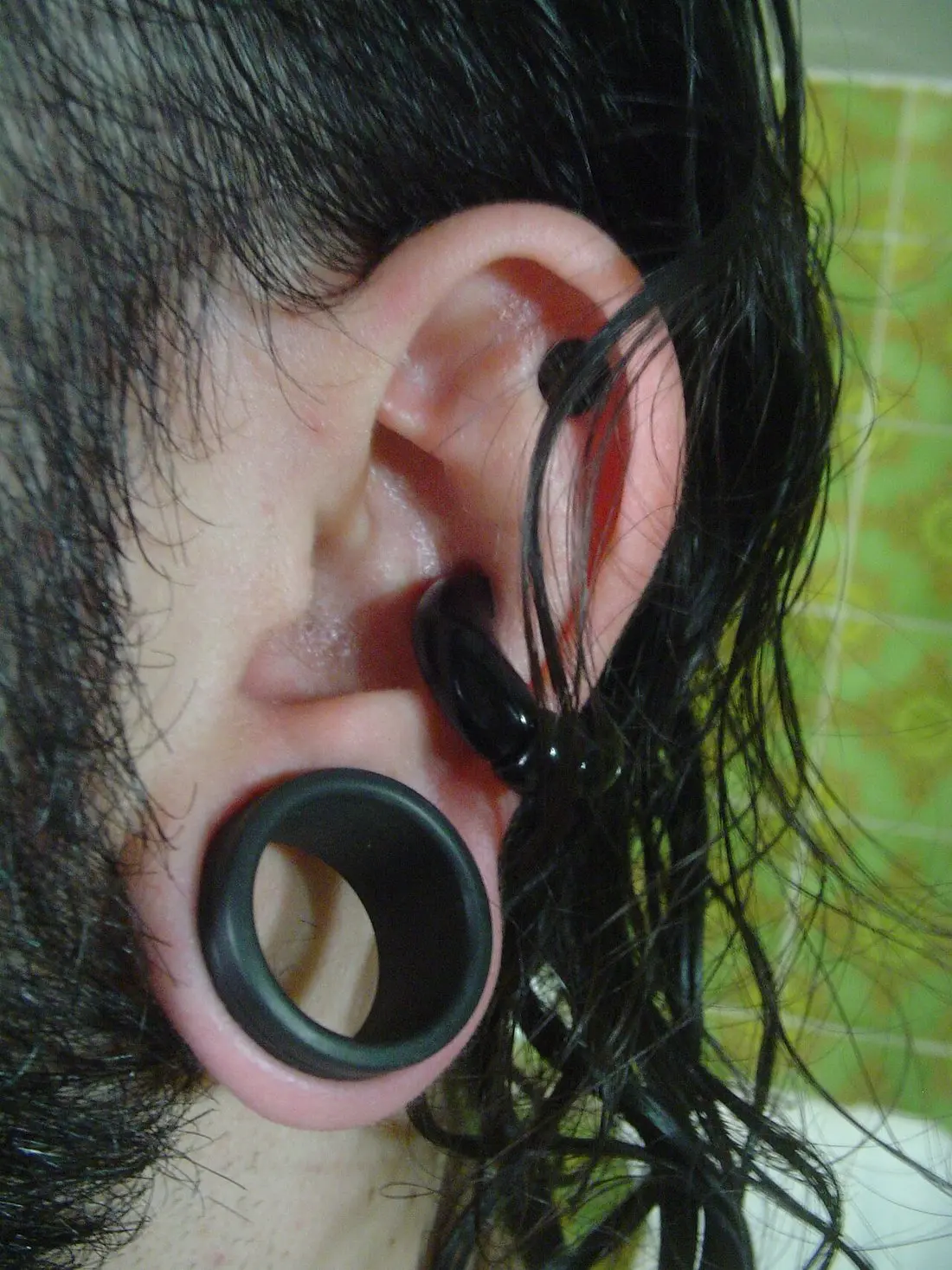
A blowout is stretched tissue turning inside out at the back of the lobe, usually where the piercing has been pushed faster or larger than the tissue could actually accommodate. The result is a permanent flared, doughnut-like lump of skin protruding around the jewelry, and it does not sit flat again on its own.
Caught very early, easing back a size or two and giving the area real rest sometimes lets a small one settle. An established blowout generally needs surgical correction to remove the excess tissue. Prevention, which means going slower than feels necessary, is the only reliable treatment.
Aftercare while stretching
Healed lobes at small stretched sizes do not need the twice-daily saline routine of a fresh piercing, but the tissue is still adjusting after every size change:
- Keep new sizes clean with a mild, fragrance-free soap in the shower for the first week after each stretch, the way you would for any piercing settling in.
- Avoid submerging in pools or hot tubs for a few days after a new size.
- A little unscented jojoba oil on the lobe helps some people keep the skin supple, especially at larger sizes. Anything with fragrance or heavy preservatives is worth avoiding.
- Do not change jewelry in the first few days at a new size, for the same reason you would not disturb a healing piercing.
Jewelry for stretched piercings
Glass, implant-grade titanium and surgical steel are the safest materials, particularly in the early stages, because they are non-porous, easy to keep clean, and will not irritate tissue that is still settling. See the materials guide for what the alloy standards actually mean.
Organic materials, wood, stone, horn, are popular for their look but are porous, cannot be sterilised the same way, and need daily oiling and drying to avoid harbouring bacteria or odour. They suit a lobe that has finished stretching and settled, not one still moving through sizes.
Whatever the material, weight matters. Large or heavy plugs worn daily, even at a stable size, gradually stretch a lobe further on their own over months and years. If you like a size and want to keep it, lighter jewelry day to day is what keeps it stable.
Will it shrink back?
This is the question almost everyone asks before starting, and the honest answer depends heavily on how far you go and how you got there.
Below roughly 000g (10 mm), lobes stretched gradually and without blowouts or tearing often shrink back substantially once the jewelry is removed for good, over a period of months to a couple of years. Some people are left with no visible trace; most are left with some looseness or a slightly larger natural hole than before.
Above that, and especially past half an inch, the skin has usually been stretched beyond what elastic recoil can close on its own. Most people at these sizes who want their lobes closed need surgical repair, which is a real procedure with its own cost and recovery, not a quick fix.
If you are stretching with the specific intention of shrinking back later, stay conservative, go slowly, and stop well below the point where you would need to ask this question again with a worse answer.
The short version
Only stretch a piercing that is genuinely healed. Move one size at a time. Wait longer than you think you need to. Use a proper lubricated taper, never tape, never force. Stop at the first sign of pain, bleeding or thinning. Every rule here exists because someone found out what happens when it is ignored.
Frequently asked questions
How do you stretch your ears safely?
Start from a fully healed piercing, move up no more than one size at a time, wait at least four to six weeks between sizes (longer as you get bigger), use a lubricated taper rather than forcing anything, and stop the moment you feel sharp pain, see bleeding or notice thinning skin. Going slower than the guides suggest is never the mistake; going faster usually is.
What is the 10% rule for stretching?
A guideline that each increase in size should be roughly 10% larger than the last, which is what moving one standard gauge at a time already gives you. Skipping sizes, for example going from 16g straight to 12g, increases the diameter by far more than 10% in one step and is where most injuries happen.
How long should I wait between stretches?
At least four to six weeks at smaller sizes, and progressively longer as the gauge increases, often two to three months or more once you are past 00g. The tissue needs to fully settle at each size before it is asked to stretch again. Pain, thinness or a lobe that has not felt normal for a full day means wait longer, not push through.
What is a blowout, and can it be fixed?
A blowout is when stretched tissue turns inside out at the back of the lobe, usually from stretching too fast or too far for the tissue's condition, leaving a permanent flared lump of skin behind the jewelry. Small ones sometimes settle if you drop back a size or two and let the area rest; established ones generally need surgical correction.
Will my stretched ears shrink back to normal?
It depends almost entirely on the final size and how long you held it. Below about 000g (10 mm), lobes stretched gradually and without damage often shrink back substantially, sometimes close to unnoticeable, over months to years once the jewelry is removed. Above that, especially past half an inch, most people are left with a permanent gap that needs surgery to close.
Can I stretch a fresh piercing?
No. The piercing has to be fully healed first, which for a lobe is six to ten weeks at the earliest and often longer. Stretching tissue that has not finished forming its own lining tears it rather than gradually expanding it, and the result is usually a piercing that has to heal all over again from a worse starting point.
Do I need special jewelry to stretch, or can I use tape?
Use a proper insertion taper, sized precisely and with a smooth, tapered lead. Wrapping tape around existing jewelry to build up the size gradually is popular online and is exactly the uneven, unmeasured pressure that produces blowouts and thin spots, because tape cannot taper smoothly the way a purpose-made tool does.
Sources
- Association of Professional Piercers - Stretchinghttps://safepiercing.org/stretching/
- Association of Professional Piercers - Suggested aftercare for body piercingshttps://safepiercing.org/aftercare/
- Association of Professional Piercers - Jewelry for initial piercingshttps://safepiercing.org/jewelry-for-initial-piercings/