On this page
A navel piercing does not go through the belly button. It passes through the lip of skin above it, entering just inside the rim of the navel and exiting on the surface a centimetre or so higher, with a curved barbell sitting behind that fold.
That is why anatomy decides whether you can have one, and why so many navel piercings fail on people who were never suitable candidates.
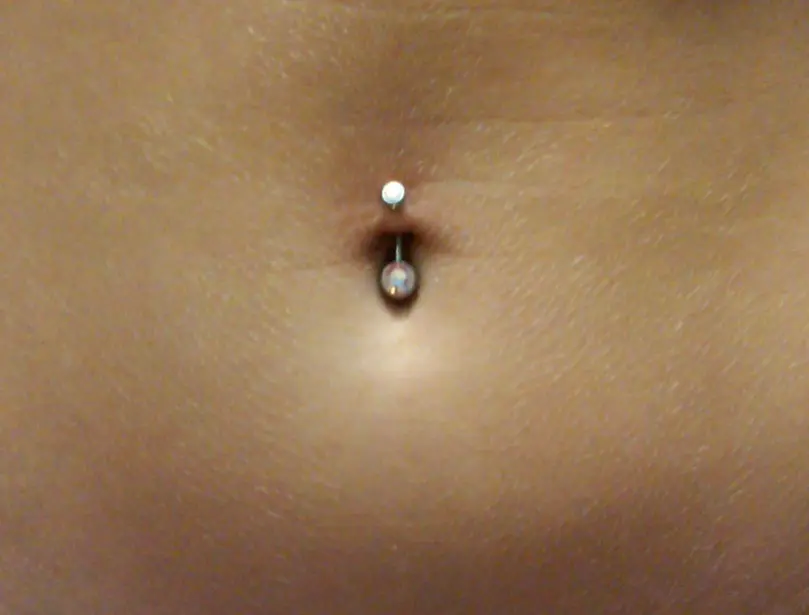
Photo by Jnagy3 via Wikimedia Commons, CC BY-SA 4.0.
The anatomy check
You need a defined shelf or overhang of skin at the top of the navel, with enough depth for the jewelry to sit behind without pressure.
A good piercer will look at you standing, sitting and bending forward, because a navel that has a good lip when you stand can flatten completely when you sit. If the fold disappears in any of those positions, the jewelry will be under constant tension and the piercing will migrate.
Some navels simply cannot take one:
- A flat navel with no overhanging lip.
- An “outie” navel, where the tissue protrudes.
- A navel where the fold only appears in one posture.
Alternative placements exist for some anatomies, including a bottom navel through the lower lip of the rim, or a floating navel for navels that fold when you sit, but they need assessment in person. A piercer who checks in three positions and says no is doing you a favour.
Pain
About 4 out of 10. A quick pinch through a fold of skin, over in a second or two. Most people find it easier than they expected.
What surprises people is the aftermath. Because the piercing sits on a hinge, every time you sit down, bend, laugh or stretch you move it. It stays tender for weeks in a way that a lobe does not.
Healing
Six to twelve months, usually the full year. This is one of the slowest common piercings and the reason is mechanical rather than biological: nothing about your day leaves it alone. How long a belly button piercing takes to heal goes through it month by month.
- Weeks 1-4: swelling, tenderness, clear discharge, sore when bending.
- Months 2-6: crusting, looks healed, still moving constantly under clothes.
- Months 6-12: the channel finally toughens.
Downsize at 8 to 12 weeks. The initial bar is long to allow for swelling, and a long bar in a navel catches on every waistband. Piercing downsizing explains it for every placement.
How long it can be left empty, which depends far more on how long you have had it than on where it is, is in how long a piercing takes to close.
Clothing is the whole game
More navel piercings are lost to jeans than to bacteria.
- High waistbands press directly on the piercing all day. Low-rise or loose clothing during healing genuinely matters.
- Tight gym leggings do the same, with added sweat.
- Belts and seatbelt buckles sit right on it.
- Sleeping face down presses the bar into the fold.
If you cannot change your wardrobe, a vented eye patch or a piercing shield taped over the area under clothing protects it during the first months. Ask your piercer.
Aftercare
Sterile saline twice a day, hands off, no rotating, and dry carefully afterwards since the navel holds moisture. The full guide covers products and showering.
Additional points here:
- No swimming until fully healed. Warm, damp and bacterial is the worst combination for a slow-healing wound.
- Exercise that involves core work moves the piercing continuously. Expect setbacks if you go straight back to it.
- Fake tan, body lotion and sunscreen should stay out of the channel.
Jewelry
Start with a curved barbell, 14 gauge, 10 to 12 mm, in ASTM F136 implant-grade titanium. The curve matches the fold, which keeps pressure off both openings. Belly button rings compares the sources on bar length, materials and styles.
Avoid dangly or heavy navel jewelry entirely while healing, and be cautious with it even afterwards. Weight hanging on the lower opening drags the channel downward over time and is a common cause of long-term migration. Threadless or internally threaded only. See the material guide.
A retainer keeps the channel open when you need to hide it, or to remove metal for a scan.
Rejection and migration
Navel piercings reject more often than most, precisely because they sit in a fold that moves. Belly button piercing rejection covers the signs in full. Watch for:
- The distance between the two ends shortening.
- Skin over the bar thinning, going shiny, or the bar becoming visible through it.
- Renewed tenderness after a settled period.
- The jewelry sitting at a new angle.
Any of these means see a piercer soon. If the tissue is thinning badly, removing the jewelry before it tears out leaves a much smaller scar than letting it migrate all the way.
Pregnancy
As the abdomen stretches, a healed navel piercing can become tight, sore, or start to migrate. Common approaches are switching to a flexible PTFE retainer, which flexes as the belly grows, or removing the jewelry and re-piercing later if the channel closes. Discuss it with your piercer and mention it to your midwife or doctor at an appointment.
Other problems
Irritation bumps are common. The APP advises avoiding friction and pressure from clothing and excessive motion, which a tight waistband or an overlong bar adds to. See piercing bump vs keloid before treating one.
Infection. The navel is warm, enclosed and easily contaminated. Spreading redness, heat, thick yellow or green discharge, increasing swelling after the first week, or fever needs a doctor the same day, with the jewelry left in.
Infected belly button piercing covers how to tell irritation from infection and when to see a doctor.
A lump that spreads beyond the piercing and keeps growing over months is a different problem: see the keloid guide.
Cost
$40 to $90 for the piercing in a US studio, plus $30 to $120 for a titanium curved barbell. Cheap navel jewelry from fashion retailers is the most common source of long-term irritation in this piercing; buy once, properly. Belly button piercing cost breaks down jewelry prices and the first-year total.
Frequently asked questions
Can everyone get a belly button piercing?
No. A navel piercing needs a defined lip or shelf of skin above the belly button for the jewelry to sit behind. If the area is flat or the navel is an outie, there is nothing to hold the barbell and it will migrate or reject. A piercer should check while you are standing and sitting.
How long does a belly button piercing take to heal?
Six to twelve months, and often the full year. It sits at a hinge point on your body, so clothing, sitting, bending and exercise all move it. It looks healed long before it is.
Does a belly button piercing hurt?
About 4 out of 10. It is a quick pinch through a fold of skin, easier than most people expect. The surprise is that it can be sore for weeks afterwards, because you move it every time you bend.
How do I know if my belly button piercing is rejecting?
The gap between the two ends gets shorter, the skin over the bar looks thin or shiny, you may be able to see the bar through it, and the piercing becomes tender again after settling. See a piercer promptly; removing it before it tears through leaves a smaller scar.
What happens to a navel piercing during pregnancy?
As the abdomen stretches, the piercing can become tight, irritated or start to migrate. Many people switch to a flexible PTFE retainer in the second trimester, and some remove the jewelry. Talk to your piercer and your midwife or doctor.
Can I swim with a new belly button piercing?
Not for the first several months. Pools, hot tubs, lakes and the sea all introduce bacteria to a slow-healing wound in a warm, damp spot. Wait until it is fully healed.
Sources
- Association of Professional Piercers - Suggested aftercare for body piercingshttps://safepiercing.org/aftercare/
- Association of Professional Piercers - Troubleshootinghttps://safepiercing.org/troubleshooting/
- Association of Professional Piercers - Jewelry for initial piercingshttps://safepiercing.org/jewelry-for-initial-piercings/
This article is for education only and is not medical advice. If a piercing is hot, swollen, spreading redness, oozing yellow or green discharge, or you have a fever, see a doctor today.