On this page
A tongue piercing passes vertically through the centre of the tongue, usually placed slightly forward of the midpoint where the tissue is thick enough for a barbell but clear of the larger blood vessels visible on the underside.
It heals faster than almost anything else on this site, and the swelling in the first days is more intense than most people expect.
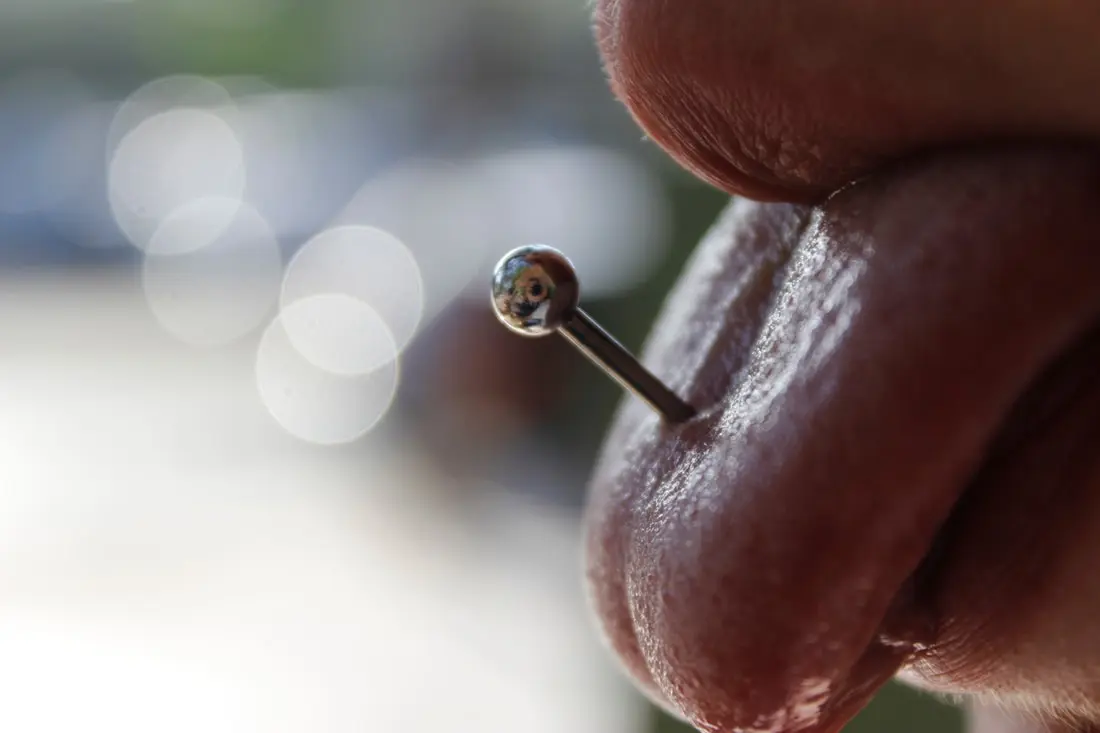
Photo by Jose Maria Bersabe via Wikimedia Commons, public domain.
Placement
Your piercer marks the centre of the tongue, has you stick it out and hold it steady, and checks the mark against the vein visible on the underside before piercing. A centred, slightly forward placement avoids the vessels and sits where a barbell causes the least interference with speech and eating once healed.
A horizontal piercing through the tip, sometimes called snake eyes, is a different and more contentious placement. See below.
Pain
About 5 out of 10. The tongue is muscle, and the sensation of the needle passing through is unusual rather than sharply painful, over in a second. What people remember afterward is not the piercing itself but the swelling that follows.
The first week: swelling is the main event
Swelling peaks around day two to four and can be dramatic, sometimes doubling the visible thickness of the tongue temporarily. This is normal, not a sign of infection, and it is exactly why the initial barbell is much longer than the final size.
To get through it comfortably:
- Eat soft, cool food: yoghurt, mashed food, smoothies, ice cream without hard mix-ins.
- Avoid spicy, acidic, very hot and very salty food, all of which irritate the swollen tissue.
- Sip cold water constantly and let ice chips melt in your mouth.
- Expect speech to be affected for a few days. This resolves as swelling drops.
- Do not swap the barbell early, no matter how large it feels. It is sized for the swelling on purpose.
Healing
Four to eight weeks, fast because the mouth has an outstanding blood supply. How long a tongue piercing takes to heal covers the swelling and what to eat.
- Days 1-5: significant swelling, tenderness, difficulty speaking clearly.
- Weeks 1-3: swelling resolves, some tenderness remains, a white coating on the tongue near the piercing is common and not a sign of infection.
- Weeks 4-8: settled.
Downsize as soon as the swelling has gone, usually within the first one to two weeks. This is not optional here: the APP says it is vital, to avoid damage to the teeth and gums. Piercing downsizing explains it for every placement.
How long it can be left empty, which depends far more on how long you have had it than on where it is, is in how long a piercing takes to close.
The dental risk, and how to reduce it
This is the part that matters over years rather than weeks, and it deserves more attention than most people give it before getting pierced.
Chipped or cracked teeth. A 2014 review (Plastargias and Sakellari) lists tongue jewellery, habitual biting or chewing of it, barbell stem length, the size of the ornament and the material among the causes of tooth trauma, which can reach the enamel, the dentin or even the pulp. A 2023 systematic review (Mosaddad and colleagues) reports that the longer tongue and lip piercings are kept in, the greater the likelihood and severity of dental problems.
Gum recession is reported on the lower front teeth. The 2014 review cites one study finding gum recession at one or more sites on the tongue side in 33% of people with a tongue piercing, and another reporting it after about two years of wear.
Reduce both by:
- Downsizing the moment swelling allows.
- Choosing a small ornament. The 2014 review lists its size as a factor.
- Not clicking, tapping or playing with the barbell against your teeth. The APP warns that playing with the jewelry can cause permanent damage to the teeth and gums, and the American Dental Association says repeated clicking against the teeth can cause damage.
- Telling your dentist about the piercing so they can monitor the area at check-ups.
Aftercare
Tongue piercings need rinsing rather than the saline-spray routine used elsewhere on the body.
- Rinse with alcohol-free mouthwash or saline after every meal, every drink other than water, and after smoking.
- Avoid alcohol-based mouthwash, which dries and irritates healing tissue.
- No kissing, sharing drinks or cutlery, or oral contact for the first couple of weeks.
- Brush your teeth normally, being gentle around the piercing.
Jewelry
Start with a straight barbell, 14 gauge, 16 to 18 mm long to allow for swelling, in ASTM F136 implant-grade titanium. Downsize to roughly 12 to 14 mm once swelling has gone. Tongue piercing jewelry sets out what the ADA, the APP and dental studies say about length, ends and materials.
Once healed, smaller and flatter ends reduce ongoing dental risk without giving up the look. See the material guide and the gauge and size chart for sizing.
A retainer keeps the channel open when you need to hide it, or to remove metal for a scan.
Snake eyes: why many piercers say no
A horizontal piercing through the tip of the tongue passes through both muscular halves rather than the centre, which can tether them together and restrict normal tongue movement. The jewelry also sits directly against the back of the front teeth in a position that is very hard to avoid contact with. Many experienced piercers decline this placement, and that is a professional judgement worth respecting rather than shopping around to override. The snake eyes guide covers it in full, including the usual alternative.
Problems
Prolonged or increasing swelling after the first week, rather than swelling that is settling down, needs medical attention. So does difficulty swallowing or breathing, which is rare but is an emergency if it happens.
A white coating on the tongue near the piercing in the first couple of weeks is normal tissue response, not infection, as long as it is not accompanied by a foul smell, fever or spreading redness.
Ongoing tooth sensitivity or visible chips should go to a dentist, not a piercer.
Cost
$30 to $70 for the piercing in a US studio, plus $20 to $60 for a titanium barbell, which is inexpensive relative to most piercings because the jewelry itself is simple.
Frequently asked questions
Does a tongue piercing hurt?
About 5 out of 10. The needle pass itself is quick, but the tongue is muscular and the sensation is unusual rather than sharply painful. Most of the discomfort people remember is the swelling in the days after, not the piercing itself.
How long does a tongue piercing take to heal?
Four to eight weeks, fast compared with almost any piercing outside the mouth, because the tongue has an excellent blood supply. The first three to five days involve significant swelling, which is the part people are least prepared for.
Will a tongue piercing affect my speech?
Temporarily, yes. Swelling in the first few days makes speech and eating awkward, and it settles as the swelling goes down over the first week or two.
Does a tongue piercing damage teeth?
It can. A 2014 review (Plastargias and Sakellari) says tongue jewellery, habitual biting or chewing of the device, the length of the barbell stem, the size of the ornament and the material can all cause trauma to the enamel, the dentin or even the pulp, and that gum recession is reported on the lower front teeth. The APP advises a shorter post once the swelling has gone, and says not to play with the jewelry.
Can I eat and drink normally with a fresh tongue piercing?
Not for the first few days. Stick to soft, cool food, avoid spicy, acidic, very hot or very salty things, and drink plenty of cold water. Normal eating resumes as the swelling drops, usually within a week.
What is a snake eyes piercing and why do some piercers refuse it?
A horizontal piercing through the tip of the tongue rather than a vertical one through the centre. Many experienced piercers decline it because it passes through both muscular halves of the tongue, can restrict movement, and sits directly against the teeth.
Sources
- Association of Professional Piercers - Oral aftercarehttps://safepiercing.org/oral-aftercare/
- Association of Professional Piercers - Oral piercing risks and safety measureshttps://safepiercing.org/oral-piercing-risks-safety-measures/
- Association of Professional Piercers - Suggested aftercare for body piercingshttps://safepiercing.org/aftercare/
- American Dental Association (MouthHealthy) - Oral piercingshttps://www.mouthhealthy.org/all-topics-a-z/oral-piercings
- Plastargias and Sakellari (2014) - The consequences of tongue piercing on oral and periodontal tissues. ISRN Dentistryhttps://pmc.ncbi.nlm.nih.gov/articles/PMC3926233/
- Mosaddad et al. (2023) - Oral complications associated with the piercing of oral and perioral tissues, and the awareness of the public and professionals: a systematic review. Diagnosticshttps://pmc.ncbi.nlm.nih.gov/articles/PMC10647284/
This article is for education only and is not medical advice. If a piercing is hot, swollen, spreading redness, oozing yellow or green discharge, or you have a fever, see a doctor today.