On this page
Nose jewelry is sized by three numbers, and a ring or stud that is wrong on any one of them will not sit properly. The frustrating part is that most online sellers give you none of them, or give you a letter instead.
This page covers the three measurements, the standard sizes for a nostril and a septum, and how to find out what you actually have. For which style to choose rather than which size, see nose piercing jewelry and septum piercing jewelry.
The three measurements
Gauge is the thickness of the wire or post. It runs backwards: 20g is thinner than 18g, which is thinner than 16g. The gauge chart has the full conversion.
Length, for a stud, is the wearable post from the flat back to the tip. Too short and the disc presses into the nostril; too long and the stud slides and catches.
Inner diameter, for a hoop, is the distance across the inside of the ring. This is the one people get wrong most often.
Standard sizes
| Gauge | Stud post (healed) | Stud post (fresh) | Hoop inner diameter | |
|---|---|---|---|---|
| Nostril | 18g (1.0 mm), sometimes 20g or 16g | 5–7 mm | 7–8 mm | 6–10 mm, usually 8 |
| High nostril | 18g or 16g | 6–8 mm | 8–9 mm | Not worn |
| Septum | 16g (1.2 mm) or 14g (1.6 mm) | — | — | 8–10 mm |
| Bridge | 16g or 14g | Sized to the pinch | Sized to the pinch | Not worn |
Two things decide where you fall inside those ranges: the studio’s choice of gauge when you were pierced, and your own anatomy. Neither is guessable from a photograph, which is why measuring beats ordering.
For every other placement on the body, not just the nose, the jewelry size finder tool looks up the same kind of figures for lobes, cartilage and lip piercings.
Finding your gauge
Ask the studio that pierced you. They will have it on record, and it is the one number that is genuinely hard to measure at home. If you cannot ask, any studio will check it in seconds with a gauge card.
Do not try to force a thicker post into a piercing made at a thinner gauge. A healed 20g nostril will take an 18g post with a little patience and a piercer’s help; it will not take a 16g without being stretched.
Finding your stud length
Once the piercing is healed, take the stud out and measure the post from the back of the disc to the tip with a ruler marked in millimetres. That is your wearable length.
If your current stud was fitted at the piercing and never changed, it is probably the longer initial size. Fresh nostrils are fitted at 7 to 8 mm to allow for swelling, and the downsize to 5 to 7 mm at six to eight weeks is what stops the stud sliding and catching. The jewelry change guide covers when that swap is safe.
Finding your hoop size
Measure the distance from the centre of the piercing hole to the edge of your nostril, and add about 1 mm. That is the inner diameter that will sit snug without pinching the tissue.
For most people that comes out at 7 to 9 mm. An 8 mm hoop is the most common fit, which is why it is the most common size sold, and why it is still wrong for a good proportion of noses.
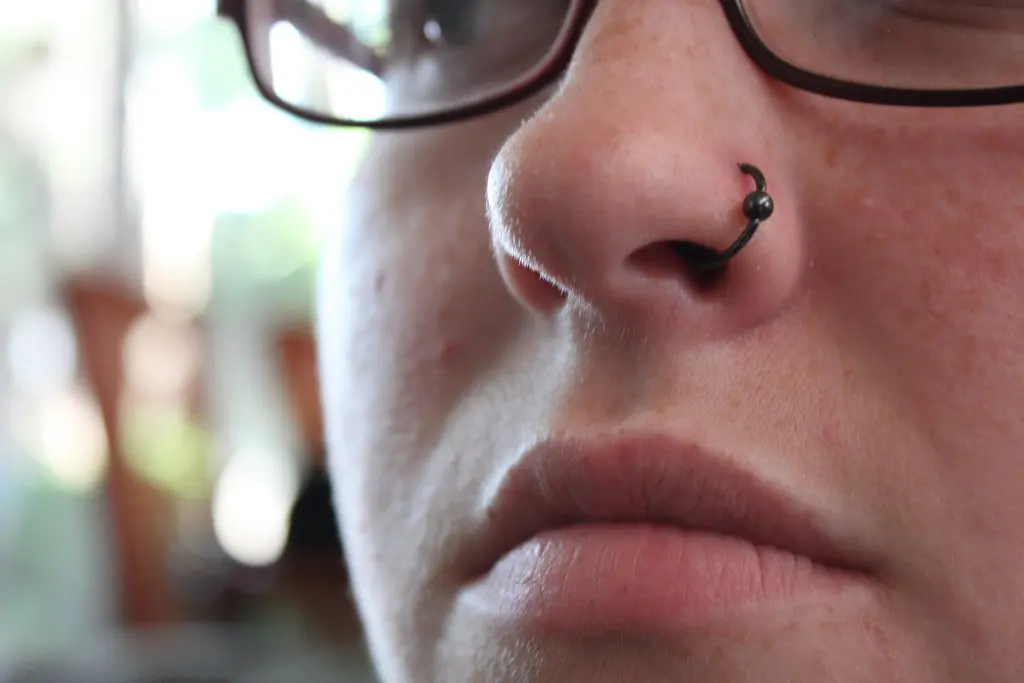
A hoop that sticks out is too big: it rotates and stands away from the nose. A hoop that pinches, leaves a mark, or will not close comfortably is too small. A millimetre either way is the difference.
Hoops are for healed nostrils only, four to six months in. Before that, a ring drags through the channel with every expression, and it is one of the most reliable ways to produce a nose piercing bump.
Septum sizing
Septum jewelry is sized by gauge and inner diameter. Most septums are pierced at 16g, some at 14g, and the usual ring or retainer diameter is 8 to 10 mm. What decides it is the distance from the piercing to the bottom edge of the septum, which a piercer measures at the appointment.
Circular barbells (horseshoes) and clickers are sized the same way. A retainer that flips up inside the nose needs to be sized precisely; too large and it shows below the nose even when flipped.
The letters problem
Jewelry sold as small, medium and large has no fixed meaning. One seller’s medium is 8 mm; another’s is 9. Without gauge and diameter in millimetres, you are guessing, and a nose piercing is a bad place to guess.
A seller who cannot give you gauge, length and diameter in millimetres is not selling body jewelry. The same goes for material: the standard you want is implant-grade titanium or solid gold, stated by alloy, and the materials guide explains why.
What a good fit looks like
A stud sits flat with the disc flush inside the nostril and the end resting on the skin, with no visible gap and no pressure mark. A hoop follows the curve of the nostril closely, moves only when you touch it, and does not stand proud. If either description does not match what you see in the mirror, one of the three numbers is wrong.
The rest of the jewelry guides cover materials, threading, sizing and retainers.
Frequently asked questions
What gauge is a nose piercing?
Most nostril piercings are 18 gauge, which is 1.0 mm. Some studios pierce at 20 gauge (0.8 mm) and a few at 16 (1.2 mm). Septum piercings are usually 16 or 14 gauge. Check with the studio that pierced you rather than guessing, because a post that is too thin moves and one that is too thick will not go in.
What length nose stud do I need?
A healed nostril usually takes a 5 to 7 mm post. A fresh one is fitted longer, typically 7 to 8 mm, to allow for swelling, and is downsized once the swelling goes. Measure the wearable post of your current jewelry from the flat back to the tip.
What size hoop for a nose piercing?
Hoops are sized by inner diameter, and the usual range for a nostril is 6 to 10 mm, with 8 mm the most common. The right size is the distance from your piercing hole to the edge of the nostril plus about 1 mm, so the ring sits snug without pinching. Septum hoops usually run 8 to 10 mm.
How do I measure my nose ring size?
Take the jewelry out once the piercing is healed and use a ruler marked in millimetres. For a stud, measure the post from the disc to the end. For a hoop, measure the inside of the ring across its widest point. Gauge needs a gauge card or a piercer; it is hard to judge by eye.
Why does my nose hoop stick out?
Because the diameter is too large for the distance from your hole to the edge of your nostril. A hoop that is a millimetre or two too big rotates and stands away from the nose. Go down a size, or ask a piercer to measure the distance and fit accordingly.
Can I wear a hoop in a new nose piercing?
Not until it has healed, four to six months in. A ring moves with every expression and drags through the channel, and the APP advises leaving the initial jewelry in place for the entire healing process unless there is a problem with it, apart from a downsize. Start with a flat-back stud and switch once the piercing is genuinely healed.
Sources
- Association of Professional Piercers - Jewelry for initial piercingshttps://safepiercing.org/jewelry-for-initial-piercings/
- Association of Professional Piercers - Suggested aftercare for body piercingshttps://safepiercing.org/aftercare/