On this page
The jewelry sits in a healing piercing for months, so the material and the finish matter. The APP says metal body jewelry should be polished to a smooth, mirror finish, and sets minimum material standards for new piercings.
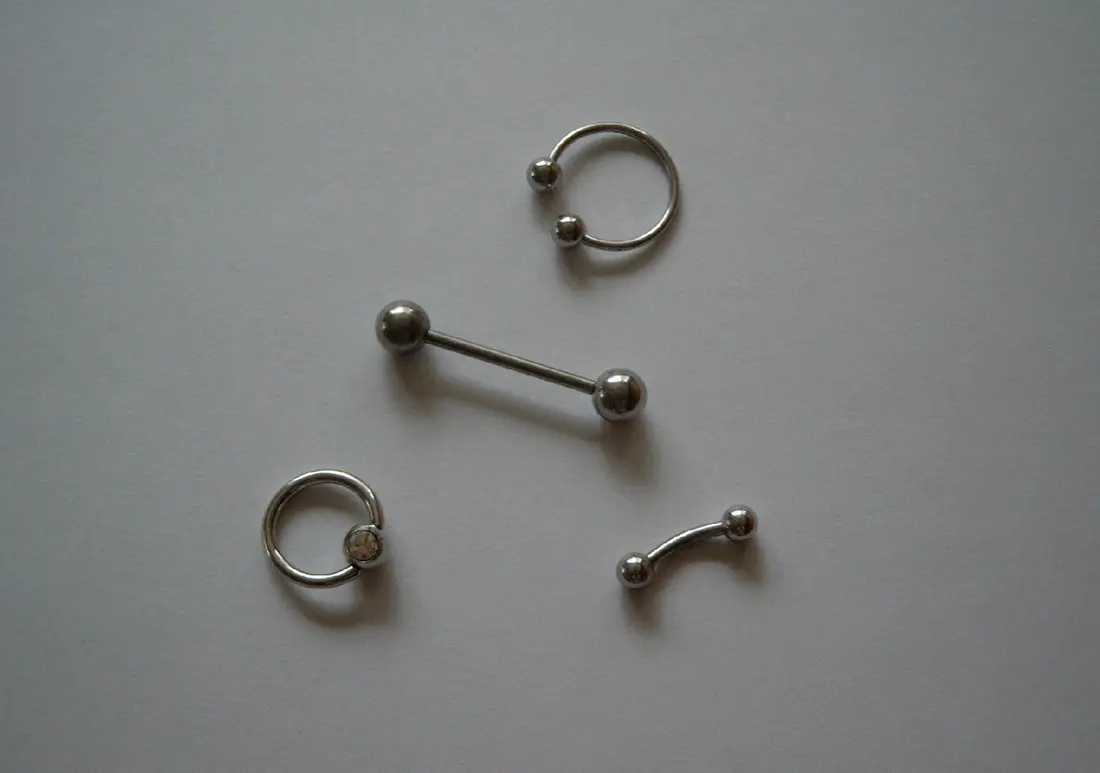
Photo by Metalhead64 via Wikimedia Commons, public domain.
The short version
| Material | Initial piercing | Healed piercing | Notes |
|---|---|---|---|
| Titanium, ASTM F136 or F67 | Yes | Yes | The default. Nickel free, light, anodisable |
| Niobium, ASTM B392 | Yes | Yes | Nickel free, heavier, anodisable |
| Solid gold, 14k+, nickel free | Yes | Yes | Must be solid, not plated |
| Implant steel, ASTM F138 | Sometimes | Yes | Contains nickel, avoid if sensitive |
| Glass, borosilicate or fused quartz | Sometimes | Yes | Inert, mostly for stretched lobes |
| “Surgical steel”, unspecified | No | Risky | Meaningless label |
| Gold plated, filled, vermeil | No | No | Plating wears through to base metal |
| Sterling silver | No | Lobes only | Tarnishes, can stain tissue permanently |
| Acrylic and plastic | No | Limited | Porous, cannot be autoclaved, degrades |
Titanium is the default
ASTM F136 is the specification for Ti-6Al-4V ELI, a titanium alloy developed for surgical implants. ASTM F67 covers commercially pure titanium. Either is appropriate for an initial piercing.
Why piercers reach for it first:
- No nickel. Nickel is the most common contact allergen in the world, and a piercing is the ideal way to sensitise yourself to it.
- Light. Weight matters on a long industrial bar or a navel curve.
- Anodisable. Colours are produced by growing an oxide layer electrically, not by plating with another metal, so nothing wears off into the wound.
- Well tolerated by almost everyone.
When a studio quotes you a price for titanium jewelry that seems high compared with what you can find online, the difference is usually certification. Certified stock costs more than uncertified metal sold under the same name.
Solid gold, and the plating trap
Solid 14k gold or higher, alloyed without nickel, is an excellent initial material. It is inert, it looks like nothing else, and good manufacturers publish their alloy composition.
Three things sold as gold that are not appropriate for a healing piercing:
- Gold plated: a microscopically thin layer of gold over a base metal. It wears through, usually within months, exposing whatever is underneath.
- Gold filled: a thicker bonded layer, still a layer, still over base metal.
- Vermeil: gold over sterling silver. Two problems in one piece.
The wear happens inside the channel where you cannot see it. By the time you notice discoloration, base metal has been in contact with healing tissue for weeks.
Below 14k the alloy content rises and so does the chance of a reaction. Above 18k gold becomes soft enough to deform in wear.
Steel: the label problem
“Surgical steel” and “surgical stainless steel” are marketing phrases with no regulatory meaning. Anyone can print them on anything.
The real specification is implant-grade stainless steel, ASTM F138 or ISO 5832-1. That is a recognised material used in medical implants and it is acceptable for many people.
The caveat is that it contains nickel. Implant-grade steel is formulated so that nickel release is very low, and most people tolerate it. But if you already know you react to nickel, or you want to avoid the risk of becoming sensitised, titanium removes the question entirely.
For an initial piercing, most piercers now default to titanium for exactly that reason.
Niobium
Niobium, ASTM B392, is inert, nickel free, and can be anodised to colours the same way titanium can. It is noticeably heavier than titanium, which is why it is less common in large pieces, but it is an excellent material and a good option for anyone who dislikes how titanium looks.
Glass
Borosilicate and fused quartz glass are inert, non-porous and autoclavable. They are mainly used for stretched lobes and for retainers, and some piercers use glass for initial piercings in specific cases. Good quality glass is genuinely body safe; cheap decorative glass is not.
What to avoid in a healing piercing
- Anything plated. Gold, rose gold, black, rainbow. If the colour is a coating rather than an anodised oxide layer, it wears off.
- Sterling silver. It tarnishes on contact with body fluids, and in an open wound that tarnish can deposit permanently in the tissue as a grey or black stain.
- Unspecified “surgical steel” and mystery metals with no standard given.
- Acrylic and plastic. Porous, cannot be autoclaved, and they degrade and can crack.
- Bioplast and PTFE have their uses, particularly as flexible retainers during pregnancy, but they are a specific tool rather than a general initial material.
Threading matters as much as metal
The material is only half of it. How the jewelry is assembled determines what passes through your channel.
- Threadless (press-fit): a pin bends slightly and holds by tension inside a hollow post. Nothing sharp passes through the tissue. Excellent for healing.
- Internally threaded: the screw thread is inside the post, so the surface passing through you is smooth.
- Externally threaded: the thread is on the outside of the post. Every insertion drags a sharp spiral through the channel. This is the cheap standard in mall shops and it should never go into a healing piercing.
More detail in threadless vs threaded jewelry.
Nickel allergy
Nickel is the most common contact allergen there is, and body piercing is one of the classic routes to becoming sensitised: prolonged contact between nickel-containing metal and broken skin.
Signs of a reaction rather than an infection: itching more than pain, a red rash that follows the shape of the jewelry contact, weeping, and symptoms that begin days after a jewelry change rather than after the piercing itself.
Once you are sensitised it is permanent. That is the practical argument for using titanium from the start, particularly for children.
The nickel allergy guide covers the signs, the safe metals, and what to do if you are already reacting.
How to buy with confidence
- Ask for the standard, not the adjective. “ASTM F136 titanium”, not “titanium-look” or “surgical grade”.
- Buy from studios or retailers who can produce mill certificates, the documents from the metal supplier certifying the composition of a batch. The Association of Professional Piercers publishes criteria for these and runs a verification programme for suppliers.
- Be suspicious of price. Certified implant-grade jewelry has a floor price. Multi-packs for a few dollars are not made of what they claim.
- Buy the size, not just the piece. The right material in the wrong length still causes bumps. See the gauge and size chart.
After healing
Once a piercing is fully healed you have more freedom, and material matters less than it did. Even then, anything you wear all day and sleep in is worth buying properly: healed piercings still react to nickel, plating still wears, and silver still tarnishes.
Frequently asked questions
What is the best material for a new piercing?
Implant-grade titanium, specified as ASTM F136 or ASTM F67. It contains no nickel, it is light, it can be anodised to colours without plating, and it is what most professional piercers use for initial jewelry.
What does ASTM F136 mean?
It is the standard covering the titanium alloy Ti-6Al-4V ELI used for surgical implants. Jewelry described as ASTM F136 is made from material certified to that specification, which is why piercers ask suppliers for mill certificates.
Is surgical steel safe for piercings?
The phrase surgical steel is unregulated and means nothing on its own. Implant-grade steel certified to ASTM F138 or ISO 5832-1 is a recognised material, but it contains nickel. Jewelry simply labelled surgical steel with no standard given should be avoided for a new piercing.
Can I wear gold in a new piercing?
Solid gold of 14k or higher, alloyed without nickel, is suitable for initial piercings. Gold plated, gold filled and vermeil are not, because the surface layer wears through to a base metal you did not choose.
Why is sterling silver bad for piercings?
Silver tarnishes when it contacts body fluids, and in a healing piercing that tarnish can deposit in the tissue and leave a permanent grey or black mark. Silver belongs in healed earlobes at most, not in fresh piercings.
How do I know if jewelry is really implant grade?
Buy from a studio or retailer that names the standard and can produce mill certificates from the manufacturer. The Association of Professional Piercers runs a verification programme for exactly this reason. Price is a signal too: implant-grade titanium is not what sells for three dollars.
Sources
- Association of Professional Piercers - Jewelry for initial piercingshttps://safepiercing.org/jewelry-for-initial-piercings/
- Association of Professional Piercers - Body Jewelry Verification Programhttps://safepiercing.org/body-jewelry-verification-program-2/
- Association of Professional Piercers - Mill certificate criteriahttps://safepiercing.org/mill-certificate-criteria/
- American Academy of Dermatology - Caring for pierced earshttps://www.aad.org/public/everyday-care/skin-care-basics/tattoos/caring-for-pierced-ears
This article is for education only and is not medical advice. If a piercing is hot, swollen, spreading redness, oozing yellow or green discharge, or you have a fever, see a doctor today.