On this page
Searches for cartilage earrings mix two different questions: what goes into a new piercing, and what you can wear once it has healed. The sources we read treat them differently.
This page follows the Association of Professional Piercers (APP), Healthline and the Cleveland Clinic. Where they say little about a placement, it says so. Details are as read in September 2026.
New piercing and healed piercing
| Stage | What the sources say |
|---|---|
| New piercing | Healthline says barbells, hoops and studs are the most common initial types for a tragus, and lists studs, barbells and rings as options for parts of the ear other than the lobe. For a rook it says the piercer will typically recommend a barbell. The APP says rings are best for some areas and bars for others. |
| Healed piercing | The APP’s healed-piercing page groups jewelry by how it fastens and says to replace anything that causes irritation. |
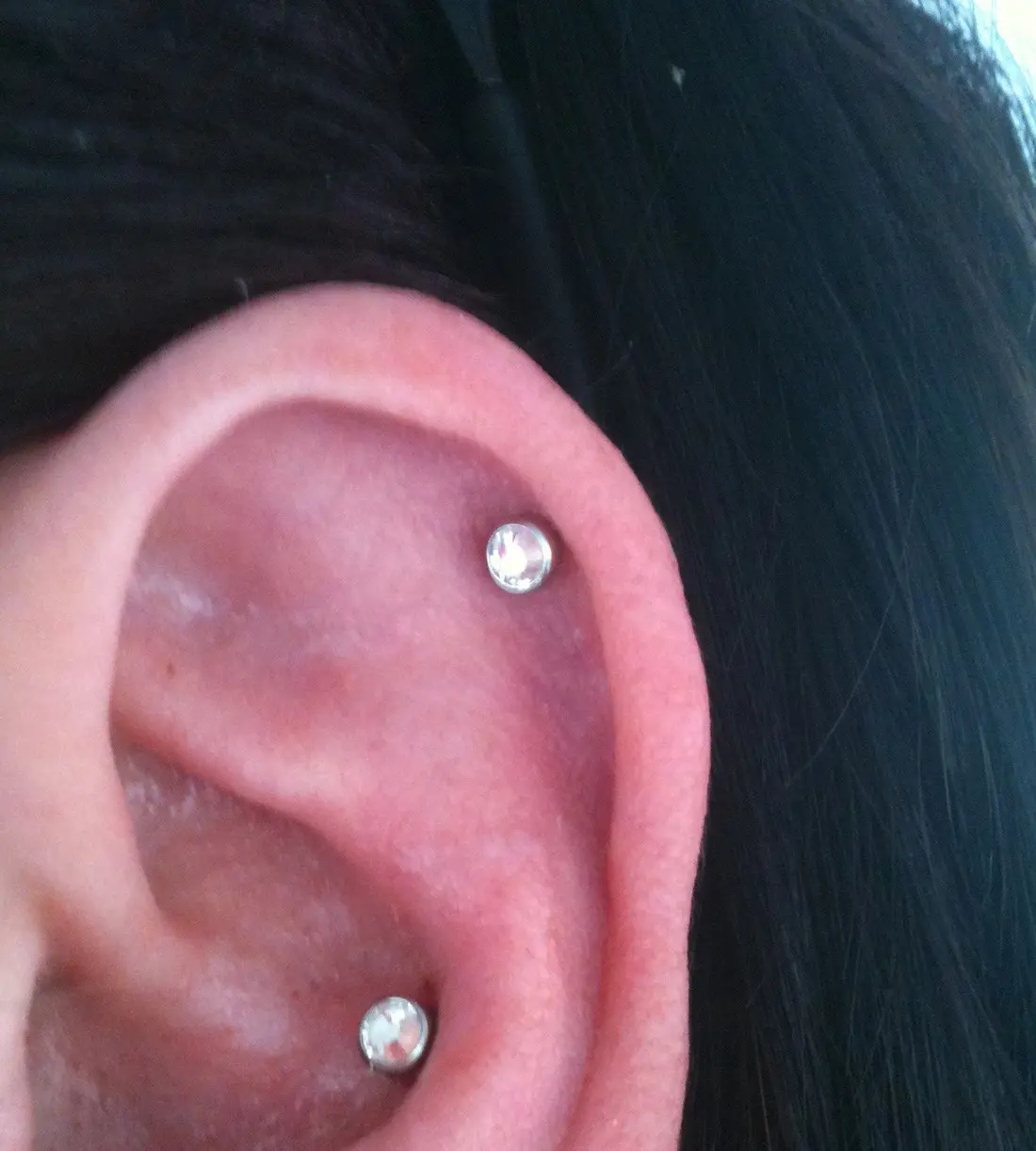
Photo by Fiona Henderson via Wikimedia Commons, CC BY 2.0.
Healthline’s tragus article says barbells are easy to get in and out of the piercing, studs might offer some protection against scarring, and rings work best if you want something simple and discreet. Those are Healthline’s descriptions.
What our piercing pages list to start
These are the typical starting figures on our own placement pages, not measurements from the sources.
| Piercing | Starting jewelry | Gauge | Downsize window |
|---|---|---|---|
| Helix | Titanium flat-back labret, 6 to 8 mm post | 16g | 6 to 10 weeks |
| Forward helix | Titanium flat-back labret, 6 to 8 mm post | 16g | 6 to 10 weeks |
| Flat | Titanium flat-back labret, 6 to 8 mm post | 16g | 6 to 10 weeks |
| Tragus | Titanium flat-back labret, 6 to 8 mm post | 16g | 4 to 8 weeks |
| Daith | Titanium curved barbell or 8 mm clicker | 16g | 6 to 10 weeks |
| Rook | Titanium curved barbell, 8 to 10 mm | 16g | 6 to 10 weeks |
| Conch | Titanium flat-back labret, 8 to 10 mm post | 16g or 14g | 6 to 10 weeks |
| Snug | Titanium curved barbell, sized to the ridge | 16g | 8 to 12 weeks |
| Orbital | Titanium ring sized to the placement, or two studs healed first then joined | 16g | 8 to 12 weeks |
| Industrial | Titanium straight barbell, 32 to 38 mm | 14g | 8 to 12 weeks |
The downsize is a swap to a shorter post of the same style, done by a piercer. See piercing downsizing and flat back earrings, and for one placement in detail, conch piercing jewelry.
Can I wear a hoop?
No source we read gives a rule for hoops in a new cartilage piercing. Healthline lists rings among the options for the ear, and its daith page does not say which style goes in first. Our own daith and orbital pages list a ring or clicker as one starting option.
What the sources do say is about timing. The APP says to leave the initial jewelry in place for the entire healing process unless there is a problem with its size, style or material, and that many piercings need a downsize before they are healed. The Cleveland Clinic says not to change your earrings until the piercing is fully healed. Healthline’s tragus article says it is best to leave the initial jewelry in until the piercing is fully healed, but that you may change it earlier if it is no longer tender and any weeping, discharge and crusting has stopped. Our cartilage change guide goes through the timing.
When it counts as healed
The APP says a piercing is healed when it is not tender, the minimum initial healing time has passed, and it is no longer secreting and getting crusty. Cartilage is slow, and the healing time guide gives the ranges. Once it is healed, the APP groups jewelry by how it fastens:
- Tension rings, which need bending or removal of a dimpled ball.
- Threaded pieces, which are unscrewed.
- Press-fit pieces, which press together and pull apart.
- Free-standing pieces, held in by gravity, other jewelry or an O-ring.
- Pieces held in by their shape.
The APP also says healed piercings can take materials such as horn, bone, wood, amber, stone, plastic including silicone, and glass, but that these are fragile compared with metal and may not be safe for sports or sleep. Our ring styles guide covers how rings open.
Materials
| Source | What it lists |
|---|---|
| APP, for initial piercings | Steel meeting ASTM F-138 or ISO 5832-1, implant-certified titanium (ASTM F-136) or commercially pure titanium (ASTM F-67), niobium, gold of 14k or higher that is nickel- and cadmium-free, platinum, and certain glass |
| Healthline, ears | Implant-grade titanium, surgical steel, 14K or higher solid gold that is not plated, niobium and platinum |
| Healthline, tragus | Surgical stainless steel, titanium, solid 14-karat or higher gold and niobium |
| Healthline, daith | Gold, titanium, niobium and stainless steel, and it says allergic reactions are most common with nickel |
Healthline says titanium and niobium contain no nickel, so they are the best options if you have a nickel allergy. The lists agree on titanium, gold, niobium and steel. As with other jewelry, the APP is the one that names standards for steel, so ask what standard it meets. See the materials guide and nickel allergy and piercings.
Gauge and size
None of the pages we read gives a gauge for cartilage. The APP says jewelry must be an appropriate gauge and that the body may treat jewelry that is too thin like a splinter, resulting in migration or rejection. It also says jewelry must be of appropriate length or diameter for your unique anatomy and the placement, and that jewelry that is too tight does not allow for air and blood circulation. Healthline says of a rook that the starter jewelry will be thicker than what you are used to in your earlobes, to hold the site open while it heals. The gauge and size chart explains the numbers.
What to check when you buy
- Gem settings. The APP says stones should be set securely, often in a prong or bezel, and that some makers use adhesive. If a glued stone falls out, which the APP says is common with lower-priced goods, the whole piece has to be replaced.
- Threading. The APP says internally threaded or threadless jewelry has a smooth post through the skin, while externally threaded jewelry has a rough screw pattern that may be passed through the tissue. See threadless vs threaded.
- Irritation. The APP says to quickly replace any jewelry that causes irritation, itching, swelling or redness, however much you like it.
How to choose a piercer covers who fits the first piece.
Frequently asked questions
What earrings can I wear in a new cartilage piercing?
Healthline says barbells, hoops and studs are the most common types used for initial piercings, in its tragus article, and lists studs, barbells and rings as options for parts of the ear other than the lobe. For a rook it says the piercer will typically recommend a barbell. The APP says rings are best for some areas and bars for others, so your piercer chooses.
Can I wear a hoop in a new cartilage piercing?
No source we read gives a rule either way. Healthline lists rings among the options for the ear, and the APP says to leave the initial jewelry in for the whole healing process unless there is a problem with its size, style or material. Ask your piercer before swapping to a hoop.
When can I change my cartilage earring?
Cleveland Clinic says not to change your earrings until the piercing is fully healed, and the APP says to leave the initial jewelry in unless there is a problem, with any downsize done by a piercer. Healthline's tragus article says you may change it earlier if the piercing is no longer tender and any weeping, discharge and crusting has stopped.
What metal should cartilage earrings be?
Titanium, gold, niobium and steel appear on the lists we read, and Healthline's ear article adds platinum. The APP names standards for each. Healthline says gold should be solid and 14K or higher, not plated, and that titanium and niobium contain no nickel, which makes them the best options with a nickel allergy.
What gauge are cartilage earrings?
The sources we read give no gauge for cartilage. Our piercing pages list 16 gauge for most ear cartilage placements, 14 for the industrial and 16 or 14 for a conch. The APP says jewelry that is too thin may be treated like a splinter by the body, resulting in migration or rejection, so let a piercer size it.
How do I know a cartilage piercing is healed?
The APP says a piercing is healed when it is not tender, the minimum initial healing time has passed and it is no longer secreting and getting crusty. Our healing guides give the time ranges by placement, which run from months to a year.
Sources
- Association of Professional Piercers - Jewelry for initial piercingshttps://safepiercing.org/jewelry-for-initial-piercings/
- Association of Professional Piercers - Jewelry for healed piercingshttps://safepiercing.org/jewelry-for-healed-piercings/
- Association of Professional Piercers - Suggested aftercare for body piercingshttps://safepiercing.org/aftercare/
- Healthline - Tragus piercing: 12 FAQs about benefits, cost, morehttps://www.healthline.com/health/body-modification/tragus-piercing
- Healthline - Getting ears pierced: placement, pain, process and morehttps://www.healthline.com/health/body-modification/getting-ears-pierced
- Healthline - Rook piercing pain levels, coping and piercing aftercarehttps://www.healthline.com/health/how-much-does-it-hurt-to-get-the-rook-of-your-ear-pierced
- Healthline - Daith piercing pain: what to expect, healing time and morehttps://www.healthline.com/health/body-modification/daith-piercing-pain
- Cleveland Clinic - Ear piercing 101: healing, hurting, cleaning and morehttps://health.clevelandclinic.org/what-to-expect-when-getting-your-ears-pierced
This article is for education only and is not medical advice. If a piercing is hot, swollen, spreading redness, oozing yellow or green discharge, or you have a fever, see a doctor today.