On this page
What to buy, at a glance
| Best for | What to look for | Link |
|---|---|---|
| Healed: classic | 16g titanium daith clickerA hinged segment that snaps shut, and our daith page lists an 8 mm clicker.
| Check price |
| Healed: bead ring | 16g titanium captive bead ringA ring held closed by a bead under tension.
| Check price |
| Barbell | 16g titanium curved barbellThe other option our daith page lists.
| Check price |
Each button opens an Amazon search, not one product we have tested. Check that the listing states the gauge, size and material, such as ASTM F136 titanium. Amazon shows the current price. As an Amazon Associate, Best Piercing earns from qualifying purchases.
The daith is the fold of cartilage just above the ear canal, where the inner and outer ear cartilage meet. Most photographs show it with a ring, but the sources we read do not say what a daith has to start with.
This page follows Healthline, the Cleveland Clinic, the American Migraine Foundation and the Association of Professional Piercers (APP). Where we give sizes they come from our own daith page and are labelled as ours. Details are as read in October 2026.
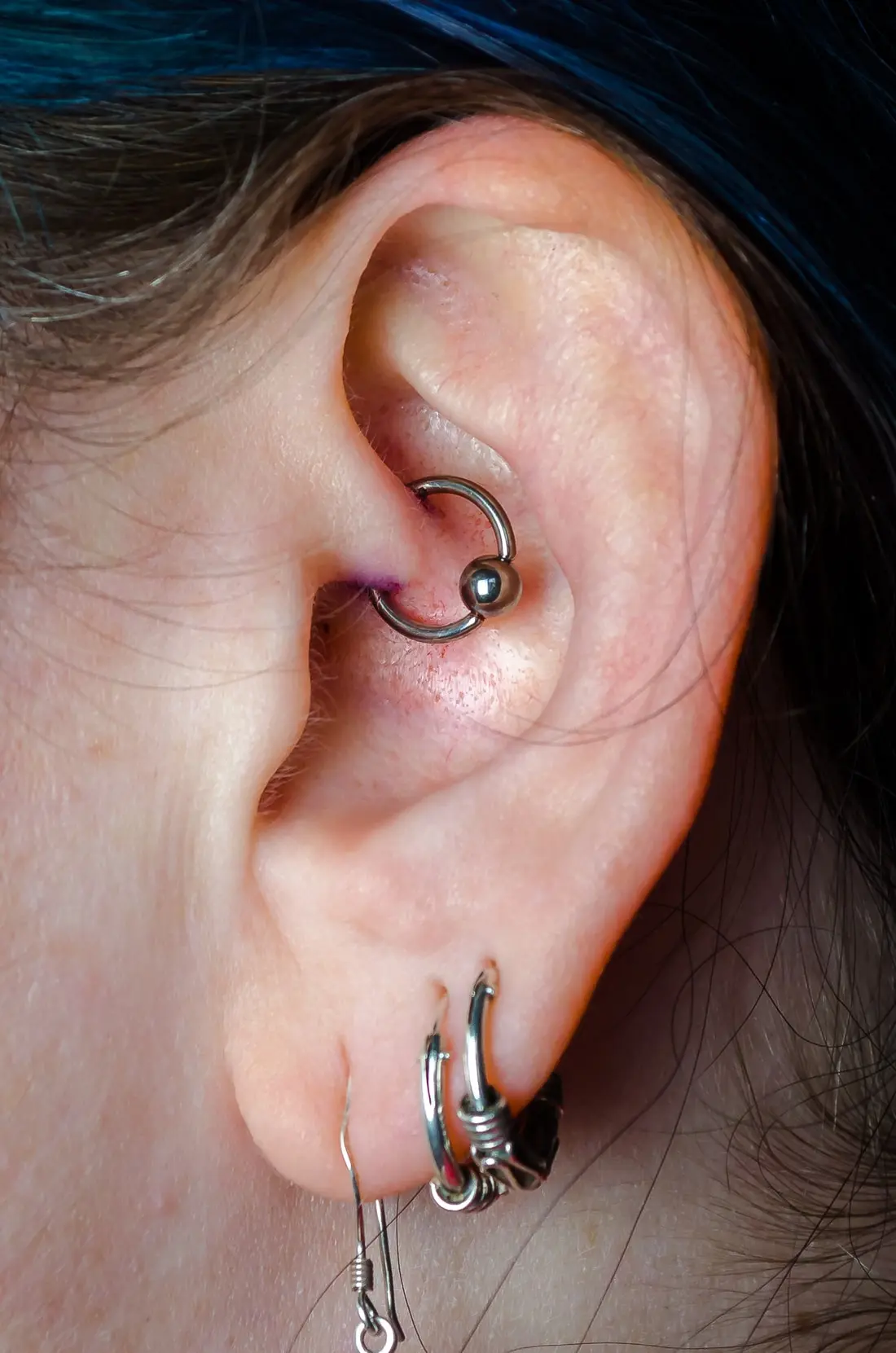
Photo by Carnivoredaddy via Wikimedia Commons, CC BY-SA 4.0.
What goes in first
None of the medical pages we read names a starter piece for the daith. The APP says rings are best for some areas and straight or curved bars for others, that jewelry must be of an appropriate length or diameter for your anatomy, and that ill-fitting jewelry increases the likelihood of swelling and embedding.
Our daith page suggests a 16 gauge implant-grade titanium curved barbell or an 8 mm clicker. That is our view, and the right diameter depends on how deep your fold is, which is why a piercer measures it. The APP warns that jewelry too thin in gauge can be treated like a splinter, resulting in migration or rejection. The gauge and size chart converts gauges to millimetres.
Ring styles
A daith ring has to pass round a tight curve and close inside the ear, so the closure matters. The usual choices are:
- Clicker. A hinged segment that snaps shut.
- Captive bead ring. A ring held closed by a bead under tension.
- Seamless ring. A ring with no bead or hinge.
Our ring styles guide explains each one. The APP asks for internally threaded or threadless jewelry for initial piercings, which applies to barbells, and our threaded vs threadless guide covers the difference.
On Amazon16g titanium daith ringsCheck the listing states the gauge, size and material.
Check priceMaterials
| Source | What it says |
|---|---|
| APP | Steel compliant with ASTM F-138 or ISO 5832-1; implant titanium (Ti6Al4V ELI) compliant with ASTM F-136; niobium; solid gold of 14k or higher, with gold above 18k too soft for body jewelry |
| Healthline, daith pain | Gold, titanium, niobium or stainless steel; allergic reactions are most common with nickel jewelry |
| Cleveland Clinic | 14K gold, medical-grade steel and titanium |
See materials and hypoallergenic earrings for how the lists compare.
Changing it
The APP says many piercings need a downsize before they have healed and that a qualified piercer should do downsizes and any jewelry change during healing. The Cleveland Clinic says not to change earrings until fully healed, and lists the signs: no pain, redness, swelling or crust, and jewelry that moves easily.
| Source | Daith healing time |
|---|---|
| Healthline, daith pain | Up to 9 months |
| Healthline, daith infection | 4 to 12 months |
| Cleveland Clinic | 6 to 12 months |
Our daith healing time guide goes through the stages. The American Migraine Foundation says most people do not change the jewelry often. Working a ring through a daith is awkward, so we would have a piercer do the first change.
Jewelry and migraines
Some studios sell daith jewelry for migraine relief. The American Migraine Foundation says the evidence is purely anecdotal, does not recommend daith piercings for migraine and says they may even make symptoms worse. The Cleveland Clinic says there is no scientific evidence or clinical trial result behind it and that any relief is likely a placebo effect. No particular ring or placement changes that. Our daith migraine guide has the detail.
When the jewelry is the problem
Healthline’s daith infection article says less blood flows to this part of the ear and that hair can catch on or irritate the piercing. Its pain article mentions snagging on hats or clothing. The APP says changing jewelry size, style or material often resolves problems, and that bumps usually come from inappropriate aftercare or over-cleaning.
If you suspect infection, leave the jewelry in. In Healthline’s daith infection article a doctor says removing it will often cause the site to close up, and the APP says removal during an infection may result in an abscess. See infected cartilage piercing.
Frequently asked questions
What jewelry goes in a new daith piercing?
The sources we read do not name a daith-specific starter piece or size. The APP says rings suit some areas and straight or curved bars others, and that jewelry must fit your anatomy. Our daith page suggests a 16 gauge implant-grade titanium curved barbell or an 8 mm clicker, which is our view.
What metal is best for a daith?
Healthline's daith article names gold, titanium, niobium and stainless steel, and says allergic reactions are most common with nickel jewelry. The APP accepts steel compliant with ASTM F-138 or ISO 5832-1, implant titanium compliant with ASTM F-136, niobium and solid gold of 14k or higher.
When can I change my daith jewelry?
The Cleveland Clinic says not to change earrings until fully healed and puts the daith at six to twelve months. Healthline's pain article says up to nine months and its infection article four to twelve. The APP says a downsize may be needed before then, done by a piercer.
Do people change daith jewelry often?
The American Migraine Foundation says most people do not change the jewelry often. A daith ring has to be worked through a curved channel deep in the ear, which is one reason we suggest having a piercer do changes.
Will a particular daith ring help with migraines?
No. The American Migraine Foundation calls the evidence purely anecdotal and does not recommend daith piercings for migraine, and the Cleveland Clinic says there are no clinical trial results behind it. Choose daith jewelry for looks and fit. See our daith migraine guide.
Should I take my daith ring out if it gets infected?
No. In Healthline's daith infection article a doctor says that if you suspect an infection you should not remove the jewelry, because the site will often close up. The APP says removing jewelry in the presence of an infection may result in an abscess.
Sources
- Healthline - Daith piercing pain: what to expect, healing time and morehttps://www.healthline.com/health/body-modification/daith-piercing-pain
- Healthline - How to identify and treat a daith piercing infectionhttps://www.healthline.com/health/beauty-skin-care/daith-piercing-infection
- American Migraine Foundation - Daith piercings and migrainehttps://americanmigrainefoundation.org/resource-library/daith-piercings-101/
- Cleveland Clinic - Can a daith piercing prevent chronic migraines?https://health.clevelandclinic.org/can-unconventional-piercing-rid-migraine-pain
- Cleveland Clinic - Ear piercing 101: healing, hurting, cleaning and morehttps://health.clevelandclinic.org/what-to-expect-when-getting-your-ears-pierced
- Association of Professional Piercers - Jewelry for initial piercingshttps://safepiercing.org/jewelry-for-initial-piercings/
- Association of Professional Piercers - Suggested aftercare for body piercingshttps://safepiercing.org/aftercare/
- Association of Professional Piercers - Troubleshootinghttps://safepiercing.org/troubleshooting/
This article is for education only and is not medical advice. If a piercing is hot, swollen, spreading redness, oozing yellow or green discharge, or you have a fever, see a doctor today.