On this page
The photographs that make people want a conch piercing nearly all show a hoop wrapping the ear. The sources we read say a hoop is not what a conch starts with.
This page follows Healthline, the Association of Professional Piercers (APP) and WebMD, and says where our own pages go further. Details are as read in October 2026.
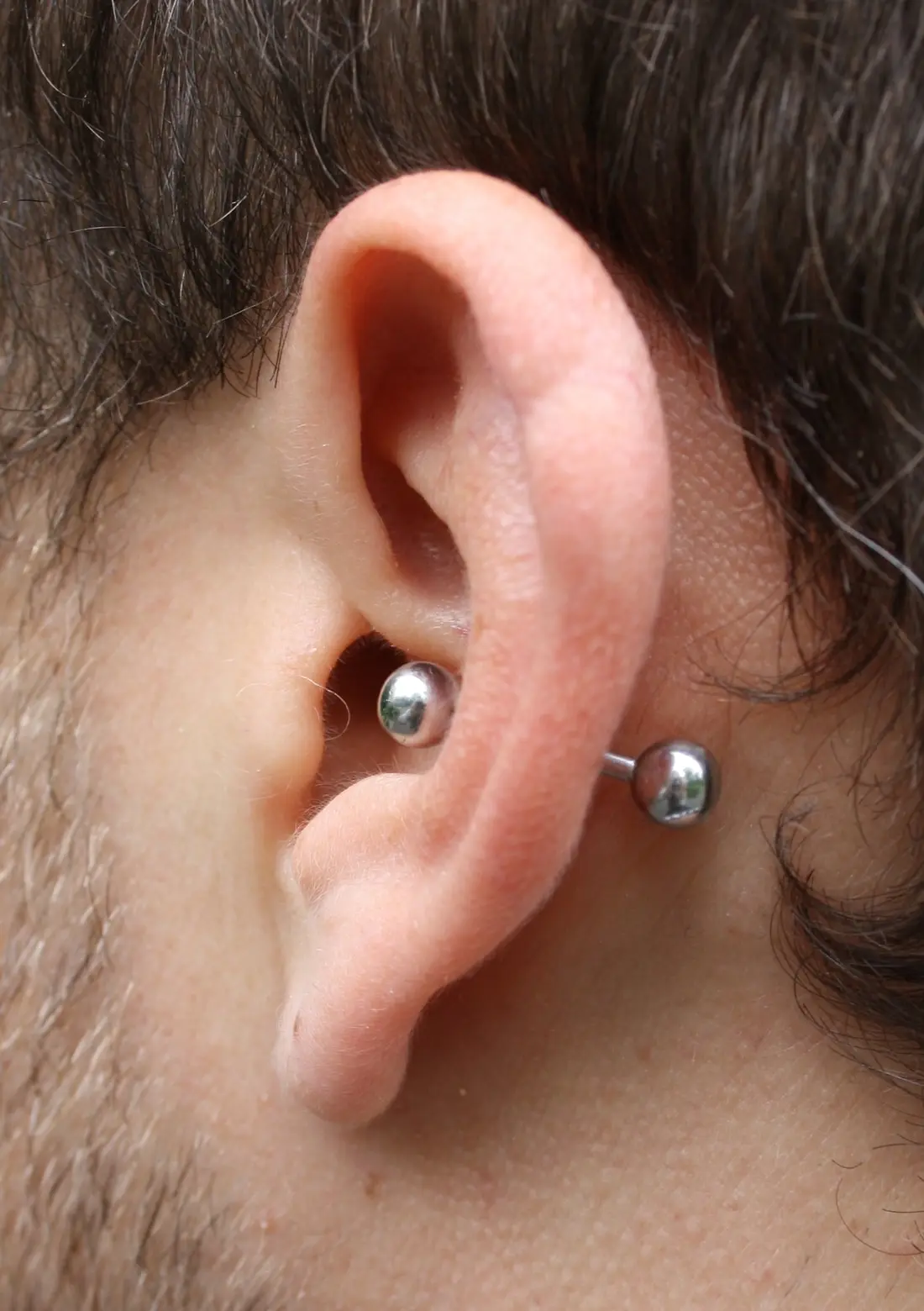
Photo by Nicor via Wikimedia Commons, CC BY-SA 3.0.
| Stage | What the sources say | What our conch page lists |
|---|---|---|
| New piercing | Healthline: flat-back studs, and a lot of piercers start with bar jewelry. Skip hoops. | Flat-back labret, 8 to 10 mm post, 16 or 14 gauge |
| After swelling | The APP: many piercings need a downsize by a piercer before they are healed | Downsize at about 6 to 10 weeks |
| Healed outer conch | Healthline: small hoops can be a good pick | No diameter given |
The starting jewelry
Healthline says studs used for a conch typically have flat backs, instead of the traditional backings on lobe studs, and that a lot of piercers recommend starting with some kind of bar jewelry, which it describes as longer posts with small balls on either end. The flat back guide covers the design.
The APP says jewelry must be of appropriate length or diameter for your unique anatomy and the placement, and that jewelry that is too tight does not allow for air and blood circulation. It also says the jewelry must be an appropriate gauge, because the body may treat jewelry that is too thin like a splinter, resulting in migration or rejection. Healthline’s conch article gives no gauge or length. The figures on our conch page are typical, not a prescription.
Internally threaded or threadless is what the APP says its members use, so the part through the skin is smooth. See threadless vs threaded.
Downsizing
The APP says many piercings require a downsize before the piercing is healed, and that a qualified piercer should do any change during healing. Whether yours needs one depends on how much it swelled. Our cartilage change guide and downsizing guide explain the timing.
Why Healthline says to skip a hoop at first
Healthline says small hoops can be a good pick for outer conch piercings, but to skip them for the initial piercing because they allow too much movement that can disrupt the healing process. It gives healing at 6 to 9 months for a needle conch and a year or more for dermal punch. WebMD says cartilage piercings may take 4 to 12 months.
The APP says to leave the initial jewelry in place for the entire healing process unless there is a problem with its size, style or material. It does not say when a hoop is safe. Our rule of thumb, not the sources’, is to wait until your piercer agrees it is healed. See cartilage earrings for how the APP defines healed.
Sizing a hoop
None of the pages we read gives a hoop size for a conch. The APP says jewelry must suit your anatomy, so have a piercer measure it rather than guessing. Our view, not a sourced rule, is that a hoop that is too small or too large will not improve by wearing it in. The APP also says jewelry that is too thin in gauge may be treated like a splinter by the body.
Healthline does not name hoop styles. Our ring styles guide covers how seamless rings, clickers and captive bead rings open.
Inner conch, outer conch
Healthline says small hoops can suit an outer conch. It does not define inner and outer. We describe the inner conch as the deep central bowl and the outer conch as the flatter cartilage nearer the rim, and which one you have depends on your ear, which a piercer will tell you at the consultation.
Two piercings, one ring
An orbital is a ring through two points. Our view, not a sourced rule, is that it should be planned as one piercing from the start so both holes line up.
Materials
| Source | What it lists |
|---|---|
| Healthline | Surgical stainless steel (safe for most people, but it contains a small amount of nickel), titanium (completely hypoallergenic), gold that is not plated, niobium |
| APP | Steel to ASTM F-138 or ISO 5832-1, implant-certified titanium (ASTM F-136), niobium, nickel- and cadmium-free gold of 14k or higher, platinum, and certain glass |
The APP says gold-plated, gold-filled and gold overlay or vermeil jewelry is not acceptable for fresh piercings. Healthline says plated gold can flake and expose you to nickel and other alloys. See the materials guide and nickel allergy and piercings.
What to avoid
- A hoop in a new piercing. Healthline says to skip it because of movement.
- A hoop sized by guesswork. Fit follows your anatomy, per the APP.
- Externally threaded jewelry. The APP says its rough screw pattern may be passed through the tissue.
- Plated or unspecified metal. The APP does not accept gold-plated jewelry for fresh piercings.
- Pressure on the piercing. Healthline says to avoid in-ear headphones, headbands and hats over a conch, and the APP says sleeping on a healing cartilage piercing can irritate it and shift its angle.
- Poorly set stones. The APP says gems should be set securely, and that a glued stone that falls out means replacing the whole piece.
The rest of the jewelry guides cover materials, threading, sizing and retainers.
Frequently asked questions
What jewelry do you start a conch piercing with?
Healthline says studs for a conch typically have flat backs, and that a lot of piercers recommend starting with some kind of bar jewelry. Our conch page lists a flat-back labret stud with an 8 to 10 mm post, 16 or 14 gauge, as a typical start. The APP says length and gauge must suit your anatomy, so your piercer sets them.
Can I get a conch hoop straight away?
Healthline says to skip hoops for the initial conch piercing because they allow too much movement, which can disrupt healing. It says small hoops can suit an outer conch once healed. The APP says to leave the initial jewelry in unless there is a problem with its size, style or material.
How long does a conch piercing take to heal?
Healthline says conch piercings done by needle typically heal in 6 to 9 months, and those done by dermal punch can take a year or more. WebMD gives 4 to 12 months for cartilage generally. Our healing guides give the longer ranges.
What is the difference between inner and outer conch?
Healthline mentions outer conch piercings as suiting small hoops. We describe the inner conch as the bowl and the outer conch as the flat cartilage nearer the rim. The sources we read do not define the two, so ask your piercer which yours is.
What metal should conch jewelry be?
Healthline lists surgical stainless steel (which contains a small amount of nickel), titanium (hypoallergenic), solid gold that is not plated, and niobium. The APP names standards for steel, titanium, gold and niobium, which our materials guide explains.
Can I sleep with a conch hoop or headphones?
Healthline says to avoid placing anything over a conch piercing, including in-ear headphones, headbands or hats. The APP says sleeping directly on a healing cartilage piercing can cause irritation and shift its angle, and suggests a travel pillow.
Sources
- Healthline - Conch piercing: pain, procedure, aftercare and morehttps://www.healthline.com/health/how-much-does-it-hurt-to-get-your-conch-pierced
- Association of Professional Piercers - Jewelry for initial piercingshttps://safepiercing.org/jewelry-for-initial-piercings/
- Association of Professional Piercers - Suggested aftercare for body piercingshttps://safepiercing.org/aftercare/
- WebMD - What are cartilage piercings?https://www.webmd.com/skin-problems-and-treatments/what-to-know-cartilage-piercings