On this page
A piercing is only as safe as the person and the setup behind it. The needle takes seconds. The rest is sterilisation, anatomy, jewelry and aftercare, and that is what to check before you book.
This page follows the Association of Professional Piercers (APP) brochure on picking a piercer, with the reasons behind each point. Where something is our own suggestion rather than the APP’s, it says so.
What to look for
Training and experience. The APP says it is advisable to ask how long your piercer has been piercing, how they learned, and what they do to keep their knowledge current, such as continuing education courses on anatomy, aftercare and aseptic technique.
A noticeably clean studio. The APP says the premises and the staff should be noticeably clean, and that smoking or drinking alcohol should never take place there. It describes five separate zones: a retail counter, a waiting area, a public bathroom, a bright, well-ventilated piercing room with a hand-washing sink, and a sterilisation room with no public access.
An autoclave, with spore test results. The APP calls an autoclave a necessary piece of equipment. It says sterilisers should be front-loading and/or cassette-based, and that top-loading machines, dry heat and liquid soaks are not acceptable. Studios should run regular spore tests, and the results should be posted publicly or readily available for you to review. What is an autoclave explains it.
Single-use needles, opened in front of you. Each needle must be used on only one client, then discarded in an approved sharps container. The needles, tools and jewelry should be sealed in individual sterile packages or sterilised in a cassette, and the packages or cassettes should be opened while you are present.
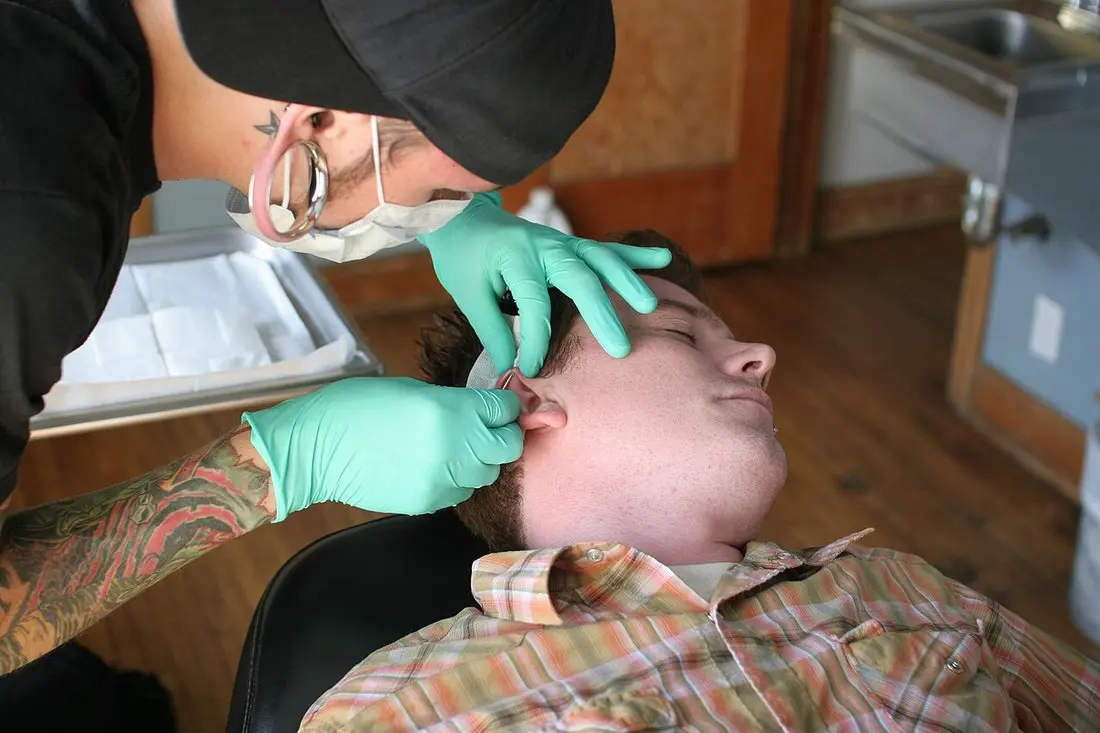
Clean hands and gloves. The APP says the piercer should first wash their hands, then put on gloves.
Proper jewelry. The APP says its members only use internally threaded jewelry for initial piercings, with smooth surfaces and a consistent mirror finish. Its jewelry standard also accepts threadless jewelry as an alternative. A studio should carry a wide range of styles and sizes, because a handful cannot fit the range of human anatomy. See the materials guide.
A portfolio that includes healed piercings. The APP says to look at the piercer’s photo portfolio, and if it features unusual piercings, to check for pictures of healed clients that show the placement works. A fresh piercing photographed on the day tells you little.
A proper consultation. Before taking your money, the APP says, a piercer should be willing to provide a consultation to inspect your anatomy and discuss jewelry selection, the procedure, potential risks and complications, the healing process and aftercare guidelines.
Written aftercare. The APP says you should receive written or electronic instructions when you come in for your piercing.
Questions to ask
From the APP’s checklist:
- How long have you been piercing?
- How did you learn?
- What do you do to keep your knowledge current?
- Can I see your spore test results?
- Can I watch you open the packages or cassettes?
Two more that are our suggestions, not the APP’s: what jewelry will you use for the initial piercing, and does the price include the first downsize? Piercing downsizing explains why the second one matters. A good piercer answers all of them without fuss.
Red flags
- A piercing gun. The APP says most ear piercing guns cannot be sterilised, and that a reputable professional will not use a gun for any piercing, even for earlobes. See piercing gun vs needle.
- Jewelry try-ons. The APP’s advice, if a studio lets customers try on piercing jewelry, is to run.
- No autoclave or no sharps container.
- Needles soaked in liquid. The APP says never to let a piercer use a needle that was soaked in a liquid.
- Outdated aftercare. The APP says outdated care like antibacterial soap or ointment is a red flag. See piercing aftercare products.
- Pressure to decide on impulse or on price.
Checking before you go
- Health department. The APP advises contacting your local health department to find out what standards and inspections apply. It adds that a licence does not guarantee the piercer has been trained, and that even the strictest laws usually set no requirements on a piercer’s abilities or education. So a licence is a starting point, not a verdict.
- APP membership. Members should have a certificate posted in the studio, and the expiry date should be current. A horizontal certificate is for attending an APP educational event, not for membership. You can check the member directory at safepiercing.org.
- Reviews and photographs, particularly of healed work. This one is our suggestion.
- Your instincts. The APP says they are a valuable tool: trust your intuition and never stay in a situation that feels wrong. Its checklist includes being treated with kindness and respect by the staff.
At the appointment
- You get a consultation before you pay.
- The piercer washes their hands and puts on gloves.
- You watch the packages or cassettes opened.
- You get written or electronic aftercare instructions.
If anything feels off, you can walk out. That is the right response to a red flag.
Price
The APP says not to act impulsively or be seduced by a low price, as you generally get what you pay for. If two studios meet every point on this page, the cheaper one is fine. If only the dearer one does, pay the difference.
Piercing prices shows typical US ranges for every placement.
If you cannot find one nearby
A long drive to a good piercer is worth it. A home kit is not the alternative. Piercing kits and DIY piercing explains why.
Frequently asked questions
How do I choose a good piercer?
Look for training and experience, a noticeably clean studio, an autoclave with spore test results you can see, single-use needles opened in front of you, quality jewelry, and a portfolio that includes healed piercings like the one you want. This follows the Association of Professional Piercers (APP) checklist.
What questions should I ask a piercer?
The APP suggests asking how long they have been piercing, how they learned, and what they do to keep their knowledge current, such as continuing education. Its checklist also says spore test results should be posted or readily available and that needles, tools and jewelry should be opened while you are present, so ask to see the results and to watch the setup.
What are the red flags at a piercing studio?
The APP says to run if a studio lets customers try on piercing jewelry, and that outdated care such as antibacterial soap or ointment is a red flag. Other warning signs from its checklist are a piercing gun, no autoclave or sharps container, needles soaked in liquid, and pressure to act on impulse or on a low price.
Is an APP member always better?
APP members may not use reusable ear piercing guns, and should display a membership certificate with a current expiry date. You can check the member directory at safepiercing.org. Membership is a useful signal, not a guarantee, so still look at the studio, the setup and the healed portfolio.
Should I choose the cheapest piercer?
No. The APP's advice is not to act impulsively or be seduced by a low price, as you generally get what you pay for. Price is a fair tie-breaker between studios that pass every other check, and a poor way to pick one that does not.
Do piercing studios need a licence?
Rules vary by state and area. The APP advises contacting your local health department to find out what standards and inspections apply where you live. It also warns that a licence does not guarantee the piercer was trained, and that even the strictest laws usually set no requirements for a piercer's abilities or education.
Sources
- Association of Professional Piercers - Picking your piercerhttps://safepiercing.org/picking-your-piercer/
- Association of Professional Piercers - Why piercing guns are a problemhttps://safepiercing.org/piercing-guns/
- Association of Professional Piercers - Jewelry for initial piercingshttps://safepiercing.org/jewelry-for-initial-piercings/
This article is for education only and is not medical advice. If a piercing is hot, swollen, spreading redness, oozing yellow or green discharge, or you have a fever, see a doctor today.