On this page
A rook sits in a fold of cartilage, so the jewelry has to sit inside that fold without pressing on either wall. That is most of what there is to choosing it.
This page follows Healthline, WebMD, the Cleveland Clinic and the Association of Professional Piercers (APP). None of them gives a rook-specific gauge or length, so where we give sizes they come from our own rook page and are labelled. Details are as read in October 2026.
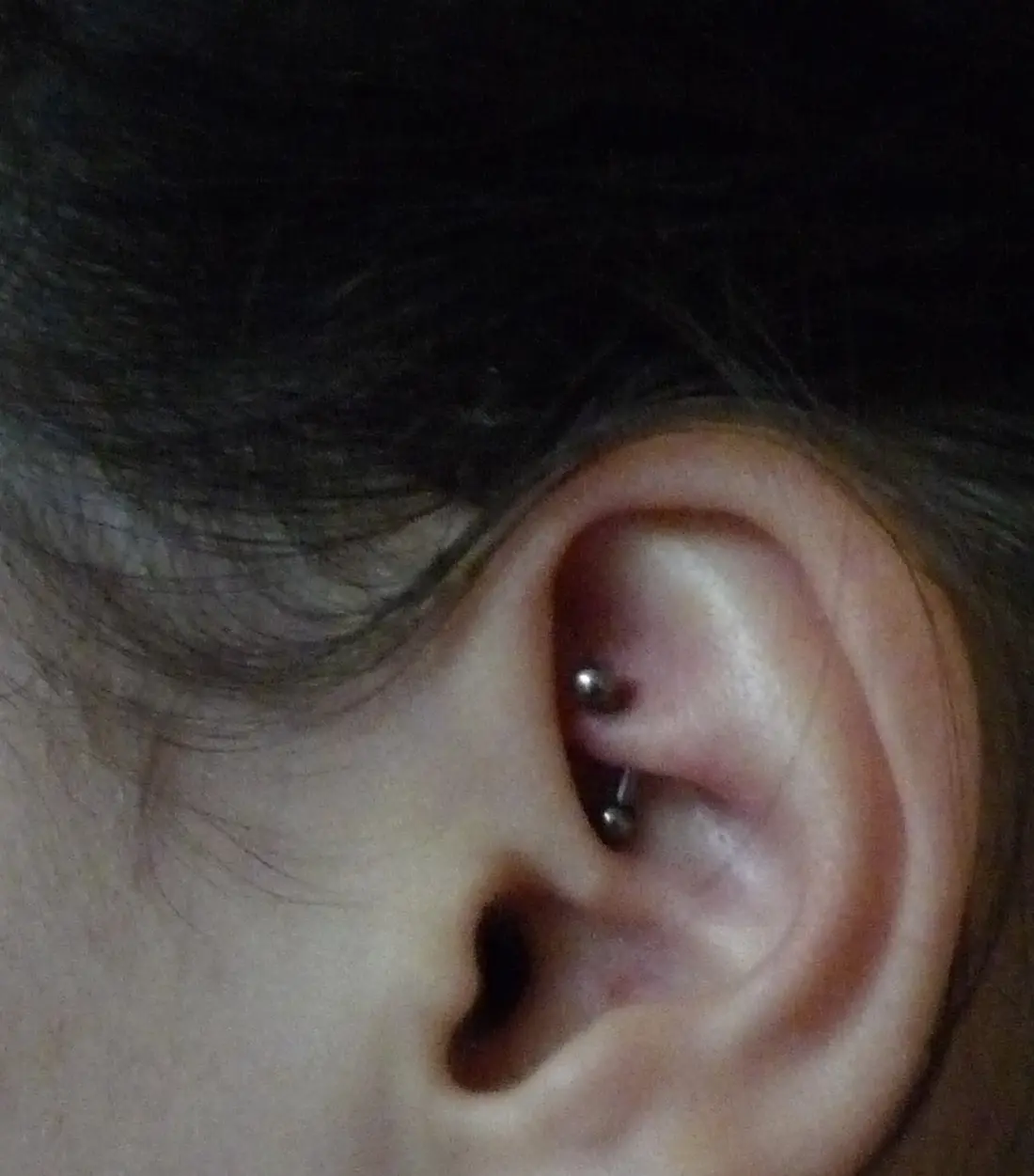
Photo by Anavrine via Wikimedia Commons, CC BY-SA 3.0.
What goes in first
Healthline’s rook article says your piercer will recommend a quality piece of starter jewelry, typically a barbell, and that it will be thicker than what you are used to wearing in your earlobes. It does not say straight or curved, or give a size.
Our rook page suggests a 16 gauge curved barbell, 8 to 10 mm long, because the curve follows the fold. That is our view, not a figure from the sources. The APP’s general rule is that jewelry must be of an appropriate length or diameter for your anatomy, and that ill-fitting jewelry increases the likelihood of swelling and embedding. A rook fold varies a lot between ears, so the length is something your piercer measures.
Gauge
The APP warns that jewelry too thin in gauge can be treated by the body like a splinter, resulting in migration or rejection. That is one reason studios do not start cartilage piercings at the thin wires used in many shop earrings. The gauge and size chart converts gauges to millimetres.
Materials
| Source | What it says |
|---|---|
| APP | Steel compliant with ASTM F-138 or ISO 5832-1; implant titanium (Ti6Al4V ELI) compliant with ASTM F-136; niobium; solid gold of 14k or higher, with gold above 18k too soft for body jewelry |
| WebMD, rook | Jewelry of good quality that does not contain nickel |
| Cleveland Clinic | 14K gold, medical-grade steel and titanium |
The APP’s steel list is narrower than “medical-grade” or “surgical” steel on most shop labels, since those terms have no fixed standard. The APP also asks for internally threaded or threadless jewelry for initial piercings. See materials and threaded vs threadless.
Downsizing and the first change
The APP says many piercings need a downsize before they are healed, once the first swelling has gone down, and that a qualified piercer should do downsizes or any jewelry change during healing. A long bar left in a rook catches on hair and headphones, which our downsizing guide covers.
For a change of style, the Cleveland Clinic says not to change earrings until fully healed, and lists signs of healing: no pain, redness, swelling or crust, and jewelry that moves easily. Healthline says not to remove the jewelry until the site is completely healed, because it can close up in minutes.
How long that takes depends on which source you read:
| Source | Rook healing time |
|---|---|
| WebMD | 12 to 16 weeks, if there are no complications |
| Healthline | 3 to 10 months |
| Cleveland Clinic | 6 to 12 months |
Our rook page uses six to twelve months. The cartilage change guide has the general checklist.
Rings, clickers and barbells once healed
The APP says rings are best for some areas and straight or curved bars for others, without naming the rook. Our rook page says a small hoop or a clicker works once the piercing has healed, but that a curved barbell suits the fold best day to day. A ring in a rook has to clear the fold on both sides, so its diameter matters as much as its gauge. Our ring styles guide explains clickers, seamless rings and captive bead rings.
When the jewelry is the problem
Healthline says bumps are relatively common with cartilage piercings. The APP says changing jewelry size, style or material often resolves problems, and that bumps usually come from inappropriate aftercare or over-cleaning. WebMD lists granulomas as a normal reaction, and says people prone to keloids should probably avoid piercings. Our cartilage piercing bump guide goes through the causes.
Pressure counts too. WebMD says to use earphones or talk on the phone on the opposite side, and to sleep on the other side or on your back. The APP suggests a travel pillow, covered in our piercing pillow guide.
If it looks infected, leave the jewelry in. The APP says removing jewelry in the presence of an infection may result in an abscess. See infected cartilage piercing.
Frequently asked questions
What jewelry goes in a new rook piercing?
Healthline says your piercer will recommend a quality piece of starter jewelry, typically a barbell, and that it will be thicker than what you are used to in your earlobes. Our rook page suggests a 16 gauge curved barbell, 8 to 10 mm long, in implant-grade titanium. The sources we read do not give a rook-specific size.
Can I put a hoop in my rook?
Once it has healed. The APP says rings are best for some areas and straight or curved bars for others, and that jewelry must fit your anatomy. Our rook page says a small hoop or clicker works once healed, but that the curve of a barbell suits the fold best day to day.
What metal is best for a rook?
The APP accepts steel compliant with ASTM F-138 or ISO 5832-1, implant titanium compliant with ASTM F-136, niobium and solid gold of 14k or higher. WebMD says to choose jewelry of good quality that does not contain nickel.
When can I change my rook jewelry?
The Cleveland Clinic says not to change earrings until the piercing has fully healed and puts the rook at six to twelve months. Healthline says not to remove the jewelry until the site is completely healed because it can close up in minutes. The APP says a downsize may be needed before then, done by a piercer.
Why does my rook keep getting a bump?
Healthline says bumps are relatively common with cartilage piercings. The APP says changing jewelry size, style or material often resolves problems, and that bumps usually come from aftercare or over-cleaning. See our cartilage piercing bump guide.
How long does a rook take to heal before I can change jewelry?
The sources disagree. WebMD says 12 to 16 weeks without complications, Healthline says three to ten months and the Cleveland Clinic says six to twelve months. Our rook page uses six to twelve months.
Sources
- Healthline - How much does it hurt to get the rook of your ear pierced?https://www.healthline.com/health/how-much-does-it-hurt-to-get-the-rook-of-your-ear-pierced
- WebMD - What to know about rook piercinghttps://www.webmd.com/beauty/what-to-know-about-rook-piercing
- Cleveland Clinic - Ear piercing 101: healing, hurting, cleaning and morehttps://health.clevelandclinic.org/what-to-expect-when-getting-your-ears-pierced
- Association of Professional Piercers - Jewelry for initial piercingshttps://safepiercing.org/jewelry-for-initial-piercings/
- Association of Professional Piercers - Suggested aftercare for body piercingshttps://safepiercing.org/aftercare/
- Association of Professional Piercers - Troubleshootinghttps://safepiercing.org/troubleshooting/
This article is for education only and is not medical advice. If a piercing is hot, swollen, spreading redness, oozing yellow or green discharge, or you have a fever, see a doctor today.