On this page
Cartilage piercings take months to heal, and the sources we read say infections there can be more serious than in the lobe. This page covers the helix, daith, tragus, conch, rook and industrial. It follows the American Family Physician (AFP), WebMD, Healthline and the Association of Professional Piercers (APP), and is information, not medical advice. Details are as read in October 2026.
Why cartilage is different
The AFP review (Meltzer, 2005) says high ear piercings through cartilage are associated with poor healing and more serious infection because of the avascular nature of auricular cartilage, meaning it has no blood supply of its own. It says minor infections can progress to perichondritis, abscess formation and necrosis, and that auricular perichondritis and perichondrial abscess typically occur in the first month after piercing, especially in warm weather.
Healthline says cartilage piercings, especially high on the ear, are more prone to infection than other ear piercings, largely because they sit closer to hair. It says hair can spread dirt and oil, tangle around the barbell and expose the piercing to hair products, and that an industrial, which has two holes, doubles the risk.
The Cleveland Clinic says lobes heal in about six to eight weeks, and that daith, rook, conch, helix and tragus take six to twelve months. The AFP review is from 2005 and the Healthline articles from 2018 and 2019, so treat the specifics as dated.
Signs of infection
| Source | What it lists |
|---|---|
| WebMD, cartilage | Hurts, hot to the touch, bright red or pink, gray, yellow or green discharge, fever, chills and nausea |
| Healthline, daith | Extreme sensitivity or pain, warm or hot tissue, discharge, swelling, unusual smell, rash, body aches, fatigue, fever of 101°F (38°C) or higher |
| Healthline, industrial | Redness and swelling that spread and enlarge, uncomfortable swelling, persistent heat, severe pain, excessive bleeding, pus, a bump at the front or back, fever |
| AFP | Perichondritis: painful swelling, warmth and redness of a part of the ear that often spares the lobe |
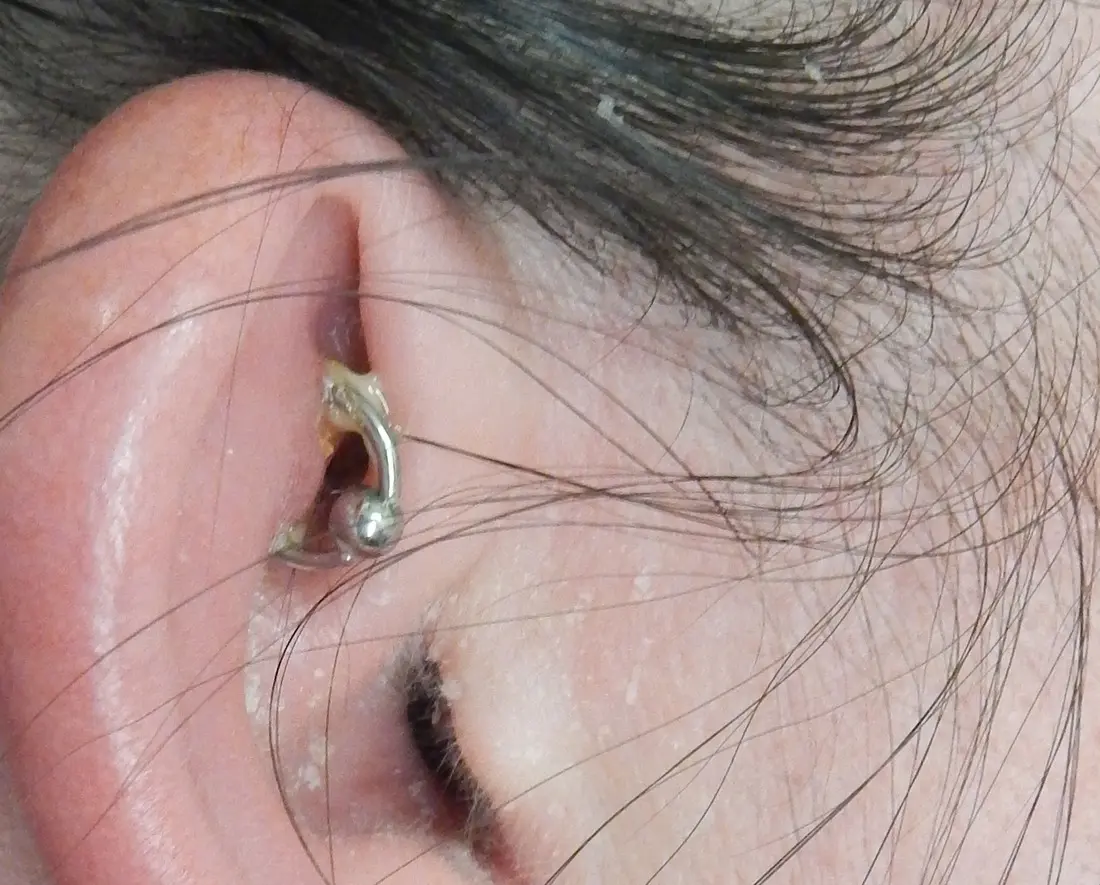
Perichondritis. Photo by James Heilman, MD via Wikimedia Commons, CC BY-SA 4.0.
Healthline’s daith article says irritation generally does not need treatment and goes away in a few days, and its industrial article lists mild swelling, redness, warmth, occasional throbbing and clear or white discharge as typical in the first two weeks. Our irritated vs infected guide has a symptom table.
What to do
| Source | What it says |
|---|---|
| Healthline, daith | Mild infections can usually be treated at home; clean three times a day; soak in a warm salt solution; see a doctor if symptoms do not improve within a day or two |
| Healthline, industrial | Clean two to three times a day with saline; if symptoms are severe, it is your first infection, or there is no improvement in two or three days, see your piercer |
| WebMD | Keep the piercing clean and follow your piercer’s instructions; talk to your doctor if you have these symptoms |
| AFP | Antibiotics with good coverage against Pseudomonas and Staphylococcus species for infections of the cartilage; incision and drainage often needed if an abscess is present |
The AFP says the most common pathogens in these infections (Pseudomonas aeruginosa, Staphylococcus aureus and Streptococcus pyogenes) respond well to fluoroquinolone antibiotics. That is a 2005 clinical review, written for doctors, and whether a doctor prescribes one today is their call. The pages do not agree on who to see: Healthline’s daith article says a doctor, and its industrial article says your piercer is the best person to diagnose. Given the AFP’s warning about abscess and necrosis, we would see a doctor.
Leave the jewelry in
Healthline’s daith article says if you suspect an infection you should not remove the jewelry, because the site will often close up, and its industrial article says taking it out can trap bacteria. The APP says removing jewelry in the presence of an infection may result in an abscess. The AFP says occasionally swelling is so significant that an earring must be removed, which a clinician decides.
What not to use
- Ointments and creams. Healthline says antibiotic ointments and creams are thick and can trap bacteria under the skin, and WebMD says antibacterial ointments can keep the piercing from getting the air it needs. The APP says ointments are not preferred and that a gel or cream such as mupirocin has been found effective. Use only what a doctor prescribes.
- Alcohol and hydrogen peroxide. Healthline’s daith article says to avoid them. Its industrial article says rubbing alcohol can damage healthy skin cells.
- Tea tree oil. Healthline’s industrial article describes diluted tea tree oil as a home option. The APP’s aftercare pages do not, and the Cleveland Clinic has a separate article on tea tree oil. We do not recommend it.
- Touching it. WebMD says touching a new piercing with unwashed hands is the best way to get an infection.
Preventing the next one
Healthline’s industrial article advises shampooing hair every other day or daily, avoiding dry shampoo, avoiding snug hats or bands over the ears, using earbuds rather than headphones, being careful with hair spray, pulling shirts over the head slowly and changing pillowcases weekly. The APP says sleeping directly on a healing cartilage piercing can cause irritation and shift its angle, and suggests a travel pillow, which our piercing pillow guide covers.
If it is a bump
WebMD says a keloid is raised scar tissue that looks like a bump, that some are caused by infection and others just happen, and that if you get one from a cartilage piercing you are more likely to get more. See cartilage piercing bump. For the general steps that apply to any placement, read how to treat an infected piercing and our infected ear piercing guide.
Frequently asked questions
Why are cartilage piercings more likely to get a serious infection?
A 2005 American Family Physician review says high ear piercings through cartilage are associated with poor healing and more serious infection because of the avascular nature of ear cartilage, meaning it has no blood supply of its own. Healthline adds that high ear piercings sit closer to hair, which spreads dirt and oil.
What are the signs of an infected cartilage piercing?
WebMD lists pain, heat, bright red or pink skin, gray, yellow or green discharge, and fever, chills and nausea. Healthline's daith article lists extreme pain, warmth, discharge, swelling, an unusual smell, rash, body aches and a fever of 101°F (38°C) or higher. The AFP describes perichondritis as painful swelling, warmth and redness of the ear that often spares the lobe.
What is perichondritis?
The AFP describes auricular perichondritis as painful swelling, warmth and redness in part of the ear, often sparing the lobe. It says minor infections can progress to perichondritis, abscess and necrosis, and that once an abscess develops, preserving the cartilage's appearance is difficult.
Should I take out an infected cartilage piercing?
Healthline says not to remove the jewelry if you suspect infection, because the site may close and trap it. The APP says removal during an infection may result in an abscess. The AFP notes that jewelry occasionally has to come out when swelling is severe, which is a clinician's call.
When should I see a doctor?
Healthline's daith article says to see a doctor if symptoms do not improve in a day or two, or for extreme pain, jewelry stuck in the skin or a fever of 101°F (38°C) or higher. WebMD says to talk to your doctor about symptoms like these. The AFP says perichondritis and abscess typically occur in the first month after piercing.
Can I use antibiotic ointment on an infected cartilage piercing?
The sources we read say no. Healthline says antibiotic ointments and creams are thick and can trap bacteria, WebMD says antibacterial ointments can keep the piercing from the air it needs, and the APP prefers a gel or cream a doctor suggests. Only use a topical antibiotic your doctor prescribes.
Sources
- American Family Physician - Complications of body piercing (Meltzer, 2005)https://www.aafp.org/pubs/afp/issues/2005/1115/p2029.html
- WebMD - What are cartilage piercings?https://www.webmd.com/skin-problems-and-treatments/what-to-know-cartilage-piercings
- Healthline - Daith piercing infection: symptoms, treatment, prevention and morehttps://www.healthline.com/health/beauty-skin-care/daith-piercing-infection
- Healthline - Industrial piercing infection: symptoms, treatment, prevention and morehttps://www.healthline.com/health/beauty-skin-care/infected-industrial-piercing
- Association of Professional Piercers - Troubleshootinghttps://safepiercing.org/troubleshooting/
- Cleveland Clinic - Ear piercing 101: healing, hurting, cleaning and morehttps://health.clevelandclinic.org/what-to-expect-when-getting-your-ears-pierced
This article is for education only and is not medical advice. If a piercing is hot, swollen, spreading redness, oozing yellow or green discharge, or you have a fever, see a doctor today.