On this page
Nearly everyone who searches for “piercing keloid” does not have one. Keloids are genuinely uncommon. The small pink lump that appears next to a piercing a few weeks in is almost always an irritation bump, and the two need opposite responses: an irritation bump resolves when you change what is causing it, while a keloid needs a dermatologist.
Telling them apart takes about a minute.
The four things people call a bump
| Irritation bump | Pustule | Hypertrophic scar | Keloid | |
|---|---|---|---|---|
| Looks like | Small, pink or red, sometimes fluid-filled, right beside the jewelry | Small white or yellow head | Raised, pink or red, stays inside the wound edges | Shiny, firm, spreads beyond the wound onto normal skin |
| Feels like | Soft, tender | Sore, sometimes throbbing | Firm | Firm, rubbery, often itchy |
| Appears | Days to weeks after a change, knock or pressure | Any time | Months in | Months in, keeps growing |
| Cause | Mechanical: pressure, movement, wrong jewelry, harsh products | Localised infection or blocked follicle | Prolonged irritation | Genetic tendency to over-produce collagen |
| Resolves? | Yes, once the cause is removed | Usually, with saline and time | Often flattens over months | No, not without treatment |
| Who to see | Piercer | Doctor if it spreads | Piercer, then doctor | Dermatologist |
The most useful single distinction: does it stay within the boundary of the piercing, or does it spread onto surrounding skin? Irritation bumps and hypertrophic scars stay put. Keloids grow outward.
Irritation bumps: the common one
If your bump appeared within weeks of getting pierced, changing jewelry, or knocking the piercing, this is what you have.
It is a mechanical response, not an infection and not a scar. Something is moving, pressing on, or catching the piercing, and the tissue is responding with localised swelling. It often weeps a little clear fluid.
The causes, in rough order of frequency:
- Sleeping on it. The APP says sleeping directly on a healing cartilage piercing can cause irritation and even shift the piercing’s angle.
- A hoop fitted before the piercing was healed. Rings move every time you move.
- A post that needs downsizing. The extra length left for swelling becomes a lever once the swelling is gone.
- Low-quality jewelry. Externally threaded posts, gold plating, mystery “surgical steel”, nickel.
- Harsh products. Tea tree oil, alcohol, peroxide, ointments, aspirin paste.
- Knocks and snags. Towels, hairbrushes, headphones, clothing, face-mask loops.
- Changing jewelry too early.
What to do about an irritation bump
Fix the cause. That is the treatment. Everything else is secondary.
- Do not remove the jewelry. The surface closes over inflamed tissue and can trap fluid.
- Stop everything you are putting on it except plain sterile saline. If you have been using tea tree oil or similar, stopping alone often resolves it.
- Stop sleeping on it. A travel pillow with a hole for your ear works.
- See your piercer about the jewelry. Ask whether the post needs downsizing, whether the material is implant grade, and whether a hoop needs swapping for a flat-back stud.
- Keep up saline twice a day and nothing more.
- Give it four to eight weeks. Bumps do not disappear overnight even once the cause is gone.
If it has not begun improving about six weeks after you removed the cause, go back to a piercer. A persistent bump sometimes means the angle of the piercing is wrong, which jewelry alone will not fix.
Pustules
A small white or yellow head, sore, sometimes with a little discharge. Often a localised, contained infection or a blocked follicle rather than a spreading infection.
Do not squeeze it. Continue saline twice daily and leave it alone. Most settle within a week or two.
See a doctor if the redness starts spreading outward, the area becomes hot, you develop several of them, or you feel unwell.
Hypertrophic scars
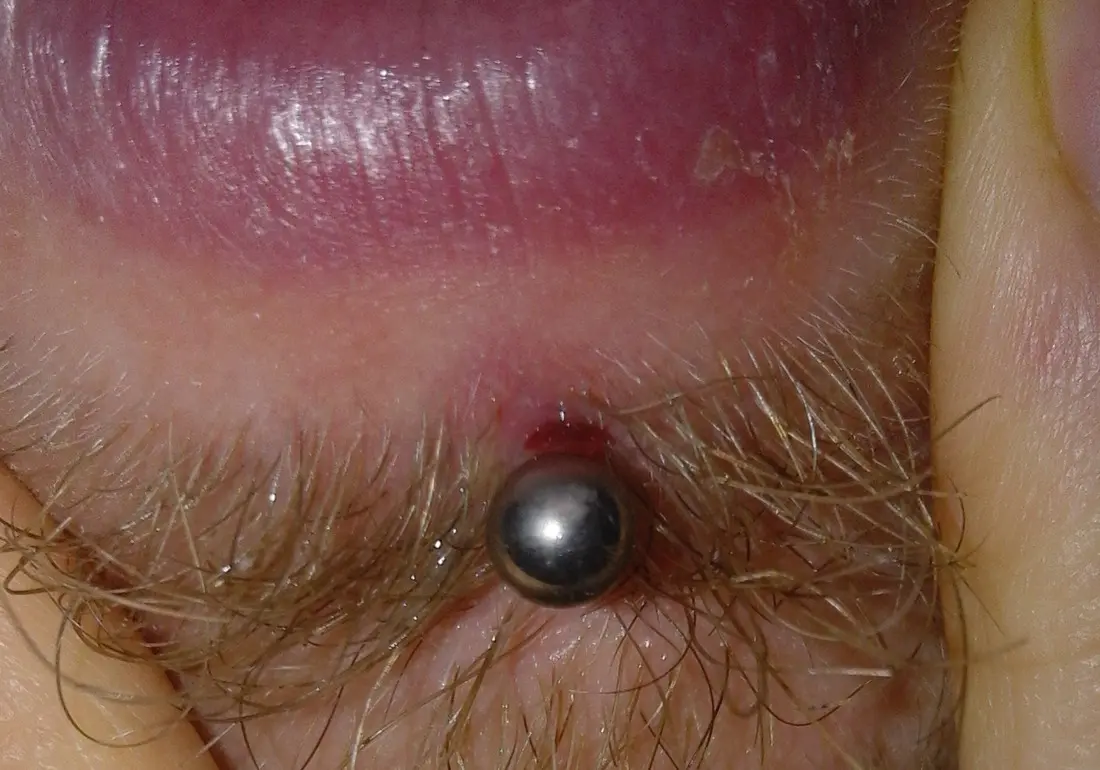
A hypertrophic scar, which stays within the footprint of the piercing. Photo by Sentient Planet via Wikimedia Commons, CC BY-SA 4.0.
Raised, firm and pink, appearing months rather than weeks in, and staying strictly within the original wound boundary. They come from prolonged irritation rather than a single event.
Many flatten and fade over six to eighteen months once the irritation ends. Silicone gel or sheets, sold for scar management, are a reasonable option and worth asking a pharmacist or doctor about. Do not attempt to sand, pick or burn them.
Keloids
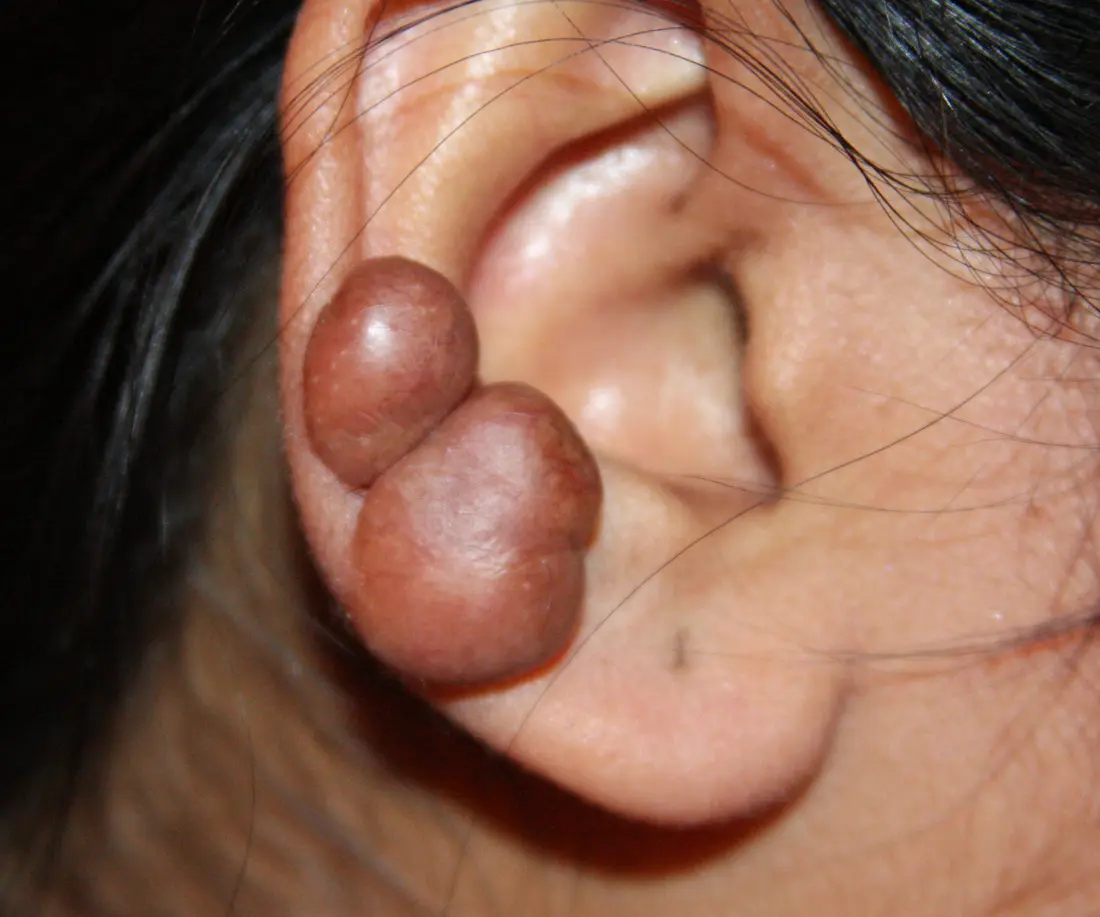
Photo by Htirgan via Wikimedia Commons, CC BY-SA 3.0.
A keloid is an over-growth of scar tissue that extends beyond the original wound onto healthy skin. It is shiny, firm, rubbery, often itchy or tender, and it does not resolve on its own.
Keloids have a strong genetic component. They are more common in people with darker skin, particularly of African, Asian or Hispanic descent, and in anyone who has formed one before. Earlobes are the most common piercing site for a true keloid; cartilage keloids happen but are less frequent.
If you think you have a keloid, see a dermatologist. Treatments exist, including steroid injections, silicone therapy, cryotherapy, surgical removal combined with other treatment, and laser. None of them are home remedies, and cutting or removing a keloid without follow-up treatment usually produces a larger one.
If you have a personal or family history of keloids, discuss it with a dermatologist before getting pierced, especially anywhere on cartilage.
The full picture, including who is at risk, which treatments work and why cutting one off makes it worse, is in the keloid guide.
What not to do, whatever the bump is
- Do not remove the jewelry on your own initiative.
- Do not apply tea tree oil, aspirin paste, toothpaste, hydrogen peroxide, alcohol or antibiotic ointment.
- Do not squeeze, pick or attempt to drain anything.
- Do not sand, file or burn a raised scar.
- Do not stack more products on top; over-treatment causes more bumps than under-treatment.
When it is not a bump at all
A bump is a localised lump. An infection is a spreading process, and the signs are different: heat, redness spreading outward, thick yellow or green discharge, increasing swelling after the first week, severe pain, fever, or red streaks running away from the site.
Any of those means see a doctor the same day, with the jewelry left in. See infected ear piercing and infected nose piercing.
Prevention is mostly the aftercare basics: saline only, hands off, no rotating, no sleeping on it, downsize on time, and implant-grade jewelry from the start.
Frequently asked questions
Is my piercing bump a keloid?
Almost certainly not. True keloids are uncommon, grow beyond the boundary of the original wound, feel firm and rubbery, and keep enlarging for months. The small pink lump that appears beside new jewelry is an irritation bump, and it resolves once the cause is removed.
How do I get rid of a piercing bump?
Remove the cause rather than treating the bump. Most come from pressure while sleeping, a hoop fitted too early, a post that needs downsizing, low-quality jewelry, or harsh cleaning products. Fix that, keep up plain saline, and give it four to eight weeks.
Should I take the jewelry out if I have a bump?
No. Removing jewelry lets the surface close over while the underlying tissue is still inflamed, and can trap fluid inside. See a piercer first.
How long does a piercing bump take to go away?
Four to eight weeks after the cause is removed, sometimes longer on cartilage. If it has not started improving within about six weeks of fixing the cause, have a piercer look at it.
Does tea tree oil get rid of piercing bumps?
No, and it frequently makes them worse. Tea tree oil is a strong irritant on broken skin. The same is true of aspirin paste, toothpaste and hydrogen peroxide, all of which circulate as home remedies.
What is the difference between a keloid and a hypertrophic scar?
A hypertrophic scar is raised but stays within the boundaries of the original wound and often flattens over months. A keloid grows beyond the wound onto surrounding skin, does not resolve on its own, and needs a dermatologist.
Who gets keloids?
There is a strong genetic component, and they are more common in people with darker skin, particularly of African, Asian or Hispanic descent, and in people who have formed keloids before. If that describes you, discuss it with a dermatologist before piercing cartilage.
Sources
- Association of Professional Piercers - Troubleshootinghttps://safepiercing.org/troubleshooting/
- American Academy of Dermatology - Keloids: overviewhttps://www.aad.org/public/diseases/a-z/keloids-overview
- American Academy of Dermatology - Caring for pierced earshttps://www.aad.org/public/everyday-care/skin-care-basics/tattoos/caring-for-pierced-ears
- Mayo Clinic - How to treat a piercing infectionhttps://www.mayoclinic.org/healthy-lifestyle/adult-health/expert-answers/ear-piercing-infection/faq-20452841
This article is for education only and is not medical advice. If a piercing is hot, swollen, spreading redness, oozing yellow or green discharge, or you have a fever, see a doctor today.