On this page
Every page on this site says the same thing about how a piercing should be made: with a needle, never a gun. This is the page that explains why, because the reasons are specific and none of them is snobbery.
What each one actually does
A needle is hollow, sharp and single-use. It removes a small core of tissue as it passes, leaving a clean channel of exactly the needle’s diameter. The jewelry follows it through the channel it just made. It is sealed sterile in its packet and thrown away afterwards.
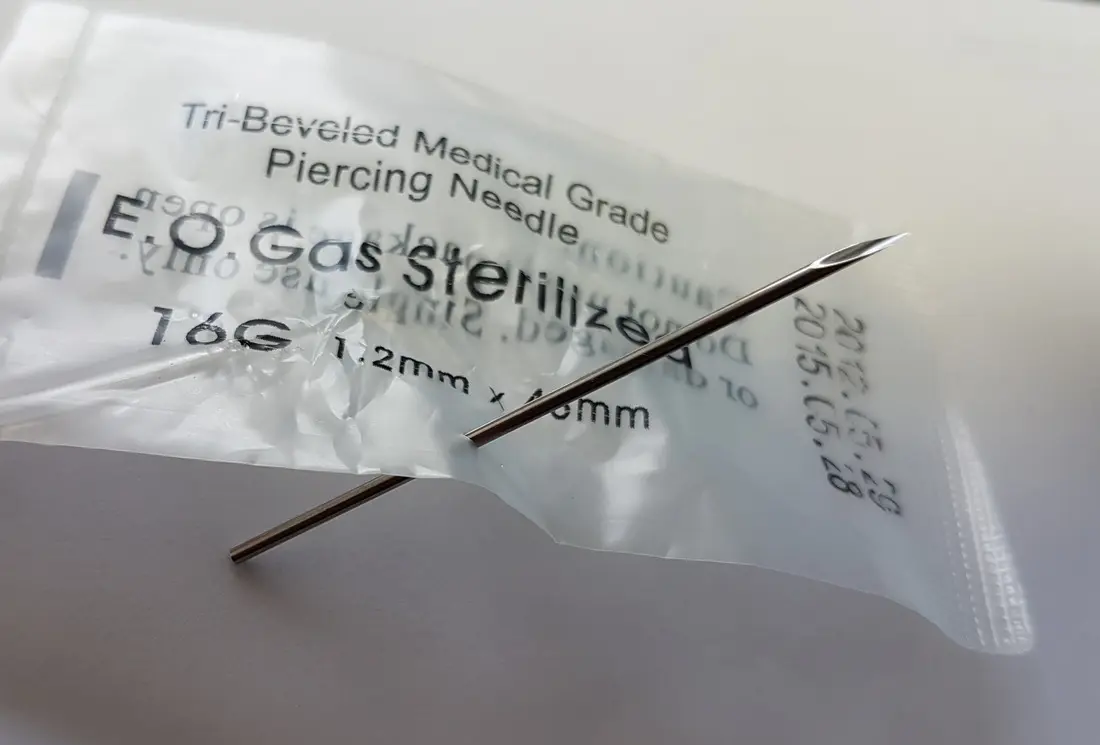
Photo by Norman Roscher via Wikimedia Commons, CC BY-SA 4.0.
A gun is a spring-loaded device that drives a stud earring through the tissue by force. The stud is not sharp; it is a blunt point being pushed until the tissue gives. Nothing is removed. The tissue is torn and compressed around the post, and the butterfly clasp is clamped on behind it in the same motion.
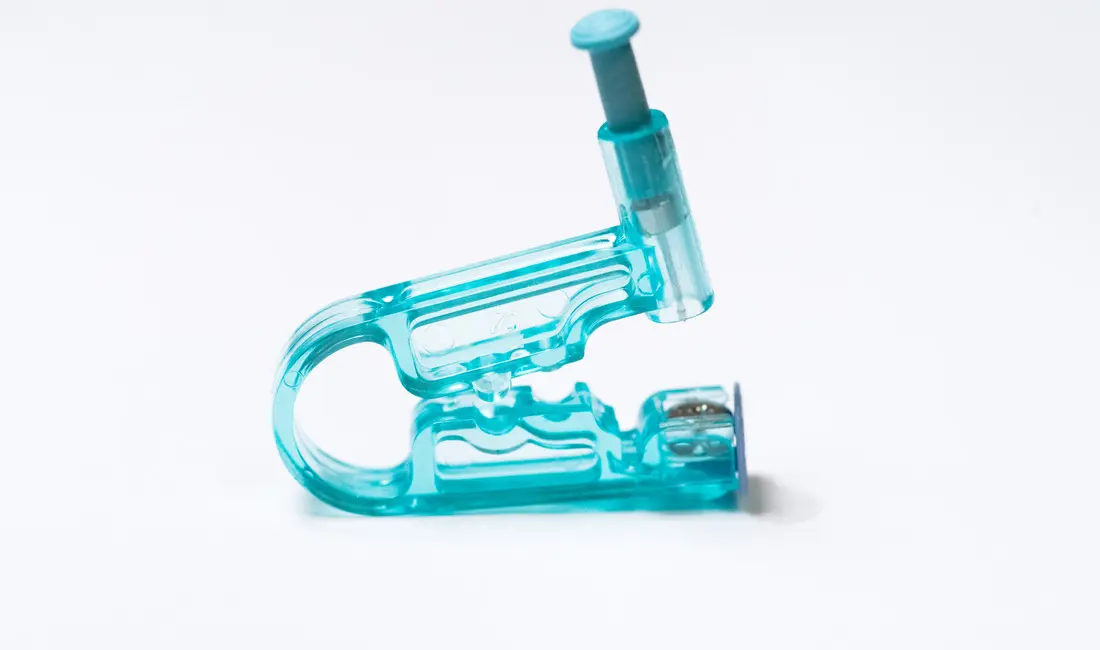
Photo by EM via Wikimedia Commons, CC BY-SA 4.0.
That single difference, cutting versus forcing, is behind everything below.
| Needle | Gun | |
|---|---|---|
| What it does to tissue | Cuts a clean core out | Tears and compresses around a blunt post |
| Sterility | Sealed sterile, single-use | Cannot be autoclaved; wiped with disinfectant only |
| Suitable for cartilage | Yes | No, ever |
| Jewelry that goes in | Sized for healing, implant-grade | A short stud sized for the device, often unspecified metal |
| Placement | Marked and placed by hand | Fixed by the device’s own geometry |
| Who does it | An apprenticed, licensed piercer | Often quick retail training |
| Pain afterwards | Brief, settles quickly | Less at the moment, more for days after |
The four problems
1. Trauma
A blunt object pushed through tissue tears rather than cuts, and the compression around the post crushes the tissue at the edges of the wound. The result is more swelling, more bruising and a longer, more uncomfortable heal than a needle piercing of the same site.
On a lobe, which is soft and forgiving, most people get away with it. On cartilage, which does not stretch, the tissue fractures. Gun-pierced cartilage is the origin of a disproportionate share of the chronic bumps, infections and permanently misshapen ears that piercers spend their careers repairing. No professional will put a gun near cartilage, and a shop that will is telling you something.
2. It cannot be sterilised
Sterile means an autoclave: pressurised steam that kills everything. A needle arrives sterile and is used once.
A piercing gun is plastic and spring-loaded. It cannot go in an autoclave, so it is wiped with disinfectant between customers, which is not the same thing. A piercing releases a fine spray of blood and tissue fluid, some of which reaches the mechanism, and the mechanism is then held against the next person’s ear. The stud cartridge is sterile; the device around it is not.
3. The jewelry is wrong
Gun studs are designed for the gun, not for healing.
- The post is short, with no allowance for swelling, so a swollen lobe presses against the clasp from day one.
- The butterfly clasp has edges and folds that trap discharge against the wound and dig in when you sleep.
- The point is blunt, because it has to be driven, not because that is good for the tissue.
- The metal is often unspecified, plated, or nickel-releasing. Weeks of nickel contact in a healing wound is exactly how lifelong nickel allergies begin, and childhood ear piercing is a common way they start.
A studio fits a flat-back stud in implant-grade titanium on a post sized for swelling, then shortens it once the swelling goes. The materials guide covers why the alloy matters.
4. Placement and training
A gun is held against the ear and fired. Its mechanism decides the angle and depth. A needle is placed by hand, by someone who has assessed the anatomy and marked the spot, and who can adjust by a millimetre.
Gun operators in retail settings are typically trained in hours. Professional piercers apprentice for years. For a lobe, that gap shows up as uneven or angled holes; for anything else, it is the difference between a piercing that suits your anatomy and one forced onto it.
“But it was quick and it barely hurt”
The gun’s speed is real, and it is why people remember it as painless. The click happens before you have registered it.
What it does not tell you is how the next week goes. A needle piercing hurts for a second and settles quickly. A gun piercing hurts less in the moment and more afterwards, because the tissue was crushed rather than cut. Speed is not the same as gentleness.
Children
Most first ear piercings are done with a gun at a jewellery counter or pharmacy, because that is where parents expect to go. It is also where most of the problems in this guide land: crushed lobes, embedded studs, infected butterfly clasps, and the nickel exposure that becomes an allergy.
A professional studio will pierce a child’s lobes with a needle, fit titanium jewelry sized for healing, and take longer over it. It costs a little more and is better on every measure that matters. The lobe guide covers what to expect, and baby ear piercing covers what pediatricians advise for infants.
If you were pierced with a gun
Most gun-pierced lobes heal fine, and there is no need to panic about one that is settling normally.
- Keep it clean with sterile saline twice a day and nothing else, as for any piercing.
- Watch the clasp. If the post is short and the lobe swells, the butterfly can press into the skin and, in the worst case, the stud can start to embed. A stud that is disappearing into the lobe, or a clasp you cannot see clearly, means a piercer today.
- Once healed, swap the gun stud for a correctly sized flat-back in implant-grade titanium. Most people find it more comfortable immediately.
- If it is hot, swollen, spreading redness or discharging, see a doctor. The infected ear piercing guide has the signs.
Gun-pierced cartilage that is still troubled months later is worth showing to a professional piercer, who can tell you whether the piercing is salvageable or whether it is better retired and redone properly once it has healed over.
To see how retailers describe their methods, read Claire’s ear piercing, Rowan ear piercing and Piercing Pagoda ear piercing (now Banter). How to choose a piercer and what is an autoclave cover the rest of the checklist, and piercing kits and DIY piercing explains why home kits do not solve the problem.
The short version
A needle cuts a clean channel, arrives sterile, and is placed by someone trained to place it, with jewelry designed to heal in. A gun forces a blunt stud through, cannot be sterilised, and leaves you wearing jewelry designed for the gun. For a lobe the difference is comfort and risk; for cartilage it is whether the piercing works at all.
Frequently asked questions
Is a piercing gun or a needle better?
A needle, for every piercing including a child's earlobes. A needle is sharp, hollow and single-use, and removes a clean channel. A gun forces a blunt stud through with spring pressure, tearing tissue rather than cutting it, and the device itself cannot be sterilised between customers.
Does a piercing gun hurt less than a needle?
No. The gun is quick, which people mistake for gentle, but forcing a blunt point through tissue produces more trauma and more swelling than a sharp needle, and the days afterwards are usually worse. A needle piercing is over in a second and heals more comfortably.
Can a piercing gun be used on cartilage?
It should never be. Cartilage does not stretch around a blunt stud the way a lobe does; it fractures. Gun-pierced cartilage is where a large share of long-running infections, bumps and permanent ear deformities come from.
Why can't piercing guns be sterilised?
Because they are plastic and spring-loaded and would not survive an autoclave. They are wiped with disinfectant between customers, which does not sterilise them, and blood and tissue spray from a piercing can contaminate the mechanism. A needle is a sterile, sealed, single-use item.
Is it safe to get a child's ears pierced with a gun?
It is the most common way it is done and the least good one. A professional studio will pierce a child's lobes with a needle and fit implant-grade titanium jewelry sized for healing. Gun studs are short, have butterfly backs that trap debris, and are often nickel-releasing, which is how many lifelong nickel allergies start.
I was pierced with a gun. What should I do now?
If it is healing without trouble, leave it, keep it clean with sterile saline, and once healed swap the gun stud for a properly sized flat-back stud in implant-grade titanium. If the stud is embedding, or the site is hot, swollen or discharging, see a piercer or a doctor rather than waiting.
Sources
- Association of Professional Piercers - Why piercing guns are a problemhttps://safepiercing.org/piercing-guns/
- Association of Professional Piercers - Jewelry for initial piercingshttps://safepiercing.org/jewelry-for-initial-piercings/
- American Academy of Dermatology - Caring for pierced earshttps://www.aad.org/public/everyday-care/skin-care-basics/tattoos/caring-for-pierced-ears