On this page
Piercing a baby’s ears is a family tradition in many cultures, and one of the most common questions parents bring to a pediatrician or a piercer.
The medical answer is calmer than a lot of what you will read online. The American Academy of Pediatrics says ears can be pierced at any age, with little risk if it is done carefully and the piercing is cared for properly. As a general guideline, it also recommends waiting until a child is mature enough to look after the piercing themselves.
Both of those are true at once. This page covers how to weigh them, and how to do it well if you decide to go ahead.
What pediatricians say
The American Academy of Pediatrics, on its HealthyChildren.org site for parents, says there is little risk at any age when a piercing is done carefully, recommends postponing it until a child can care for it, and advises having it done by a doctor, a nurse or an experienced technician.
Pediatricians in practice give similar advice. A University of Utah Health pediatrician describes ear piercing as fairly safe when it is done in a safe setting, and advises waiting until a child has had at least one tetanus vaccine, avoiding businesses that use piercing guns, and choosing earrings that are small, round and flat.
Neither says no. The difference between piercing a baby and waiting is mostly about practicalities and choice, not about safety.
The case for waiting
- Your child gets to decide. This is the reason behind the AAP’s guideline, and for many families it settles the question.
- An older child can sit still. That makes it easier to place both piercings evenly, which is hard on a baby who is wriggling.
- An older child can help with aftercare, keep their hands off, and tell you when something hurts.
- Babies pull at their ears. Earrings get knocked, loosened and lost, and a loose earring is a choking hazard.
- Vaccinations. Waiting at least until after the first tetanus vaccine is a common pediatric recommendation.
The case for piercing younger
Tradition. For many families, pierced ears in infancy are part of culture and identity, and that is a legitimate reason.
Keloids. A keloid is a firm, raised overgrowth of scar tissue that can form after a piercing. A small study published in Pediatrics in 2005 surveyed 32 patients being treated for ear keloids and found keloids were more likely to have formed after piercings done at age 11 or older than before it. The authors suggested that people with a family history of keloids consider not piercing at all, or piercing in early rather than later childhood.
That finding is worth knowing, particularly if keloids run in your family. It is also a small study of people who already had keloids, and it does not show that piercing a baby is free of risk. The keloid guide explains what keloids are and how they differ from ordinary bumps.
The real risks
- Infection. The main one. The Association of Professional Piercers notes that babies and young children may be at higher risk, which is one reason clean technique and sterile equipment matter so much.
- Loose earrings. Earrings and their backs are small enough to swallow or inhale. Butterfly backs loosen easily. Check the earrings every day.
- Embedding. If a back is pushed on too tightly, or a post is too short to allow for swelling, the earring can sink into the skin.
- Metal allergy. Nickel in cheap earrings is a common cause of irritation, and a reaction in the first weeks can look like infection. See nickel allergy and piercings.
- Keloids, which are rare but more likely with a family history.
- Uneven placement, which is more likely on a baby who cannot hold still.
A needle, not a gun
Many infant ear piercings are done at retail counters with a spring-loaded piercing gun. Professional piercers recommend against them for anyone, and the reasons apply especially to babies.
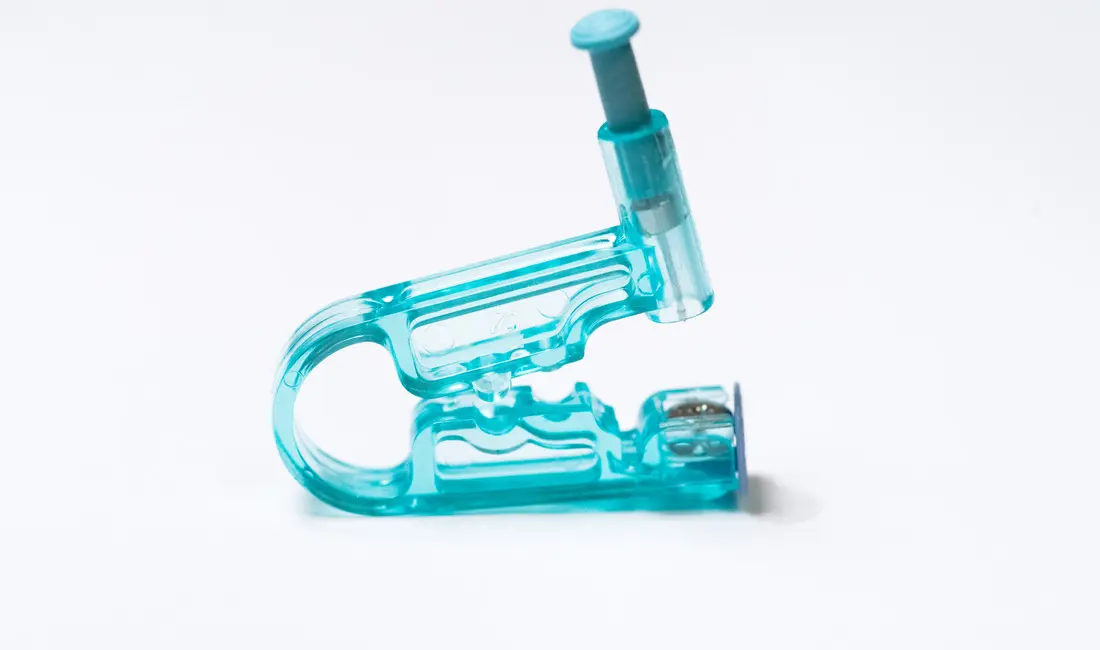
Photo by EM via Wikimedia Commons, CC BY-SA 4.0.
According to the Association of Professional Piercers, plastic piercing guns cannot be autoclave sterilised, and they force a blunt stud through the tissue in a way that works more like a crush injury than a clean piercing. Gun studs can be too short for the ear, and their butterfly clasps can make embedding worse. The APP also points out that babies and young children may be at higher risk from those problems.
A needle piercing by an experienced piercer uses a single-use sterile needle and jewelry chosen for the ear. Some studios have two piercers do both ears at the same moment, which is quicker for a child who will not sit still twice. Piercing gun vs needle covers the differences in detail.
Choosing who does it
The AAP suggests a doctor, a nurse or an experienced technician. Whoever you choose, look for:
- Experience piercing children, and the patience to stop if your child is too distressed.
- A single-use needle opened in front of you, and sterilised equipment.
- Implant-grade jewelry, and a clear answer about exactly what metal it is.
- Marks checked with you before anything is pierced, with the chance to adjust them.
Studio policies vary. Some professional studios pierce infants, and some wait until a child can ask for the piercing themselves. Neither policy is a sign of a bad studio.
The right earrings
- Small, round and flat. Nothing that dangles, catches or can be grabbed.
- Implant-grade titanium or solid gold. The AAP recommends gold posts to reduce the risk of an allergic reaction; professional piercers use implant-grade titanium or solid gold for new piercings.
- A secure back. A flat-back labret, with a flat disc behind the ear and a threadless or internally threaded front, cannot be pulled apart the way a butterfly back can. See flat back earrings.
- A post long enough to allow for some swelling, so the back does not press into the skin.
Avoid hoops, dangling earrings, large stones and butterfly backs until the piercings have fully healed, and ideally until your child is older.
Caring for a baby’s new piercing
Advice on aftercare varies, and it is worth knowing that before you start.
The AAP’s parenting page suggests applying rubbing alcohol or an antibiotic ointment twice a day for a few days, leaving the earring in for four to six weeks, and turning it gently each day. Professional piercers generally advise sterile saline and leaving the earring still, because alcohol dries and irritates healing skin and turning the earring drags crust through the new channel. The ear cleaning guide explains that approach.
Ask whoever does the piercing which routine they recommend, check it with your pediatrician, and then follow one routine consistently. Whichever you use:
- Wash your hands before touching the ears.
- Clean twice a day and pat dry with clean paper towel.
- Keep hair, hats and blankets from catching on the earrings.
- Check the earrings and backs daily, making sure nothing is loose and nothing is pressing into the skin.
- Leave the earrings in for the full healing time. An earlobe piercing typically takes six to ten weeks, and the AAP advises not removing the earrings for at least four to six weeks.
Signs of infection
The AAP advises seeking medical attention promptly if a piercing becomes red or tender. Watch for:
- Redness or swelling that is spreading.
- Skin that is warm or hot to the touch.
- Yellow or green discharge.
- An earring sinking into the skin.
- Your baby being feverish, unusually unsettled, or seeming unwell.
Call your pediatrician if you see any of these. Leave the earring in unless a doctor tells you to remove it, and see a doctor or piercer the same day if it is embedding. Infected ear piercing explains how to tell irritation from infection.
If you decide to wait
Nothing is lost. An earlobe piercing is one of the quickest and simplest piercings there is, and a child who asks for it, can sit still and can help with aftercare usually has a better experience. The earlobe piercing guide covers what to expect when the time comes.
Claire’s says it pierces from around 3 months old. Claire’s ear piercing sets out what it says and what to ask in store, and how to choose a piercer covers the wider checklist. Rowan and Banter publish their own age rules, and all three are compared here.
Not medical advice
This page is educational. Talk to your pediatrician before piercing a baby’s ears, and seek medical advice promptly if a piercing looks infected or your baby seems unwell.
Frequently asked questions
At what age can a baby get their ears pierced?
There is no medical minimum. The American Academy of Pediatrics says ears can be pierced at any age with little risk if it is done carefully, but recommends waiting until a child can look after the piercing themselves. Some pediatricians also ask parents to wait until after at least one tetanus vaccine.
Is it safe to pierce a baby's ears?
Generally it is low risk when done carefully, in a clean setting, with good jewelry and consistent aftercare. The main risks are infection, loose earrings becoming a choking hazard, earrings embedding in swollen skin, metal allergy and, rarely, keloids.
Should a baby's ears be pierced with a needle or a gun?
A needle. The Association of Professional Piercers notes that plastic piercing guns cannot be autoclaved, force the stud through tissue, and that babies and young children may be at higher risk. Pediatricians also advise avoiding businesses that use guns.
What earrings are best for a baby?
Small, round, flat studs in implant-grade titanium or solid gold, with a back that cannot be pulled off, such as a flat-back labret. Avoid hoops, dangling earrings, large stones and butterfly backs, which loosen easily.
How do I clean my baby's new ear piercing?
Advice varies. The AAP's parenting site suggests rubbing alcohol or an antibiotic ointment and turning the earring daily, while professional piercers generally recommend sterile saline and leaving the earring still. Ask whoever does the piercing and your pediatrician which routine to follow, then stick to one.
Does piercing ears young prevent keloids?
Not exactly. A small 2005 study of patients with ear keloids found keloids were more likely after piercings done at age 11 or older than before. It does not show that piercing is risk-free at any age, and a family history of keloids is worth discussing with your doctor first.
Sources
- American Academy of Pediatrics (HealthyChildren.org) - Avoiding infection after ear piercinghttps://www.healthychildren.org/English/health-issues/conditions/ear-nose-throat/Pages/Avoiding-Infection-After-Ear-Piercing.aspx
- University of Utah Health - Ear piercing: how young is too young?https://healthcare.utah.edu/healthfeed/2023/07/ear-piercing-how-young-too-young
- Pediatrics (2005) - Relationship between age of ear piercing and keloid formationhttps://pubmed.ncbi.nlm.nih.gov/15867040/
- Association of Professional Piercers - Why piercing guns are a problemhttps://safepiercing.org/piercing-guns/
- Association of Professional Piercers - Jewelry for initial piercingshttps://safepiercing.org/jewelry-for-initial-piercings/
This article is for education only and is not medical advice. If a piercing is hot, swollen, spreading redness, oozing yellow or green discharge, or you have a fever, see a doctor today.