On this page
The rings, dangles and spirals people search for are, according to WebMD, styles for a healed piercing. The pages we read name one starting style for a new navel piercing: a curved barbell.
This page follows the Association of Professional Piercers (APP), WebMD and Healthline, plus one retailer guide (BodyCandy) for what the styles look like. It also shows where they disagree, because they do on bar length. Details are as read in September 2026.
Which jewelry goes where
| Stage | Jewelry | What the sources say |
|---|---|---|
| New piercing | Curved barbell, in titanium | WebMD says you are likely to use one, usually titanium. BodyCandy calls it the go-to for initial piercings, in implant-grade titanium. |
| Healed piercing | Rings, dangles, spirals, circular barbells | WebMD lists these as styles for after healing. |
| Floating navel | Curved barbell with a flat disc on the lower end | See the floating navel page. |
Among the pages we read, none recommends starting a navel piercing with a ring.
Start with a curved barbell
WebMD describes it as a banana-shaped stick with a ball on either end. Banter’s glossary defines a curved barbell as slightly curved and says it is usually used for eyebrow or belly button piercings.
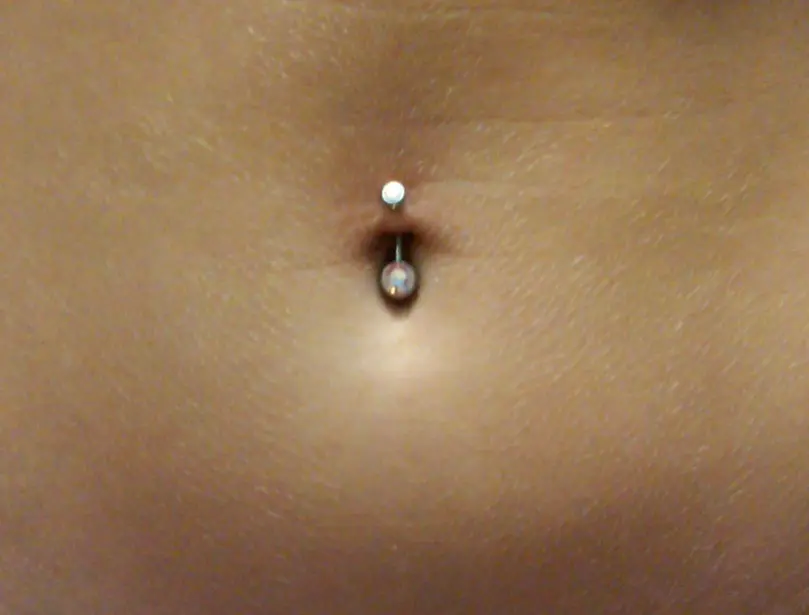
Photo by Jnagy3 via Wikimedia Commons, CC BY-SA 4.0.
The APP says its members use internally threaded or threadless jewelry for initial piercings, so the part that passes through the skin is smooth. Its wording on rings is short: rings are best for some areas, straight or curved bars for others. See threadless vs threaded for how each is assembled.
Bar length: the sources disagree
| Source | Bar length | Note |
|---|---|---|
| WebMD | 7/16 inch, about 11 mm | Says the correct length is 7/16 inch. |
| BodyCandy | 3/8 inch, or 10 mm | Calls it the standard size for most navel piercings, with 14 gauge. |
| Our belly button page | 10 to 12 mm | A typical starting range, not a measurement of you. |
| APP | No figure | Says jewelry must be of appropriate length or diameter for your unique anatomy and the placement. |
The gap between 3/8 and 7/16 inch is under 2 mm, but it shows that no source has a length that fits everyone. The APP ties length to your anatomy and says jewelry that is too tight does not allow air and blood circulation. A piercer picks the bar when they see the fold of skin.
Gauge
The two sources that give a figure agree. WebMD says around 14 gauge, and BodyCandy gives 14 gauge as 1.6 mm. The APP gives no number but explains why not to go thinner: the body may treat jewelry that is too thin like a splinter, resulting in migration or rejection. See belly button piercing rejection and the gauge and size chart.
Materials
| Source | Materials it lists |
|---|---|
| APP, for initial piercings | Steel meeting ASTM F-138 or ISO 5832-1, implant-certified titanium (ASTM F-136) or commercially pure titanium (ASTM F-67), niobium, gold of 14k or higher that is nickel- and cadmium-free, platinum, and certain glass |
| WebMD | Medical-grade stainless steel, 14-karat gold, titanium or niobium |
| Healthline | 14- or 18-karat gold, titanium, surgical steel or niobium, and it says to avoid nickel alloys and brass |
| BodyCandy | Implant-grade titanium for a new piercing |
The lists overlap on titanium, gold and niobium. The difference is steel: the APP names the standards it must meet, while WebMD and Healthline say medical-grade or surgical steel without one. If steel is offered, ask which standard it meets. The APP also says gold above 18k is too soft for body jewelry, and that niobium is very similar to titanium but has no implant-grade designation. The materials guide explains the standards.
Styles for once it has healed
WebMD lists five, and describes them briefly:
| Style | WebMD’s description |
|---|---|
| Non-dangle ring | Like the curved barbell but with diamonds or other gems at the ends |
| Dangle ring | A charm hangs from one end |
| Twister spiral | Spiral-shaped rather than curved, with screw-on balls |
| Captive bead ring | A complete circle with a ball |
| Circular barbell | A hoop with two balls |
BodyCandy adds a reverse or top-down style, also called a J-bar, in which the main decorative piece sits inside the belly button. Banter’s glossary defines a captive bead ring as a hoop with a single unattached bead held in place by tension, and a circular barbell as a curved barbell that makes an incomplete circle. Our ring styles guide covers how each opens.
The APP’s healed-piercing page groups jewelry by how it fastens: tension rings that need bending or removal of a dimpled ball, threaded pieces, press-fit pieces, free-standing pieces and pieces held in by shape.
Dangles, weight and clothing
BodyCandy says dangle rings are more likely to snag on clothing and suggests swapping them out during workouts or sleep. WebMD says tight clothing and rough fabric rub against a navel piercing and can make it take longer to heal. The APP suggests protecting a healing navel from irritation, sports and tight clothing with a hard, vented eye patch from a pharmacy.
Our belly button page goes further and advises avoiding dangly or heavy jewelry while healing. That is our own advice, not a rule from these sources.
When to change it
WebMD says to wait until the piercing has healed to change the jewelry, at least 6 months. The APP says to leave the initial jewelry in place for the entire healing process unless there is a problem with its size, style or material, and that many piercings need a downsize before they are healed. It says to see a qualified piercer for downsizes or any change during healing. Our piercing page puts the downsize at 8 to 12 weeks.
Those are different questions, and the sources do not reconcile them. If a piercer says the bar is too long, follow their assessment of your piercing. Our healing guide and downsizing guide go through it.
What to check when you buy
- Gem settings. The APP says stones should be set securely, often in a prong or bezel, and that some makers use adhesive. It says that if a glued stone falls out, which is common with lower-priced goods, the whole piece has to be replaced.
- Threading. The APP says externally threaded jewelry has a rough screw pattern that may be passed through the tissue.
- A loose ball. For captive rings, the APP says you may need a new ball or the tension adjusted.
- Irritation. For a healed piercing, the APP says to quickly replace any jewelry that causes irritation, itching, swelling or redness, however much you like it.
The cost guide covers what jewelry adds to the price. If you need to hide the piercing or remove metal for a scan, see piercing retainers, and how to choose a piercer covers who fits the first bar.
Frequently asked questions
What jewelry should I start a belly button piercing with?
A curved barbell. WebMD says you are likely to use one, usually titanium, and BodyCandy calls it the go-to for initial piercings. None of the pages we read recommends starting a navel piercing with a ring. WebMD lists rings, dangles and spirals as styles for after healing.
What size belly button ring do I need?
The two sources that give a figure agree on 14 gauge, about 1.6 mm, but not on bar length: WebMD says 7/16 inch and BodyCandy says 3/8 inch, or 10 mm. The Association of Professional Piercers (APP) gives no figure and says length must suit your anatomy, so have a piercer measure.
What metal should a belly button ring be made of?
Titanium, gold, niobium and steel are on the APP, WebMD and Healthline lists. The APP attaches standards: implant-certified titanium (ASTM F-136), steel to ASTM F-138 or ISO 5832-1, and nickel-free gold of 14k or higher. Healthline says to avoid nickel alloys and brass.
When can I change my belly button ring?
WebMD says to wait until the piercing has healed, at least 6 months. The APP says to leave the initial jewelry in for the whole healing process unless there is a problem with its size, style or material, and that many piercings need a downsize first, done by a piercer.
Can I wear a dangle belly ring?
WebMD lists dangle rings among the styles for after healing, and BodyCandy says dangles are more likely to snag on clothing and suggests swapping them out for workouts or sleep. Our belly button page advises against dangly or heavy jewelry while healing.
What if the ball on my ring keeps coming loose?
The APP says that if the ball on a captive ring comes off or is loose, you may need a new ball or to have the tension on the ring adjusted. Ask your piercer to check it rather than wearing it loose.
Sources
- Association of Professional Piercers - Jewelry for initial piercingshttps://safepiercing.org/jewelry-for-initial-piercings/
- Association of Professional Piercers - Jewelry for healed piercingshttps://safepiercing.org/jewelry-for-healed-piercings/
- Association of Professional Piercers - Suggested aftercare for body piercingshttps://safepiercing.org/aftercare/
- WebMD - Belly button piercing and your healthhttps://www.webmd.com/beauty/belly-button-piercing
- Healthline - Belly button piercing: your piercer, aftercare, infection, and morehttps://www.healthline.com/health/belly-button-piercing
- BodyCandy - Types of belly button ringshttps://www.bodycandy.com/blogs/news/types-of-belly-button-rings
- Banter - Body jewelry glossaryhttps://www.banter.com/body-jewelry-glossary
This article is for education only and is not medical advice. If a piercing is hot, swollen, spreading redness, oozing yellow or green discharge, or you have a fever, see a doctor today.