On this page
Is your piercing healed?
Tick everything that is true right now. All four have to hold, and the calendar has to agree, before a jewelry change is a good idea.
Tick the boxes above to see where you stand.
This is a guide, not a clearance. Even with all four true, having your piercer look at it and make the first change is the safer route, and it is usually quick and cheap. If anything is hot, spreading, producing thick or coloured discharge, or you have a fever, see a doctor rather than a piercer.
The short answer is four to six months for a nostril and two to three months for a septum, and almost nobody wants to hear it.
Your nose piercing will look completely healed at around six weeks. The outside seals quickly because the surface skin closes first. Inside, the channel is still a thin, new, fragile tube of tissue that tears if you drag jewelry through it. That gap between looking healed and being healed is where most nose piercing problems are created. How long a nose piercing takes to heal walks through each stage, for every nose placement.
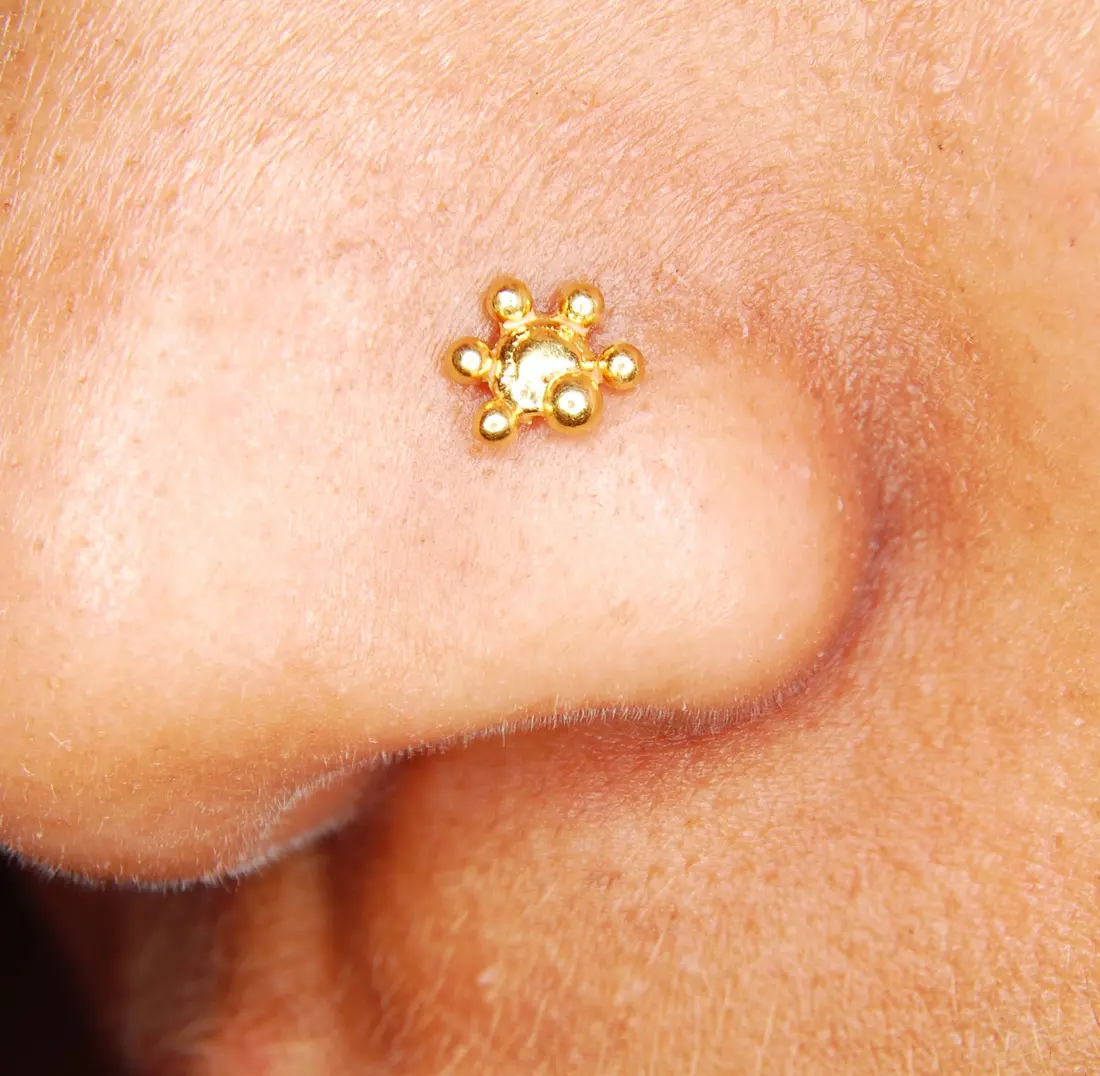
Photo by Challiyil Eswaramangalath Vipin via Wikimedia Commons, CC BY-SA 2.0.
Before buying the new piece, nose ring sizes covers gauge, post length and hoop diameter, and nose piercing jewelry compares the styles.
The four tests
Do not go by the calendar alone. Your piercing is ready when all four of these are true, not three:
- No tenderness. Press gently beside the jewelry. Nothing.
- No discharge or crusting for at least two weeks.
- No redness or pink tinge around either opening.
- The jewelry moves freely with no tugging or resistance when you touch it.
If any one of those fails, wait another month and test again.
Downsizing is not the same thing
There is one jewelry change that should happen early: the downsize.
Your initial post was deliberately longer than needed to leave room for swelling. Once the swelling has gone, at about four to eight weeks, that extra length sticks out and catches on towels, pillows and clothing. Have your piercer fit a shorter post.
This is not the same as a full jewelry change and it should be done by a piercer, not at home. It is short, quick, and it prevents most nostril bumps.
Doing it yourself, safely
Once you have passed all four tests:
- Wash your hands and clean the piercing with saline first.
- Do it after a warm shower, when the tissue is soft and pliable.
- Have the new jewelry ready, cleaned and to hand. The channel starts shrinking the moment the old jewelry is out.
- Do not force anything. If it resists, stop.
- Use a flat-back labret, not a nose bone or an L-shape. Bones have a ball fused on the end that you must force through the channel; L-shapes rotate inside the nostril and are hard to insert.
For a first change, having a piercer do it is genuinely the better call. It costs little, takes two minutes, and they will tell you whether it was actually ready.
If it will not go back in
This is common and it is not a disaster, but the response matters.
Do not force it. Pushing hard against resistance creates a false channel through the tissue alongside the real one, which is painful, bleeds and heals badly.
Instead:
- Try again after a warm shower with a gentle, straight angle.
- Try a taper if you have one, or ask a friend to help you see the angle.
- Go to a piercer. They reinsert jewelry into shrunken channels routinely, using an insertion taper, and it takes seconds.
If it has been out for days rather than hours, the channel may have closed. A piercer will tell you whether it can be reopened or needs re-piercing.
Keep a titanium retainer somewhere you can reach it. If jewelry ever falls out, having something to put straight back in saves the piercing.
Septum piercings
Two to three months, because the sweet spot is soft tissue with a good blood supply rather than cartilage.
The particular trap with a septum is flipping. If you hide the piercing by flipping a horseshoe up into your nose every morning and down every evening, you are dragging the ring through the channel twice a day, and that is enough movement to keep it inflamed for months. If you need it hidden, wear a retainer instead of flipping a ring.
What to change into
Implant-grade titanium (ASTM F136) or solid 14k or higher gold. Threadless or internally threaded, so the post that passes through the channel is smooth.
Gold-plated, mystery “surgical steel” and sterling silver are all poor choices for a piercing that is less than a year old. Silver in particular can tarnish against tissue and leave a permanent grey mark. See the jewelry material guide.
If something goes wrong after a change
A bump appearing within days of a jewelry change is an irritation bump, and the cause is nearly always the change itself or the new jewelry. Put the old jewelry back if you can, keep up saline, and give it four to eight weeks. See piercing bump vs keloid.
Heat, spreading redness, thick coloured discharge, increasing swelling or fever means see a doctor and leave the jewelry in. More in infected nose piercing.
Frequently asked questions
When can I change my nose piercing?
A nostril piercing needs four to six months before the first jewelry change. A septum needs two to three months. Both look healed far earlier, which is why changing at four to six weeks is the most common way people cause a bump.
How do I know my nose piercing is healed?
Four tests: no tenderness when you touch it, no discharge or crusting for at least two weeks, no redness around the opening, and the jewelry moves freely without any tugging sensation. All four, not three.
What happens if I change it too early?
The channel is a thin new tube of tissue. Forcing jewelry through tears it, which restarts healing and usually produces an irritation bump. In the worst case the piercing swells shut around the new jewelry.
How long can I leave a nose piercing out?
In the first year, not long. A nostril channel can shrink enough to make reinsertion difficult within a few hours, and can close within a day. Even piercings held for years can shrink overnight.
What if I cannot get the jewelry back in?
Do not force it. Forcing creates a false channel through the tissue beside the real one. Go to a piercer, who can usually reinsert with a taper in seconds. If it has been out for a long time, a re-pierce may be needed.
Can a piercer change it for me?
Yes, and for a first change that is the best option. Most studios will do it for a small fee or free if you bought the jewelry there, and it takes a couple of minutes.
Sources
- Association of Professional Piercers - Suggested aftercare for body piercingshttps://safepiercing.org/aftercare/
- Association of Professional Piercers - Jewelry for initial piercingshttps://safepiercing.org/jewelry-for-initial-piercings/
- Association of Professional Piercers - Troubleshootinghttps://safepiercing.org/troubleshooting/
This article is for education only and is not medical advice. If a piercing is hot, swollen, spreading redness, oozing yellow or green discharge, or you have a fever, see a doctor today.