On this page
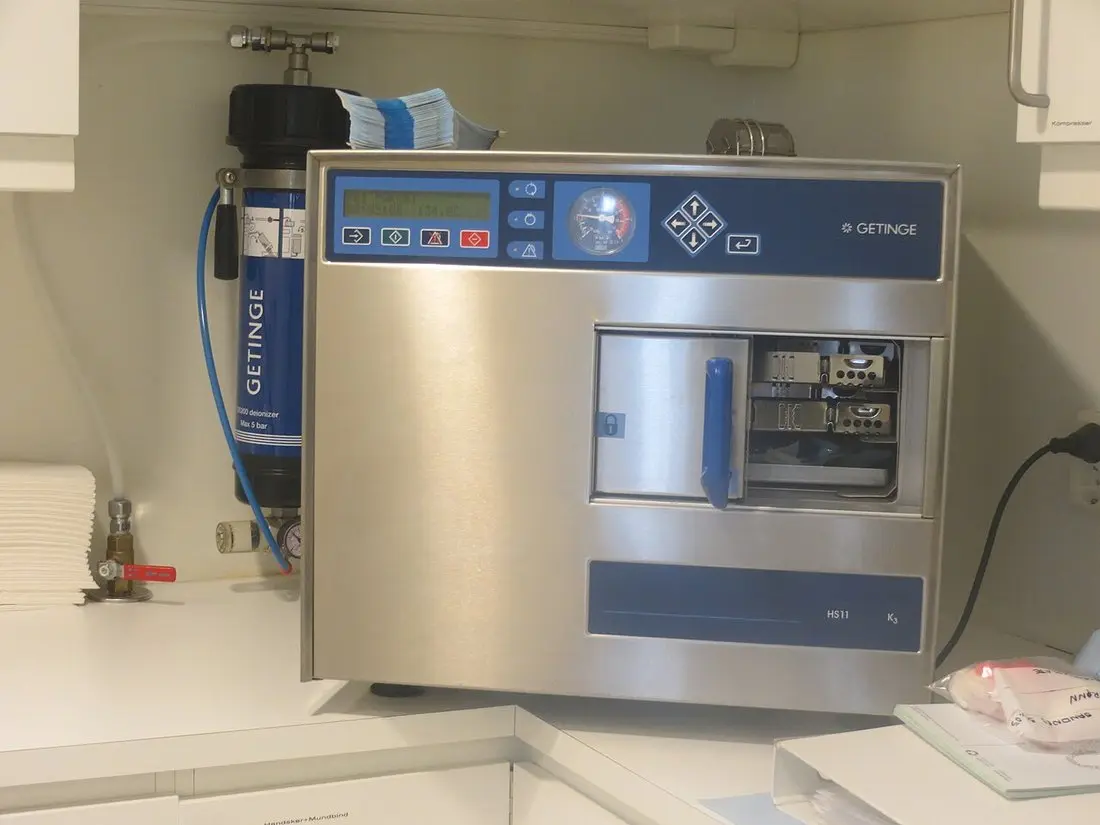
An autoclave is the machine that makes a piercing studio’s jewelry and tools safe to put into a wound. If a studio cannot show you a working one, treat that as a red flag.
You do not need to understand the engineering, but it is worth knowing what it does, what proves it is working, and what to ask.
What it does
Sterilising means destroying all microbial life, including bacterial spores. Disinfecting does not. The Association of Professional Piercers (APP) describes an autoclave as a device that uses steam under pressure to sterilise jewelry and other equipment used for piercings, by killing germs and their spores.
The CDC explains that steam sterilisation depends on four parameters: steam, pressure, temperature and time. Pressure is the means of reaching the high temperatures needed to kill microorganisms quickly. Two standard exposures it lists:
| Type of sterilizer | Temperature | Standard exposure |
|---|---|---|
| Gravity displacement | 121°C (250°F) | 30 minutes |
| Prevacuum | 132°C (270°F) | 4 minutes |
Both are well above 100°C, the temperature boiling water reaches at normal pressure. Boiling and wiping with alcohol are not sterilisation.
What gets autoclaved in a studio
The APP says needles, tools and jewelry should be sealed in individual sterile packages or sterilised in a cassette. Each needle is used on one client and then discarded in a sharps container, and the packages or cassettes should be opened while you are present.
The APP’s 2025 statement on point-of-use sterilisation defines it as sterilising instruments and other items in the same room or area where the piercing is done, generally in a cassette-based sterilizer, for immediate use rather than pre-packaging for later. It says this lets the piercer autoclave jewelry and instruments at the time of use.
Which kind counts
The APP says sterilisers in piercing studios should be front-loading and/or cassette-based, such as a Statim. It says top-loading machines, dry heat and liquid soaks are not acceptable sterilisation methods for piercings. If a studio says it “disinfects” instead, that is not the same thing.
How you know it works: spore tests
A machine can look like it is working and not be. The CDC says the steam cycle is monitored by mechanical, chemical and biological monitors.
- Mechanical: the machine’s own readings of time, temperature and pressure.
- Chemical: indicators fixed to the outside of a pack and placed inside it, which monitor temperature, or time and temperature.
- Biological: the spore test. The CDC says the effectiveness of steam sterilisation is monitored with a biological indicator containing spores of Geobacillus stearothermophilus. Bacterial spores are among the hardest things to kill, so if they die, the machine did its job.
How often
Requirements for piercing studios vary by state and local health department, so the honest answer is to ask. For reference, the CDC’s dental guidance is that a spore test should be used at least weekly to monitor sterilisers, with a matching control.
If a spore test comes back positive, that guidance is to remove the sterilizer from service and repeat the test immediately. If the repeat is also positive, the sterilizer stays out of service until it has been inspected or repaired and passed spore tests in three consecutive fully loaded cycles.
What to ask your piercer
The APP says spore test results should be posted publicly or readily available for you to review, and that packages and cassettes should be opened while you are present. So sensible questions are:
- What sterilisation method do you use?
- Can I see your latest spore test results?
- Can I watch you open the packages or cassettes?
A studio that is proud of its process will show you. One that gets defensive has told you what you need to know. How to choose a piercer has the full checklist.
Why guns do not qualify
The APP says plastic ear piercing guns cannot be autoclave sterilised, and that wiping a gun with antiseptic does not kill pathogens inside its working parts. APP members may not use reusable ear piercing guns for any piercing. See piercing gun vs needle.
Why it cannot be done at home
A home setup has no autoclave and no way to spore test one. Piercing kits and DIY piercing covers what goes wrong.
When sterility fails
A piercing done with unsterile equipment risks infection. Irritated or infected piercing explains the signs, and how to treat an infected piercing explains what to do.
Frequently asked questions
What is an autoclave?
A sterilising machine that uses steam under pressure. The Association of Professional Piercers (APP) describes it as a device that sterilises jewelry and other equipment used for piercings by killing germs and their spores, and calls it a necessary piece of equipment. The CDC says steam sterilisation depends on four things: steam, pressure, temperature and time.
How does an autoclave work?
Items are exposed to steam at a set pressure, temperature and time. The CDC says pressure is how the high temperatures needed to kill microorganisms are reached quickly. Two standard exposures it lists are 30 minutes at 121°C (250°F) in a gravity displacement sterilizer, and 4 minutes at 132°C (270°F) in a prevacuum sterilizer.
What is a spore test?
A test that shows the autoclave is working. The CDC says the effectiveness of steam sterilisation is monitored with a biological indicator containing spores of Geobacillus stearothermophilus. Bacterial spores are among the hardest things to kill, so if they die, the machine reached sterilising conditions.
How often should an autoclave be spore tested?
Rules for piercing studios vary by state and local health department. The CDC's dental guidance is to spore test sterilisers at least weekly, with a matching control. The APP says a studio's results should be posted publicly or readily available for you to review.
Does every piercing studio need an autoclave?
In practice, yes. The APP calls an autoclave a necessary piece of equipment and says sterilisers in piercing studios should be front-loading and/or cassette-based. Whether the law requires one depends on your state and local health department.
Can piercing guns be autoclaved?
The APP says plastic ear piercing guns cannot be autoclave sterilised, and that wiping a gun with antiseptic does not kill pathogens inside its working parts. That is one reason it says a reputable professional will not use a gun for any piercing.
Sources
- CDC - Steam sterilizationhttps://www.cdc.gov/infection-control/hcp/disinfection-sterilization/steam-sterilization.html
- CDC - Best practices for sterilization monitoring in dental settingshttps://www.cdc.gov/dental-infection-control/hcp/dental-ipc-faqs/sterilization-monitoring.html
- Association of Professional Piercers - Picking your piercerhttps://safepiercing.org/picking-your-piercer/
- Association of Professional Piercers - 2025 stance on point of use steam sterilizationhttps://safepiercing.org/2025-app-stance-on-point-of-use-steam-sterilization/
- Association of Professional Piercers - Why piercing guns are a problemhttps://safepiercing.org/piercing-guns/
This article is for education only and is not medical advice. If a piercing is hot, swollen, spreading redness, oozing yellow or green discharge, or you have a fever, see a doctor today.