On this page
Piercing kits are sold to the general public, and they look simple: a needle or a gun, a pair of studs, a pack of wipes. The professional body for piercers is blunt about them. The Association of Professional Piercers (APP) says piercing kits for sale to the general public represent a serious potential health hazard.
This page explains what is wrong with them, and what to do if you have already used one.
What the APP says
The APP’s position on kits comes down to four points:
- Training. Much piercer education and training is necessary to perform a safe, sterile, accurate piercing, and simply providing tools to an inexperienced consumer is, in the APP’s words, a dangerous act of negligence.
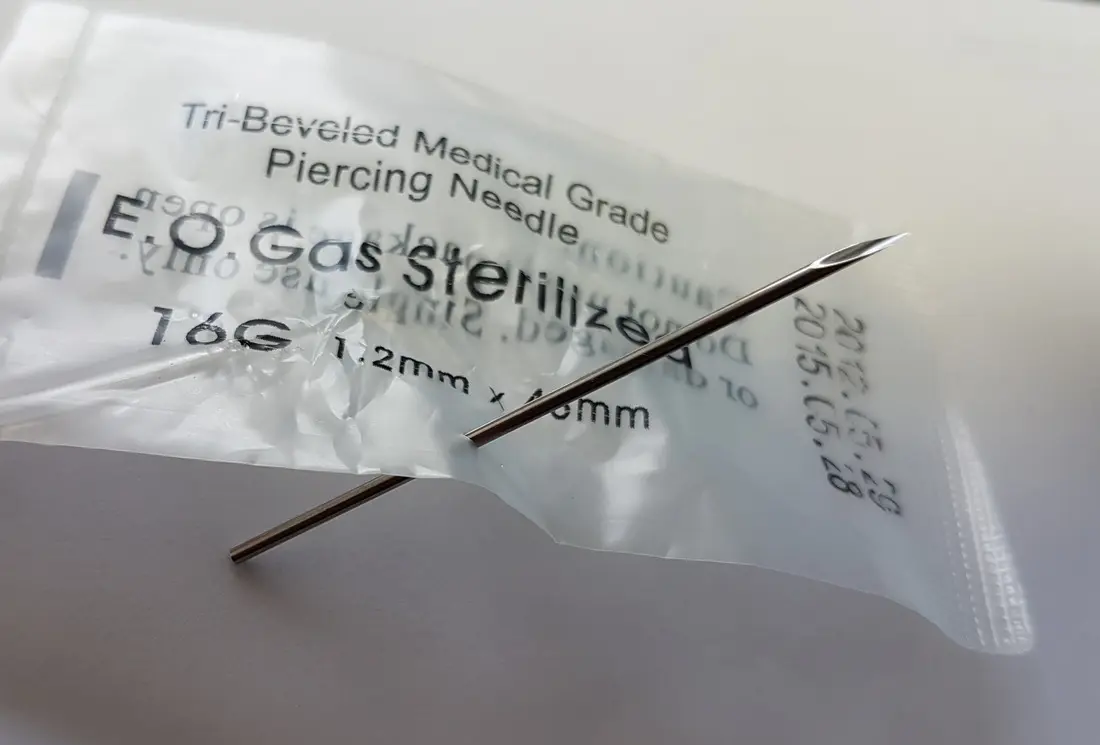
- Sterility. All tools, needles and jewelry must be sterile, and all needles must also be single-use.
- Jewelry. What is in the kit is low quality and not sized to your anatomy.
- Support. A kit does not come with a piercer to consult when problems come up, and there is no clean, hygienic environment to do it in.
The jewelry problem
This is the part people underestimate, because the needle gets all the attention. The APP lists what bad jewelry does:
- Low quality jewelry can cause an immediate problem, an allergic reaction, or longer-term problems: prolonged healing and excessive scar tissue.
- Improperly sized jewelry can cause excessive swelling, embedding of the jewelry under the skin, or even cause a piercing to fail.
Jewelry that suits a piercing is a matter of material, finish and length. The APP’s own standard names specific accepted materials, such as implant-certified titanium. See the materials guide for what to look for, and piercing downsizing for why length matters.
The sterility problem
A kit cannot supply the process that makes a piercing sterile. The APP’s checklist for a studio includes a working autoclave, regular spore tests, and needles, tools and jewelry sealed in sterile packages or sterilised in a cassette and opened in front of you. A home has no autoclave and no way to spore test one. What is an autoclave explains what that machine does.
What about guns?
Some kits use a gun-style instrument, and it does not solve the problem. The APP says most ear piercing guns cannot be sterilised, and that a reputable professional will not use a gun for any piercing, even for earlobes. The Cleveland Clinic says piercing guns are not always sterilised between uses, and quotes a physician who recommends needles for piercing children. See piercing gun vs needle.
What a studio costs
The saving from a kit is smaller than it looks. On this site, an earlobe is the cheapest piercing at $20 to $40 for the piercing, before jewelry, and a second lobe is $25 to $60. Piercing prices shows every placement. How much is ear piercing compares studio and retail prices from published price lists.
If you are under 18
The APP’s standard is that for any piercing of a minor, a parent or legal guardian must be present to sign a consent form. That is a reason not to skip a studio, not a reason to skip the parent. Laws vary by state, so check the rules where you live.
If you have already done it
- Leave the jewelry in. The NHS says to leave your jewellery in unless a doctor tells you to take it out, and the APP warns that removing it from an infected piercing may result in an abscess.
- Clean it with sterile saline and nothing else. See piercing aftercare products.
- Watch for infection. Irritated or infected piercing has a symptom table.
- See a doctor if it looks infected. The NHS advises an urgent GP appointment or NHS 111 if you think your piercing might be infected. How to treat an infected piercing explains what to do.
- Consider having a professional look at the jewelry. The APP says initial jewelry must be of appropriate length or diameter for your anatomy, which a kit cannot guarantee. Do not remove anything yourself if the piercing is infected.
What to do instead
- Find a studio that passes the checks. How to choose a piercer lists them, and the APP’s member directory at safepiercing.org helps.
- Start with the cheapest placement if cost is the barrier. An earlobe is the least expensive on this site.
- Travel if you have to. A long drive is worth it.
Not medical advice
This page is educational. If a piercing is hot, has spreading redness, thick coloured discharge or red streaks, or you feel unwell, see a doctor the same day.
Frequently asked questions
Are at-home piercing kits safe?
The Association of Professional Piercers (APP) says piercing kits for sale to the general public represent a serious potential health hazard. It says much piercer education and training is necessary to perform a safe, sterile, accurate piercing, and that all tools, needles and jewelry must be sterile, with every needle single-use.
What is wrong with the jewelry in piercing kits?
The APP says the jewelry included is low quality and not sized to individual anatomy. Low quality jewelry can cause an allergic reaction, prolonged healing or excessive scar tissue, and improperly sized jewelry can cause excessive swelling, embedding of the jewelry under the skin, or even a piercing to fail.
Can I pierce my own ears at home?
Professionals advise against it. The APP says kits do not come with a piercer to consult when problems come up, and lack a clean, hygienic environment. The American Academy of Dermatology's advice is to select an experienced piercer in a licensed studio. An earlobe is also the cheapest piercing on this site, at $20 to $40 for the piercing.
Is a piercing gun a safer option than a needle?
The APP says most ear piercing guns cannot be sterilised and that a reputable professional will not use a gun for any piercing, even for earlobes. The Cleveland Clinic says guns are not always sterilised between uses, and quotes a physician who recommends needles for piercing children.
What if I have already pierced myself and it looks infected?
Leave the jewelry in unless a doctor says otherwise, keep cleaning with sterile saline, and get it seen. The NHS advises an urgent GP appointment or NHS 111 if you think a piercing might be infected, and in the US that means a doctor or urgent care promptly. The APP warns that removing jewelry from an infected piercing may result in an abscess.
How do I find a good piercer if there is no studio near me?
Use the APP's member directory at safepiercing.org and be prepared to travel. A long drive to a studio that passes the checks is worth it. How to choose a piercer lists what to look for, and what to ask, before you book.
Sources
- Association of Professional Piercers - Piercing FAQhttps://safepiercing.org/piercing-faq/
- Association of Professional Piercers - Picking your piercerhttps://safepiercing.org/picking-your-piercer/
- Association of Professional Piercers - Why piercing guns are a problemhttps://safepiercing.org/piercing-guns/
- American Academy of Dermatology - How to care for a new piercinghttps://www.aad.org/news/how-to-care-for-a-new-piercing
- Cleveland Clinic - Ear piercing 101: healing, hurting, cleaning and morehttps://health.clevelandclinic.org/what-to-expect-when-getting-your-ears-pierced
- NHS - Infected piercingshttps://www.nhs.uk/conditions/infected-piercings/
This article is for education only and is not medical advice. If a piercing is hot, swollen, spreading redness, oozing yellow or green discharge, or you have a fever, see a doctor today.