On this page
A lip piercing’s jewelry decides how kind it is to your teeth and gums. The style matters less than the length: the APP and the ADA both say the long starter jewelry has to be replaced with a shorter piece once the swelling goes.
This page follows the Association of Professional Piercers (APP), the American Dental Association (ADA), WebMD and Healthline, and reports dental research where a review gives numbers. Details are as read in September 2026.
The labret stud
Banter’s glossary says a labret is the common name for both the piercing in the centre of the lower lip and the jewelry worn there. The APP calls a labret stud specialty jewelry for specific placements. In our guides a flat-back labret stud has a decorative end on the outside and a flat disc inside the mouth, and flat back jewelry explains the design.
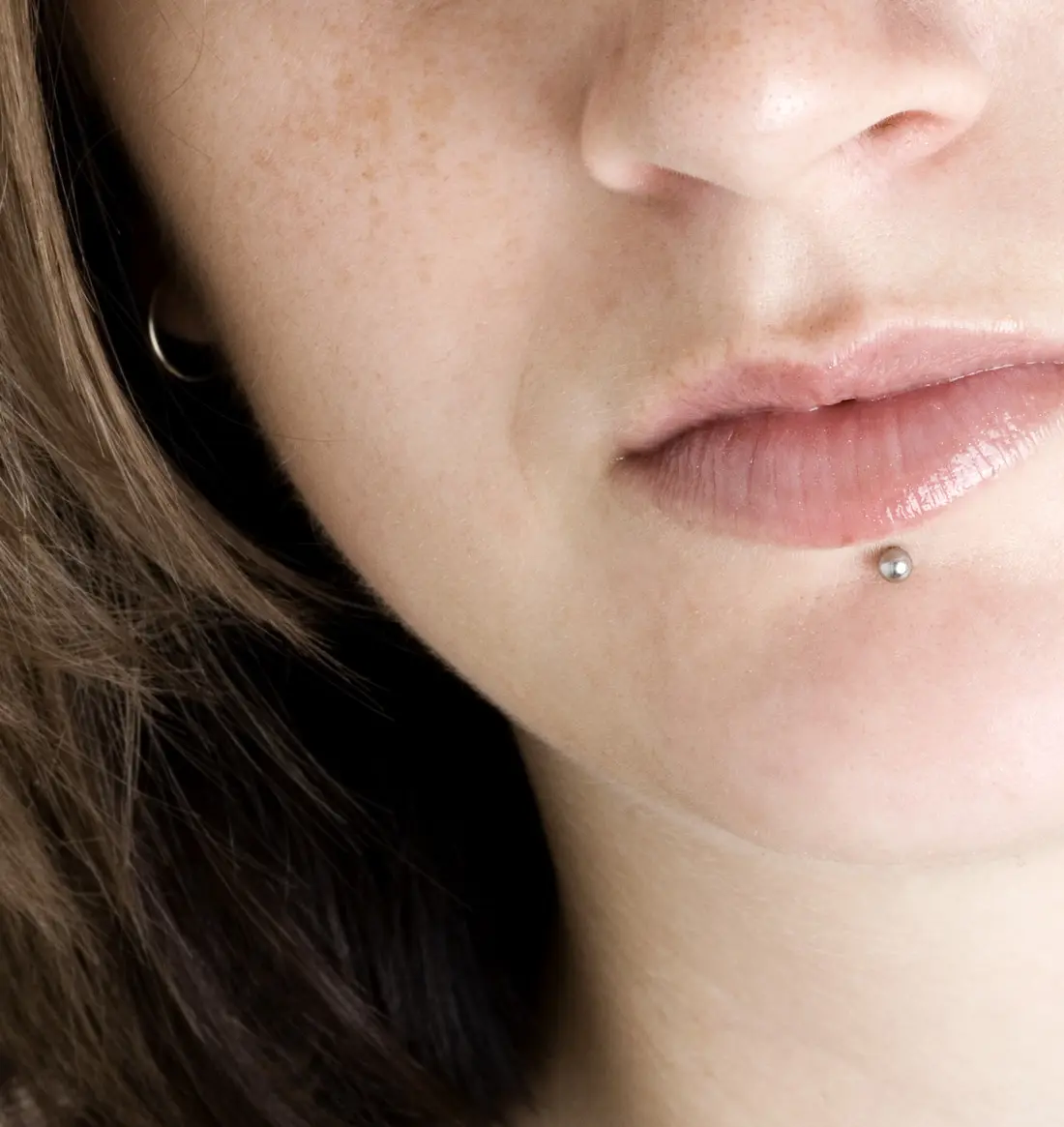
Photo by Nicholas Renaud via Wikimedia Commons, CC BY-SA 2.0.
What our piercing pages list
These are the typical starting figures on our own pages, not measurements from the sources, and none of the APP, ADA or WebMD pages we read gives a length in millimetres.
| Piercing | Starting jewelry | Downsize window |
|---|---|---|
| Labret | Flat-back labret stud, 10 mm post, downsized to 6 to 8 mm | 2 to 4 weeks |
| Medusa | Flat-back labret stud, 8 to 10 mm post | 2 to 4 weeks |
| Monroe | Flat-back labret stud, 8 to 10 mm post, downsized to 5 to 6 mm | 2 to 4 weeks |
| Ashley | Flat-back labret stud, 8 to 10 mm post, downsized to 5 to 6 mm | 2 to 4 weeks |
| Vertical labret | Curved barbell, 12 to 14 mm, downsized to 8 to 10 mm | 3 to 6 weeks |
| Snake bites | Two flat-back labret studs, 10 mm posts, downsized to 6 to 8 mm | 2 to 4 weeks |
All are 16 gauge on our pages. Types of lip piercings compares the whole group.
Start long, then shorten the post
The APP says that once the swelling has subsided, it is vital to replace the original, longer jewelry with a shorter post or barbell to avoid damage to the teeth and gums. For lip and cheek piercings it adds that posts should be shortened to fit snugly once healing is done, to minimize contact of the jewelry with the teeth and gums. The ADA says the piercee needs to visit their piercer to replace the longer piece with a shorter one, to help minimize damage or irritation to oral tissues.
The APP also says jewelry must be of appropriate length or diameter for your unique anatomy and the placement, and that jewelry that is too tight does not allow for air and blood circulation. So the first post is long enough to allow for swelling and the second is fitted to the healed lip. Piercing downsizing explains the swap.
Studs, rings and curved barbells
Here the sources say little. The APP’s only line on style is that rings are best for some areas, straight or curved bars for others, and specialty jewelry such as a labret stud for specific placements. The ADA lists studs, barbells, rings and hoops as common oral jewelry, and names a lip ring or stud when it says to remove jewelry for sports.
The one placement where we found styles laid out is the vertical labret. Healthline lists three options for it:
| Option | Healthline’s description |
|---|---|
| Fully enclosed ring or hoop | Wraps around the entire pierced area, similarly to an earring in your earlobe |
| Curved barbell | A thick rod that usually measures 14 to 16 gauge and bends around the lips, with beads on each end facing forward |
| Vertical labret bars | Go through the piercing vertically with a bead on each end, and can be worn side by side for double vertical labrets |

Photo by GorillaWarfare via Wikimedia Commons, CC0.
None of the pages we read says whether a ring suits a new lip piercing, and none of the dental studies we read separates rings from studs. Ask your piercer what they would start with and why. Our ring styles guide covers how rings open.
Materials
| Source | What it says |
|---|---|
| APP | Quality jewelry in an appropriate material, and points to its minimum jewelry standards for initial piercings |
| WebMD, vertical lip piercing | Surgical stainless steel, gold, titanium or acrylic |
| ADA | Steel, gold, titanium and various alloys or synthetic materials, and research found lower bacterial colonization on synthetics such as PTFE or polypropylene than on steel or titanium |
Our tongue jewelry page sets out the studies that compare materials in the mouth. They were done on tongue piercings, so we do not apply them to lips. The materials guide explains the APP standards.
What the dental research says
The Mosaddad et al. review, a systematic review of 34 studies published in 2023, summarises these findings on lip piercings:
| Study | What it reported |
|---|---|
| Kieser et al. (2005) | 80% of those with labial piercings showed signs of gum recession at one or more piercing sites |
| Vilchez-Perez et al. (2009) | Gum recession was more common, and there was less keratinized and attached gum, on the piercing side |
| Giuca et al. (2012), 25 people with piercings and 25 without | Those with tongue or lip piercings had more significant gum recession than those without |
These are individual studies as the review summarises them, and none of the figures we read tells you which jewelry style or post length was worn. They do fit the APP’s advice to shorten the post.
Habits, sports and how long you wear it
The ADA says habits related to the presence of a piercing, such as biting, rolling, stroking and sucking, are the main cause of damage to the dentition. The APP says playing with oral jewelry is the most frequent cause of tooth and gum damage and should be avoided. The ADA says all oral jewelry, including a lip ring or stud, should be removed before athletic and other physical activity, particularly contact and collision sports, and MouthHealthy says to use a mouthguard. The ADA also says long-term wearing of oral jewelry is discouraged.
Keeping it secure
The APP says to check that threaded ends are on securely and to tighten them daily, and that threadless jewelry should have no gaps between post and top. MouthHealthy says you could possibly choke if part of the jewelry breaks off in your mouth. Threadless vs threaded explains the two fastenings, and lip piercing healing time and cost cover the rest.
Frequently asked questions
What jewelry do you start a lip piercing with?
The APP names a labret stud as specialty jewelry for specific placements, and our piercing pages list a flat-back labret stud with a post longer than you will wear later. The APP says the longer starter jewelry must be replaced with a shorter piece once the swelling has gone.
Can I start a lip piercing with a ring?
The sources we read give no rule for a new lip piercing. Healthline lists a fully enclosed ring or hoop among the options for a vertical labret, and the ADA counts lip rings as oral jewelry. The APP says rings are best for some areas and bars for others, so ask your piercer what they would start with.
How long should the post be?
The sources give no length. The APP says posts should be shortened to fit snugly once healing is done, to minimize contact with the teeth and gums. Our labret page lists a 10 mm post downsized to 6 to 8 mm. Your piercer sets the figure for your lip.
What metal should lip jewelry be?
WebMD lists surgical stainless steel, gold, titanium or acrylic for a vertical lip piercing, and the ADA lists stainless steel, gold, titanium, alloys and synthetic materials. For initial piercings the APP points to its minimum jewelry standards, which our materials guide explains.
Can a lip piercing damage my gums?
It can. The ADA says habits such as biting, rolling and playing with the jewelry are the main cause of damage. A 2023 review cites a study in which 80 percent of people with labial piercings showed signs of gum recession at one or more piercing sites.
Do I need to take a lip ring or stud out for sports?
The ADA says all oral jewelry, including a lip ring or stud, should be removed before athletic and other physical activity, particularly contact and collision sports. MouthHealthy adds that you should protect your mouth with a mouthguard.
Sources
- Association of Professional Piercers - Oral aftercarehttps://safepiercing.org/oral-aftercare/
- Association of Professional Piercers - Oral piercing risks and safety measureshttps://safepiercing.org/oral-piercing-risks-safety-measures/
- Association of Professional Piercers - Jewelry for initial piercingshttps://safepiercing.org/jewelry-for-initial-piercings/
- American Dental Association - Oral piercing/jewelryhttps://www.ada.org/resources/ada-library/oral-health-topics/oral-piercing-jewelry
- American Dental Association (MouthHealthy) - Oral piercingshttps://www.mouthhealthy.org/all-topics-a-z/oral-piercings
- WebMD - Vertical lip piercing: what is it, and are there any risks involved?https://www.webmd.com/skin-problems-and-treatments/what-to-know-about-a-vertical-lip-piercing
- Healthline - Vertical labret piercing: how it works, if it hurts, and aftercarehttps://www.healthline.com/health/vertical-labret
- Banter - Body jewelry glossaryhttps://www.banter.com/body-jewelry-glossary
- Mosaddad et al. (2023) - Oral complications associated with the piercing of oral and perioral tissues, and the awareness of the public and professionals: a systematic review. Diagnosticshttps://pmc.ncbi.nlm.nih.gov/articles/PMC10647284/
This article is for education only and is not medical advice. If a piercing is hot, swollen, spreading redness, oozing yellow or green discharge, or you have a fever, see a doctor today.