On this page
Tongue jewelry is a short list of choices, and the ones that matter most are set by your teeth and gums: how long the barbell is, what sits on the underside, and what it is made of.
This page follows the Association of Professional Piercers (APP), the American Dental Association (ADA) and WebMD, and reports what dental studies found where they give numbers. Details are as read in September 2026.
The parts that matter
| Part | What the sources say |
|---|---|
| Length | Start with a longer barbell to allow for swelling, then replace it with a shorter one. |
| The end under the tongue | A smaller ball or a low-profile end reduces contact (APP). |
| Fastening | Check threaded ends daily (APP) and check tightness periodically (ADA). |
| Material | The APP points to its minimum jewelry standards. The ADA and dental studies compare metals and synthetics. |
| Habits | Playing with the jewelry is the main cause of damage (ADA, APP). |
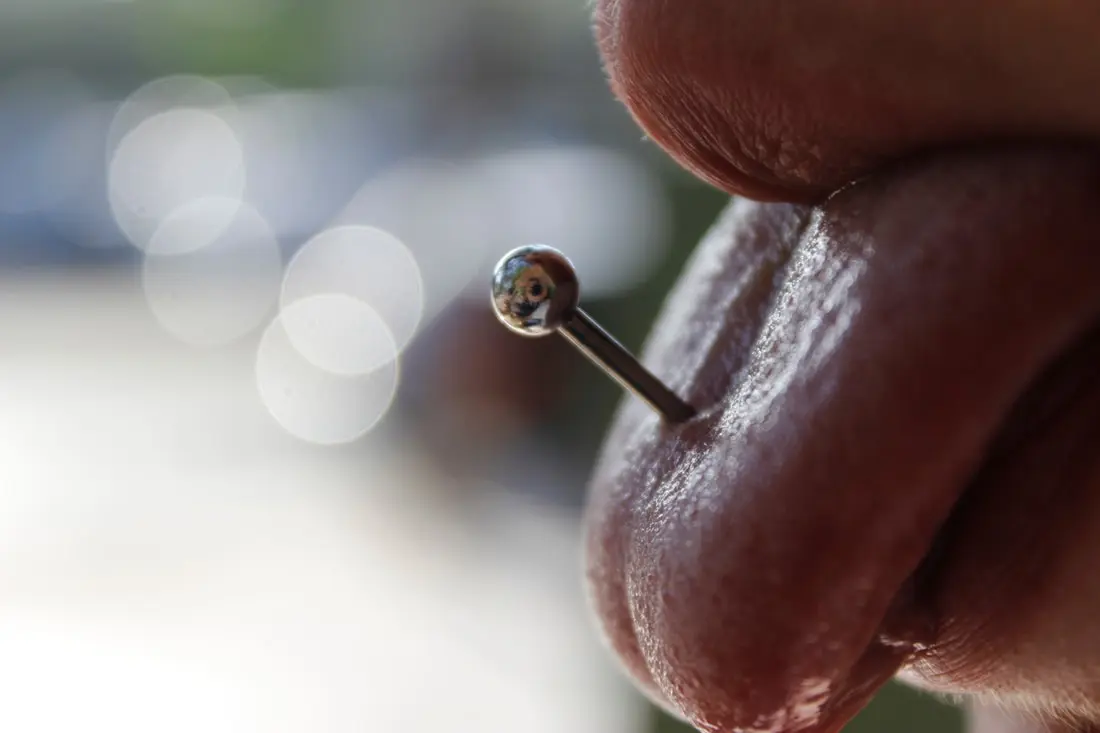
Photo by Jose Maria Bersabe via Wikimedia Commons, public domain.
Start long, then go shorter
WebMD says the piercer starts with a larger barbell to give your tongue room to heal as it swells, and that after the swelling goes down, dentists recommend replacing it with a smaller one that is less likely to bother your teeth. The APP says the longer jewelry that allows for initial swelling must be replaced with a shorter piece once swelling has dissipated, to reduce the chance of harm to teeth and other oral structures. The ADA says the same, and that a piercer should make the change.
None of them gives a length or a date. Our tongue page lists a 16 to 18 mm barbell to start, and our healing guide says the swap usually comes within the first one to two weeks. Those are our figures, not the sources’. Piercing downsizing explains the swap.
Length matters in both directions. The 2014 review by Plastargias and Sakellari cites a 2002 study of barbell stem length, in which short shanks were linked to overgrown tissue and long shanks to a hyperplastic tissue reaction. That is the review’s summary of one study, and it fits the advice to have a piercer size the second barbell.
The end under the tongue
The APP says wearing a smaller ball, or a lower-profile end such as a dome or an m&m-shaped piece, on the underside of the tongue helps reduce contact between the jewelry and the area under the tongue. The Plastargias and Sakellari review cites the same 2002 study on the size of the ornament on the barbell as a possible cause of trauma to the teeth.
Keeping it secure
The APP says to check that threaded ends are on securely and to tighten them daily so the jewelry stays in place, and that threadless jewelry should have no gaps between post and top. The ADA says to check the tightness periodically, with clean hands, which can help prevent swallowing or choking if the jewelry becomes dislodged. The ADA also says you could possibly choke if part of the jewelry breaks off in your mouth. Threadless vs threaded explains the two fastenings.
Materials
| Source | What it says |
|---|---|
| APP | Quality jewelry in an appropriate material, and points to its minimum jewelry standards for initial piercings |
| WebMD | Surgical steel, solid gold or platinum |
| ADA | Oral jewelry comes in stainless steel, gold, titanium, various alloys and synthetic materials, and research found lower bacterial colonization on synthetics such as PTFE or polypropylene than on steel or titanium |
| APP, for healed piercings | Plastic, including silicone, and glass can be used in a healed piercing, but are fragile compared with metal and may not be safe for sports or sleep |
The materials guide explains the APP’s standards for titanium, steel, gold and glass.
Two studies in the Mosaddad et al. review, a systematic review of 34 studies published in 2023, put numbers on material:
| Study | People | What it reported |
|---|---|---|
| Kapferer et al. (2011) | 85 people with tongue piercings | Stainless steel studs had considerably higher levels of 67 of the 80 bacterial species studied than PTFE or polypropylene studs |
| Hickey et al. (2010) | 201 people | Gum recession in 52.9% (titanium), 23.5% (stainless steel) and 9% (Teflon); chipped teeth in 35.7%, 42.5% and 14.3%, in the same order |
In the Hickey figures titanium had the most recession and steel the most chipping, and Teflon was lowest on both. That does not point to one metal, and we read the figures as the review reports them without seeing how the groups differed. Treat them as a reason to ask your piercer about material, not as a ranking.
Habits and how long you wear it
The ADA says habits related to the presence of a piercing, such as biting, rolling, stroking and sucking, are the main cause of damage to the dentition, and that clicking the jewelry against the teeth repeatedly can damage them. The APP says playing with oral jewelry is the most frequent cause of tooth and gum damage. The ADA also says long-term wearing of oral jewelry is discouraged, because of risks including tooth decay from trapped food, enamel damage, chipped teeth and gum inflammation.
Studies in the Mosaddad review found problems that grew with wear time:
| Study | People | What it reported |
|---|---|---|
| Campbell et al. (2002) | 52 adults with tongue piercings | Half of those who wore lengthy barbells for two years or more had gum recession on the tongue side of the lower front teeth |
| Kapferer et al. (2011) | 85 people with tongue piercings | 28.8% had recession on the tongue side, and 5% had at least one chipped tooth |
| Ziebolz et al. (2012) | 46 people with tongue piercings and 46 without | Enamel fissures, enamel fractures and recession on the tongue side were more common in those with piercings |
These are small studies, and the review does not turn them into a rule for how long is too long. They fit what the ADA says: the risk is not only at the piercing appointment.
Sports, scans and daily care
The ADA says all oral jewelry, including a tongue barbell, should be removed before athletic and other physical activity, particularly contact sports, and MouthHealthy says to protect your mouth with a mouthguard. MouthHealthy also says the jewelry can get in the way of dental care by blocking X-rays, and to talk to your dentist.
Whether to take it out at night once healed is one place the sources differ. WebMD says to take the jewelry out every night after your tongue has healed and brush it the way you brush your teeth. The APP’s general aftercare says to leave jewelry in at all times, because even well-healed piercings can shrink or close in minutes. If you remove it, that risk is what you are weighing. The healing guide covers the first weeks, and how to choose a piercer covers who fits the barbell.
What to avoid
- Keeping the long starter barbell after the swelling has gone. The APP says it must be replaced with a shorter piece.
- Playing with the jewelry. The APP and ADA both name it as a cause of damage.
- Loose ends. Check them, because a piece that comes off in your mouth is a choking risk.
- Wearing it for sports. The ADA says to remove it and use a mouthguard.
Frequently asked questions
What jewelry do you start a tongue piercing with?
A straight barbell that is longer than you will wear later. WebMD says the piercer starts with a larger barbell to give the tongue room to swell. The APP says the longer jewelry must be replaced with a shorter piece once swelling has gone. Our tongue page lists a 16 to 18 mm barbell to start.
When should I switch to a shorter barbell?
Once the swelling has subsided, according to the APP, the ADA and WebMD, and a qualified piercer should fit it. None of them gives a number of days. Our healing guide says usually within the first one to two weeks.
Does the size of the ball matter?
The APP says a smaller ball, or a low-profile end such as a dome or m&m shape, on the underside of the tongue helps reduce contact with the area under the tongue. A review of dental studies also names the size of the ornament on the barbell as a possible cause of trauma to the teeth.
Is plastic or acrylic tongue jewelry safer?
The ADA says research found lower bacterial colonization on synthetic jewelry, such as PTFE or polypropylene, than on steel or titanium. In one 201-person study reported in a 2023 review, gum recession and chipped teeth were less common with Teflon. These are single studies, so ask your piercer about material rather than treating them as a ranking.
Should I take my tongue piercing out at night?
The sources differ. WebMD says that once the tongue has healed you can take the jewelry out every night and brush it like your teeth. The APP's general aftercare says to leave jewelry in at all times, because even well-healed piercings can shrink or close in minutes. Ask your piercer.
Can tongue jewelry damage my teeth?
It can. The ADA says habits such as biting, rolling, stroking and sucking are the main cause of damage to the teeth, and the APP says playing with oral jewelry is the most frequent cause of tooth and gum damage. The ADA also says long-term wearing of oral jewelry is discouraged.
Sources
- Association of Professional Piercers - Oral aftercarehttps://safepiercing.org/oral-aftercare/
- Association of Professional Piercers - Oral piercing risks and safety measureshttps://safepiercing.org/oral-piercing-risks-safety-measures/
- Association of Professional Piercers - Jewelry for initial piercingshttps://safepiercing.org/jewelry-for-initial-piercings/
- Association of Professional Piercers - Jewelry for healed piercingshttps://safepiercing.org/jewelry-for-healed-piercings/
- Association of Professional Piercers - Suggested aftercare for body piercingshttps://safepiercing.org/aftercare/
- American Dental Association - Oral piercing/jewelryhttps://www.ada.org/resources/ada-library/oral-health-topics/oral-piercing-jewelry
- American Dental Association (MouthHealthy) - Oral piercingshttps://www.mouthhealthy.org/all-topics-a-z/oral-piercings
- WebMD - Mouth or tongue piercing: care, safety and problemshttps://www.webmd.com/oral-health/oral-piercing
- Plastargias and Sakellari (2014) - The consequences of tongue piercing on oral and periodontal tissues. ISRN Dentistryhttps://pmc.ncbi.nlm.nih.gov/articles/PMC3926233/
- Mosaddad et al. (2023) - Oral complications associated with the piercing of oral and perioral tissues, and the awareness of the public and professionals: a systematic review. Diagnosticshttps://pmc.ncbi.nlm.nih.gov/articles/PMC10647284/
This article is for education only and is not medical advice. If a piercing is hot, swollen, spreading redness, oozing yellow or green discharge, or you have a fever, see a doctor today.