On this page
The short answer is that there is no reliable evidence a daith piercing treats migraine, and the organisations that specialise in headache do not recommend it as a treatment.
That answer deserves more than a sentence, because the people asking this question are usually in real pain and have often tried a lot of things already. This page explains where the claim came from, why the personal accounts are honest but do not show what they appear to, and what actually has evidence behind it.
Where the claim came from
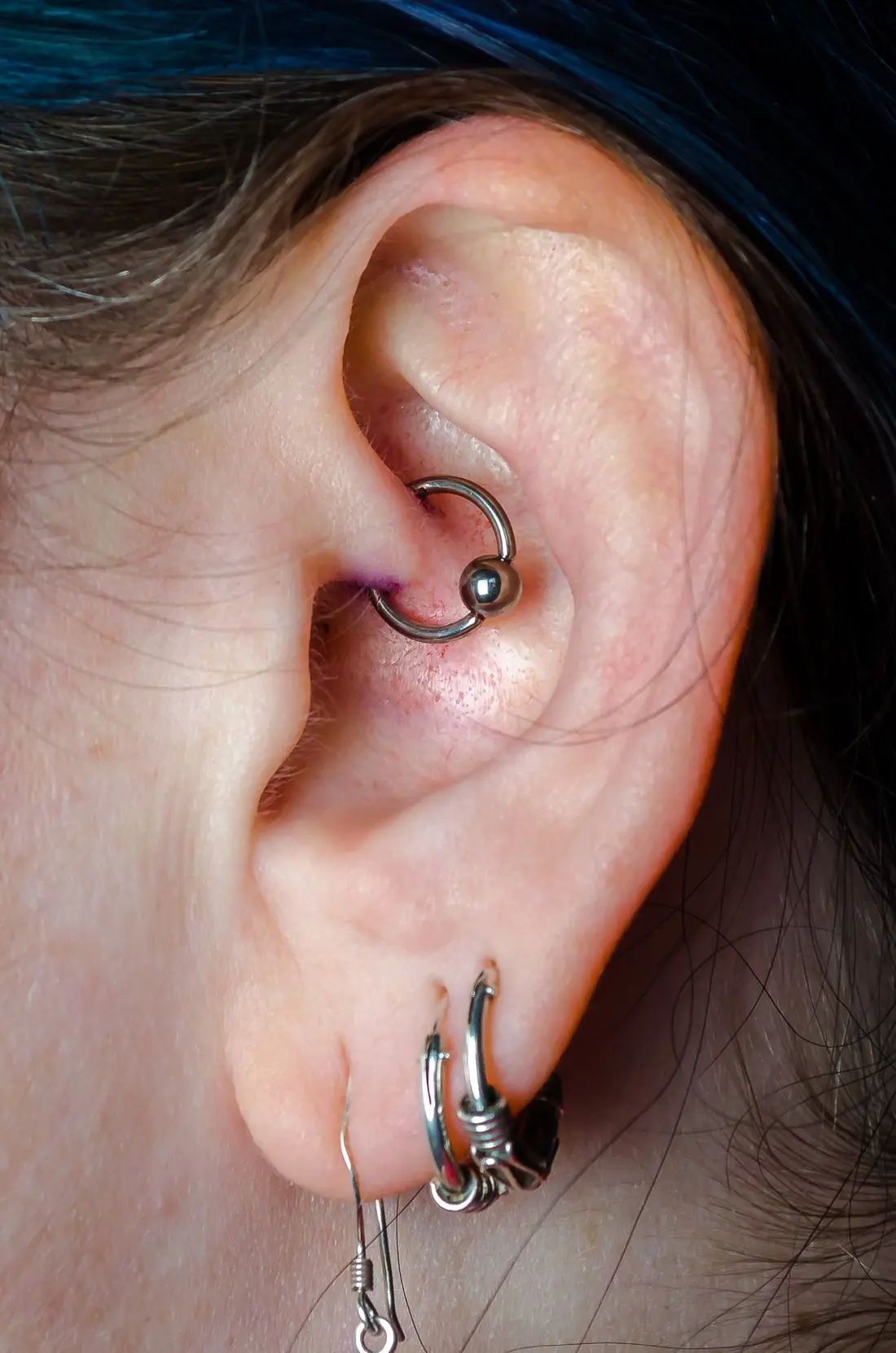
The daith is the fold of cartilage just above the ear canal. In ear acupuncture, an area near that fold is used as a treatment point.
The reasoning behind the migraine claim was an analogy: if pressing that point briefly helps, perhaps a piece of jewelry sitting in it permanently would help continuously.
That is a hypothesis, not a finding. It spread through social media and news coverage around 2015 and became widely repeated, but the step from “this is near an acupuncture point” to “this treats migraine” was never actually tested.
What the evidence shows
No randomised controlled trial has tested daith piercing for migraine. What exists is case reports and personal accounts.
That matters more in migraine than in almost any other condition, for two specific reasons.
Migraine fluctuates on its own. It comes in cycles, and people tend to seek out a new treatment during a bad stretch. A bad stretch is, by definition, usually followed by a better one. Improvement after any intervention started at a low point is expected whether or not the intervention did anything. Researchers call this regression to the mean.
Migraine has an unusually strong placebo response. In properly controlled migraine trials, a substantial proportion of people improve on placebo. A visible, permanent, somewhat painful intervention that you paid for and that people ask you about is close to a best case for a placebo response.
Put those together and honest reports of improvement are exactly what you would expect from a treatment that does nothing at all. This is not a claim that anyone is lying or imagining their relief. It is that personal accounts cannot distinguish between the piercing working and these two effects, and only a controlled trial can.
What the risks actually are
A daith is a cartilage piercing, and it behaves like one:
- Six to twelve months to heal, not weeks. See the cartilage guide.
- Real infection risk. Cartilage has a poor blood supply, which makes infection there more serious and harder to treat than in a lobe. See infected ear piercing.
- It is inside the ear, which makes it awkward to clean and easy to knock with earbuds and pillows.
- It costs money, typically $40 to $90 plus jewelry.
None of that makes it a dangerous piercing. It is a normal piercing with normal risks. The concern specific to this page is different: spending money, pain and a year of healing on something with no demonstrated effect, and possibly delaying treatment that would work.
If you have migraine and are not under the care of a doctor about it, that is the thing to change first.
What has evidence behind it
Migraine treatment has moved a long way, and there is far more available now than there was when the daith claim started circulating. Broadly it divides into:
- Acute treatment, taken when an attack starts.
- Preventive treatment, taken regularly to reduce how often attacks happen. This now includes drug classes developed specifically for migraine.
- Trigger and lifestyle management, including sleep, hydration, caffeine and meal timing, usually tracked with a headache diary.
- Neuromodulation devices, several of which are approved and have trial evidence.
Which of these suits you is a conversation with a doctor, and it is genuinely worth having if you have not had it recently. The NHS migraine page and the Migraine Trust are reasonable starting points for what to ask about; both are listed in the sources below.
If you want a daith anyway
Plenty of people do, and it is a good-looking piercing. Get it because you like it.
Two things to keep straight if you do:
Do not change anything about your migraine treatment. Do not stop a preventive medication to “see if the piercing works”. If you want to try it, keep everything else the same.
Judge it honestly. If you are going to track whether it helped, keep a headache diary for a couple of months before the piercing as well as after. Comparing against a remembered baseline is exactly where regression to the mean does its work.
The daith piercing guide covers the anatomy, the pain, the healing and the aftercare.
Not medical advice
This page is educational and does not replace assessment by a clinician. If your headaches are new, changing in pattern, unusually severe, or accompanied by fever, weakness, confusion, vision loss or a stiff neck, seek medical care rather than reading further.
Frequently asked questions
Does a daith piercing help migraines?
There is no reliable evidence that it does. No randomised controlled trial has tested it, headache organisations do not recommend it, and the improvements people report are consistent with placebo and with the natural rise and fall of migraine. Some people genuinely feel better; that is not the same as the piercing being the cause.
Where did the daith migraine idea come from?
From acupuncture. The daith sits near a point used in ear acupuncture, and the reasoning was that a permanent piercing might act like permanent pressure on it. That is an analogy rather than a finding, and it has never been tested properly.
Why do some people say it worked for them?
Migraine comes and goes in cycles, so many people seek a new treatment when they are at their worst and then improve regardless. Add a strong placebo response, which is well documented in migraine trials, and honest personal reports of improvement are exactly what you would expect even if the piercing does nothing.
Which side should I get pierced for migraines?
There is no established answer, because there is no established effect. Advice to pierce the side you get headaches on comes from the acupuncture analogy, not from evidence.
Is it harmful to get a daith piercing for migraine?
Not inherently, but it is a cartilage piercing that takes six to twelve months to heal and carries a real infection risk. The concern is spending money and healing time on an unproven treatment, and possibly delaying an effective one.
Should I get a daith piercing at all?
If you want one because you like how it looks, it is a perfectly good piercing. Get it for that reason. Just do not get it as a medical treatment, and do not stop or delay treatment your doctor has prescribed.
Sources
- American Migraine Foundation - Daith piercings as migraine treatmenthttps://americanmigrainefoundation.org/resource-library/daith-piercings-101/
- NHS - Migrainehttps://www.nhs.uk/conditions/migraine/
- The Migraine Trusthttps://migrainetrust.org/
- StatPearls (NCBI Bookshelf) - Migraine headachehttps://www.ncbi.nlm.nih.gov/books/NBK560787/
- Association of Professional Piercers - Suggested aftercare for body piercingshttps://safepiercing.org/aftercare/
This article is for education only and is not medical advice. If a piercing is hot, swollen, spreading redness, oozing yellow or green discharge, or you have a fever, see a doctor today.