On this page
A healing piercing needs one product: sterile saline, with only sodium chloride and water on the label. Almost everything else sold as piercing aftercare is optional at best and harmful at worst.
This page covers how to read a label, how the common products stack up, and why an old piece of advice, the home-made sea salt soak, has been dropped by the people who used to give it.
The one product you need
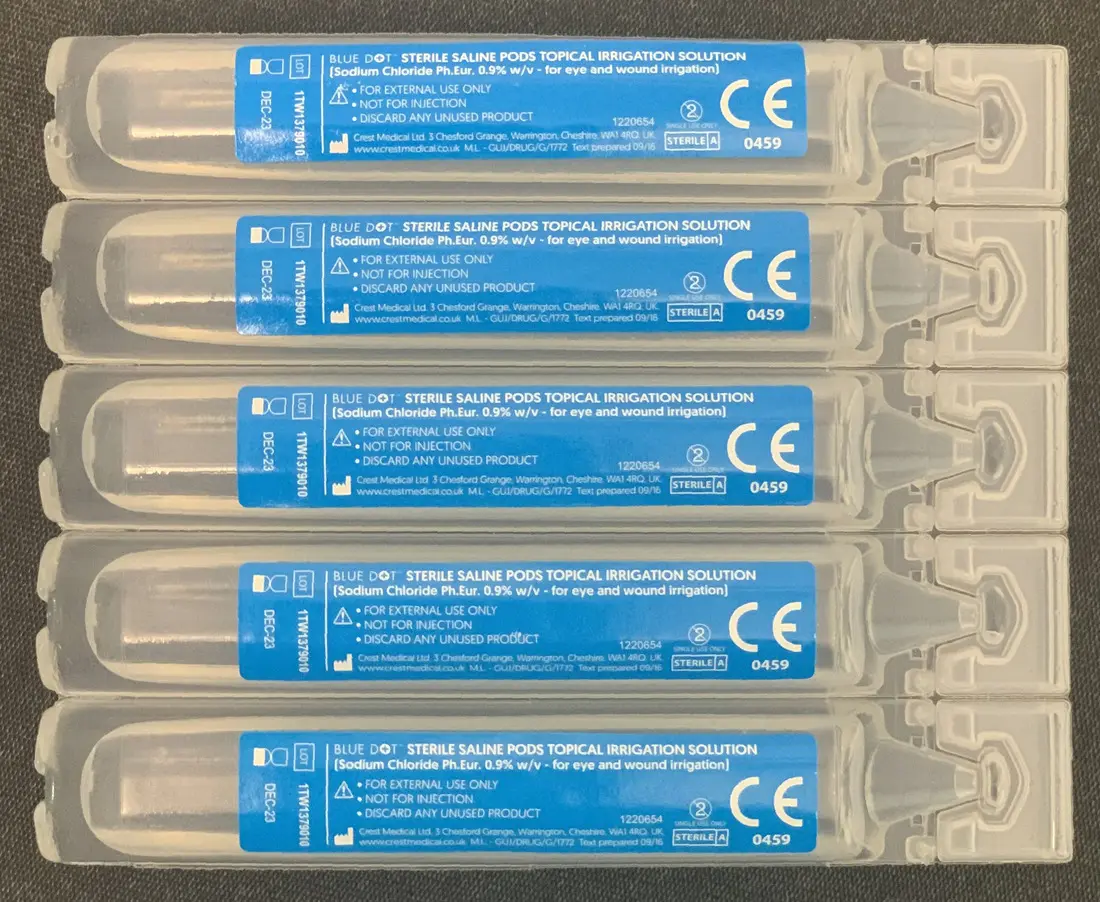
The Association of Professional Piercers (APP) advises spraying a healing piercing with sterile saline wound wash. The ingredient list should show 0.9% sodium chloride as the only ingredient, and purified water is sometimes listed as well. That is the whole formula. The aftercare guide covers the routine: wash your hands, spray, dry with clean disposable gauze, twice a day.
How to read the label
Turn the can around and check four things:
- Sodium chloride 0.9% and water, nothing else. No fragrance, no essential oils, no “soothing” botanicals.
- Sterile. It should be sealed, and stay sealed until you use it.
- No preservatives or medication. NeilMed makes the point directly, saying solutions for piercing aftercare should avoid preservatives that might harm a healing piercing.
- No claims that it kills germs. An antiseptic is a different product with a different job.
Products compared
| Product | Verdict | Why |
|---|---|---|
| Sterile saline wound wash, 0.9% sodium chloride | Use it | The APP standard |
| NeilMed Piercing Aftercare | Passes the label test | The maker lists water and sodium chloride, and no preservatives |
| Contact lens solution or nasal saline | Usually skip | Many have added ingredients. Fine only if the label lists sodium chloride and water alone |
| Home-mixed sea salt soak | Skip | The APP no longer suggests it |
| Alcohol, hydrogen peroxide, iodine | Skip | The APP advises against harsh products |
| Antibacterial soap | Skip | The APP advises against it, and calls it outdated care |
| Antibiotic ointment | Skip, unless a doctor prescribes it | The APP says ointments prevent air circulation |
| Tea tree oil, “bump solutions” | Skip | Not saline, and the APP advises avoiding any harsh products |
NeilMed, specifically
NeilMed Piercing Aftercare is the product people search for most, so it is worth saying exactly what its maker claims.
- Ingredients: pharmaceutical-grade water and sodium chloride.
- Preservatives: none. The maker describes it as free from preservatives.
- Format: a fine mist can, using bag-on-valve technology that the maker says keeps the contents sterile and lets it spray upside down.
- Sizes: a 177 mL bottle, and a 75 mL travel size that the maker describes as TSA-compliant for carry-on flights.
That matches the APP label test. It does not make NeilMed the only good choice: any sterile saline that passes the same test does the same job. There are no affiliate links on this page.
The sea salt soak: the advice changed
For years the standard advice was to dissolve sea salt in warm water and soak. The APP has dropped it. Its current guidance says mixing your own sea salt solution is no longer a suggested practice, because the mixture commonly ends up far too salty and strong, which can over-dry the piercing.
Advice elsewhere has not caught up everywhere. The NHS’s page on infected piercings still says to use warm, salty water to soften crusting. Sterile saline comes at the right strength every time, which is the whole point of buying it.
What else is worth having
- Clean, disposable gauze for drying. The APP says cloth towels should be avoided because they can harbor bacteria and snag on jewelry.
- A travel pillow, for ear cartilage piercings. The APP says sleeping directly on a healing cartilage piercing can cause irritation and even shift its angle, and suggests placing a travel pillow on top of your pillow and putting your ear in the opening.
- A waterproof transparent film dressing, if you want to protect a piercing in water. The APP says these are available at most pharmacies and are ideal for nipple, navel and surface piercings. See swimming with a new piercing.
That is the full list. A piercing does not need a kit, a serum or a subscription.
When a product is the problem
If a bump will not settle, look at what has been on or near the piercing. The APP advises avoiding alcohol, hydrogen peroxide, antibacterial soaps, iodine, harsh products and ointments, so stopping anything on that list is the obvious first step. Piercing bumps explains what to do next.
A studio’s aftercare advice is a clue
The APP lists outdated aftercare, such as antibacterial soap or ointment, as a red flag when you are choosing a studio. How to choose a piercer has the rest of the checklist.
Not medical advice
This page is educational. If a piercing is hot, has spreading redness or thick coloured discharge, or you feel feverish or unwell, see a doctor rather than trying another product.
Frequently asked questions
What is the best product for cleaning a new piercing?
Sterile saline wound wash, with 0.9% sodium chloride as the only ingredient, sprayed on twice a day. The Association of Professional Piercers says the ingredients should list 0.9% sodium chloride and nothing else, though purified water is sometimes listed too.
Is NeilMed good for piercings?
NeilMed says its piercing spray contains pharmaceutical-grade water and sodium chloride and is free from preservatives, which is what the APP label test asks for. Any sterile saline that passes the same label test does the same job. There are no affiliate links on this page.
Can I make my own sea salt soak for a piercing?
The APP no longer suggests it. A home mix commonly ends up far too salty and strong, which can over-dry the piercing. The NHS still mentions warm salty water for softening crust on an infected piercing, but sterile saline avoids the mixing problem.
Can I use contact lens solution or nasal saline spray?
Usually not. Many products in those aisles have added ingredients. They are only acceptable if the label lists sodium chloride and water and nothing else, and if the list is longer than the APP's, put it back.
Are piercing cleaners and antiseptic sprays safe?
The APP advises avoiding alcohol, hydrogen peroxide, antibacterial soaps, iodine and any harsh products on a healing piercing. A product sold as a cleaner or antiseptic falls into that group. Saline is the only product a healing piercing needs.
Should I put antibiotic ointment on my piercing?
Not by choice. The APP says ointments prevent the air circulation a piercing needs. If it is infected, a doctor may prescribe a cream, ointment or tablets, and that is a different situation from putting one on a healing piercing yourself.
Sources
- Association of Professional Piercers - Suggested aftercare for body piercingshttps://safepiercing.org/aftercare/
- Association of Professional Piercers - Picking your piercerhttps://safepiercing.org/picking-your-piercer/
- NeilMed - Piercing aftercarehttps://www.neilmedpac.com/usa/piercing-aftercare/
- NHS - Infected piercingshttps://www.nhs.uk/conditions/infected-piercings/
This article is for education only and is not medical advice. If a piercing is hot, swollen, spreading redness, oozing yellow or green discharge, or you have a fever, see a doctor today.