On this page
Frog eyes are two tongue piercings placed side by side across the front of the tongue, near the tip, so the two top beads sit next to each other. Each is an ordinary straight barbell through the tongue; the pair is what makes the look.
Everything true of a single tongue piercing is true here twice, and one thing is specific to the pair: the anatomy underneath.
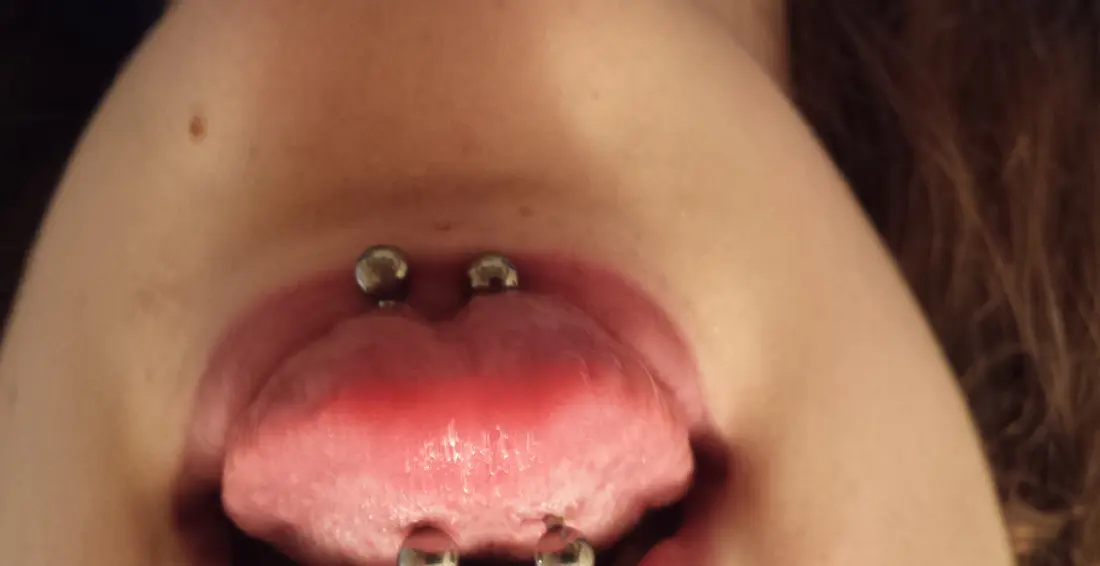
Photo by GorillaWarfare via Wikimedia Commons, CC BY-SA 1.0.
Frog eyes or venom
Both names describe a symmetrical pair of tongue piercings, and studios use them inconsistently. The most common distinction is position: frog eyes near the tip, venom (or venom bites) further back toward the middle of the tongue. Plenty of studios use the two interchangeably.
Describe where you want them. A pair near the tip and a pair in the middle are different in how they feel, how they meet your teeth and how much tongue movement they take, and the name alone will not communicate which you mean.
The veins decide it
The underside of the tongue carries two large, visible veins running lengthways. A single centre tongue piercing sits between them. A pair near the tip has to sit either side of the centre line, which puts each piercing closer to a vein than a single would be.
A piercer will look at the underside of your tongue with it lifted, and the answer depends on where your veins run and how much room there is. Some tongues take a pair easily; some take a pair with more space between them than you had in mind; some take a single piercing and not a pair. Being told the last of those is a piercer doing the job properly.
The tongue’s frenulum, the web underneath, also matters: a short frenulum limits how far forward the pair can sit.
Pain
About 5 out of 10 each. A tongue piercing is a quick, sharp moment rather than a slow pressure, and it is over before you have processed it. Two in a row means the second goes into a tongue that is already tender.
The swelling is the part to plan for. A single tongue piercing swells noticeably for three to five days; a pair near the tip swells more and affects speech and eating more, because the tip is what you use to form words and move food. Cold water, ice chips, soft food and clear speaking practice all help. Have the fridge stocked before you go.
Healing
Four to eight weeks, healing in parallel. The mouth has an exceptional blood supply, which is why tongue piercings are measured in weeks when cartilage is measured in months. Tongue piercing healing time covers the swelling and what to eat.
- Days 1-5: peak swelling, difficulty eating and speaking clearly, some bruising of the tongue is normal.
- Weeks 1-2: swelling drops, white film on the barbells inside the mouth, which is normal.
- Weeks 3-8: the channels mature. Still no playing with the jewelry.
Downsize both at two to four weeks. The initial barbells are long to allow for swelling. Left in afterwards, two long bars near the tip of your tongue clack against your front teeth every time you speak, which is where the dental damage comes from. Piercing downsizing explains it for every placement.
How long it can be left empty, which depends far more on how long you have had it than on where it is, is in how long a piercing takes to close.
Teeth and gums, twice over
Every tongue piercing puts jewelry within constant reach of your teeth. Frog eyes put two beads near the tip of the tongue, close to the front teeth.
The risks are chipped or cracked teeth and gum recession. A 2014 review of tongue piercing complications (Plastargias and Sakellari) lists tongue jewellery, habitual biting or chewing of it, barbell stem length, the size of the ornament and the material among the causes of tooth trauma, and reports gum recession on the lower front teeth.
What reduces them:
- Downsize on schedule. The APP says a shorter post is vital once swelling subsides, to avoid damage to the teeth and gums.
- Smaller beads. The 2014 review lists the size of the ornament, and the material, as factors in tooth trauma. Ask your piercer about both.
- Placement. Ask your piercer whether a pair set slightly further back would meet the teeth less than a pair at the very tip.
- Stop the habit. Rolling the barbells against your teeth is a habit that forms in week one and does the damage over years.
- Tell your dentist, and have the lower front gum checked at each visit.
Aftercare
The oral routine, doubled in area but not in complexity:
- Alcohol-free antibacterial or saline mouth rinse after eating, after drinking anything but water, and after smoking.
- No alcohol-based mouthwash, which is far too harsh for a fresh wound in the mouth.
- Cold, soft food for the first week; no spicy, acidic or very hot food, and no kissing or oral contact until healed.
- Do not play with the jewelry.
The tongue guide has the full routine and the swelling management in detail.
Jewelry
Two straight barbells, 14 gauge, implant-grade titanium, long to start and downsized to sit just proud of the tongue on both sides. Threadless or internally threaded only, so the post through the tongue is smooth. See the materials guide.
Once healed, matching ends are the usual choice, since the pair is the point.
A retainer keeps the channel open when you need to hide it, or to remove metal for a scan.
Related placements
- Tongue: the single centre piercing, and the sensible way to find out how your mouth handles one before committing to two.
- Tongue web: through the frenulum underneath, hidden and quick.
- Smiley: the upper-lip frenulum.
- Snake bites: the paired lip piercing that frog eyes are often worn alongside.
- Snake eyes: a single horizontal bar across the tip of the tongue, which many piercers refuse and offer frog eyes instead.
Cost
$70 to $140 for the pair in a US studio, plus jewelry for each. Most studios discount the second piercing in the same session. Tip 15 to 20 percent.
Frequently asked questions
What is a frog eyes piercing?
Two tongue piercings placed side by side across the front of the tongue, near the tip, so the two top beads sit next to each other like a pair of eyes. Each is a separate straight barbell through the tongue.
Is frog eyes the same as a venom piercing?
Mostly. Both names describe a symmetrical pair of tongue piercings. Some studios use venom for a pair set further back and frog eyes for a pair near the tip; others use them interchangeably. Describe where you want them rather than relying on the name.
Do frog eyes piercings hurt?
About 5 out of 10 each. A single tongue piercing is a quick, sharp moment; two in one sitting means going through it twice, and the second is felt more because the tongue is already tender. The swelling over the following days is the harder part.
How long do frog eyes take to heal?
Four to eight weeks, healing in parallel. The mouth heals quickly, which is why tongue piercings are measured in weeks, but two barbells mean more swelling and a longer stretch of awkward eating and speaking than one.
Are frog eyes bad for your teeth?
They double the exposure of a single tongue piercing. Two barbells near the tip sit close to the front teeth and meet them constantly when you speak and eat. Damage to the teeth and gums is the long-term risk. A 2014 review of tongue piercing complications lists the size of the ornament and the length of the barbell stem among the causes, and the APP says a shorter post is vital once the swelling has gone.
Can everyone get frog eyes piercings?
No. The tongue has large veins running along its underside, and two piercings placed near the tip have to avoid them on both sides. A piercer will look at the underside of your tongue and may decline, suggest more space between them, or suggest a single piercing instead.
Sources
- Association of Professional Piercers - Suggested aftercare for oral piercingshttps://safepiercing.org/oral-aftercare/
- Association of Professional Piercers - Jewelry for initial piercingshttps://safepiercing.org/jewelry-for-initial-piercings/
- American Dental Association (MouthHealthy) - Oral piercingshttps://www.mouthhealthy.org/all-topics-a-z/oral-piercings
- Plastargias and Sakellari (2014) - The consequences of tongue piercing on oral and periodontal tissues. ISRN Dentistryhttps://pmc.ncbi.nlm.nih.gov/articles/PMC3926233/
This article is for education only and is not medical advice. If a piercing is hot, swollen, spreading redness, oozing yellow or green discharge, or you have a fever, see a doctor today.