On this page
The right jewelry for an eyebrow piercing is a 16 gauge curved barbell in implant-grade titanium, with small, smooth ends. That answer does not change for a new piercing or a healed one. Everything else on this page is about size, what to avoid, and when other styles become possible.
The reason is structural. An eyebrow piercing is a surface piercing: it passes through a pinch of skin rather than through a fold or a flap of tissue. The body can gradually push a shallow channel like that toward the surface, and the jewelry you choose either slows that down or speeds it up.
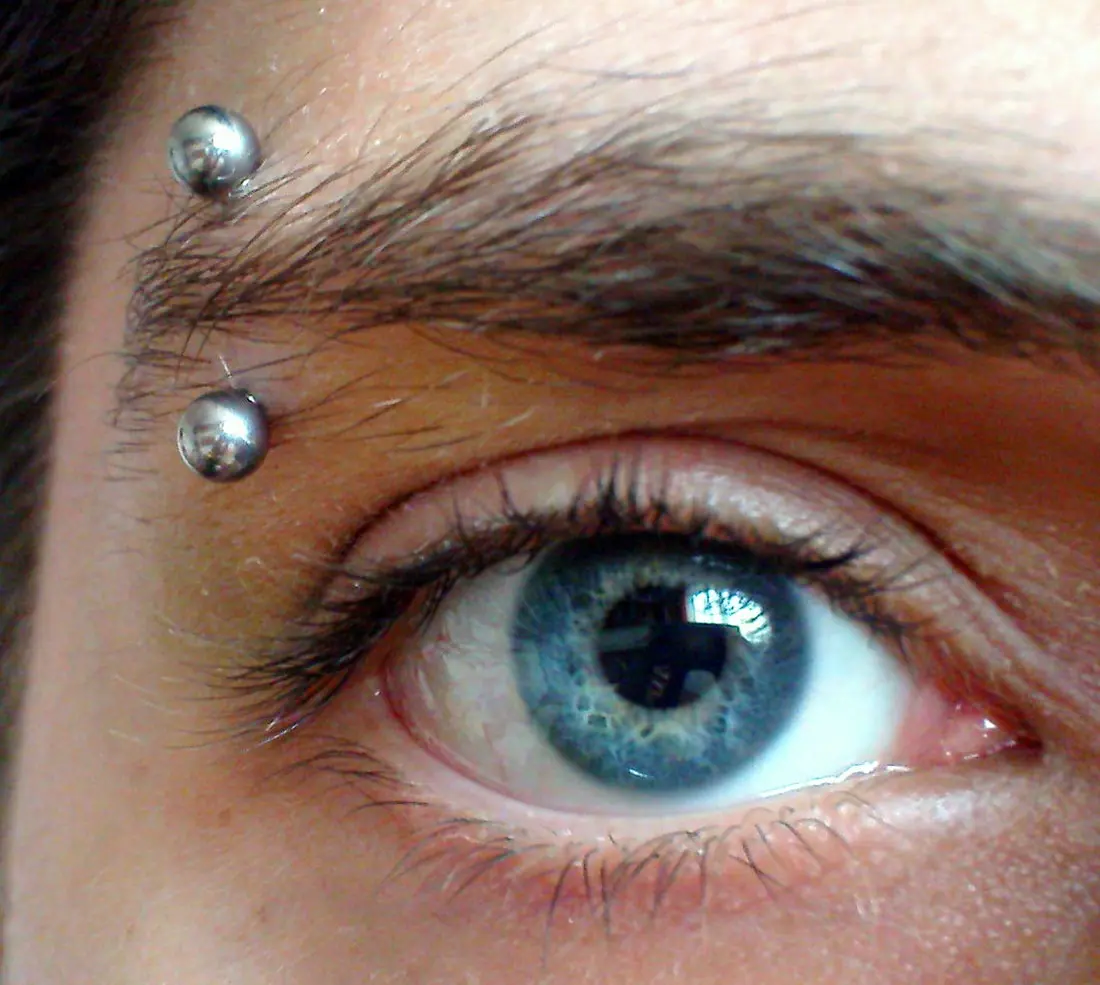
Photo by Lukas Stavek via Wikimedia Commons, CC0.
The styles compared
| Style | When to wear it | What to know |
|---|---|---|
| Curved barbell | From day one, and for as long as you like | The standard. Follows the channel and spreads pressure |
| Ring (captive bead ring, seamless ring, circular barbell) | Fully healed only, four months at the earliest | Moves more, so raises the migration risk |
| Retainer | When you need to hide it or remove metal | Keeps the channel open. See piercing retainers |
| Surface bar or dermal | Not for a standard eyebrow | Used for the anti-eyebrow, a different piercing |
| Spikes, large gems, dangles | Avoid while healing, keep light afterwards | They snag, and weight drags on the channel |
The ring styles guide explains the differences between the ring types if you plan to move to one later.
Gauge and length
Gauge: 16 gauge, which is 1.2 mm. It is thick enough to be stable in skin and thin enough to suit the piercing.
Length: The right length depends on how much skin your piercer took and how swollen it is.
- A fresh piercing starts on a longer bar, around 10 to 12 mm, to leave room for swelling.
- Once the swelling has gone, the bar is downsized. The lengths most commonly sold for a healed eyebrow are 8 mm (5/16 inch) and 10 mm (3/8 inch).
Those are typical, not rules. The Association of Professional Piercers says jewelry must be of appropriate length for your unique anatomy. Have the first downsize done by your piercer, who can fit it to your brow.
How to tell if it fits
Look at the skin around the ends:
- Too short: the skin puffs up over the ends, the ends leave a dent, or the piercing looks tight and red.
- Too long: the bar swings, sticks out from the brow, or catches on towels, hair and glasses.
- About right: the ends sit on the skin with a small gap, and the bar moves only slightly when you touch it.
A bar left too long is a common cause of a snagged eyebrow piercing. That is why the downsize at four to six weeks matters so much.
Material
The Association of Professional Piercers publishes standards for jewelry in a new piercing. For an eyebrow, that means:
- Implant-grade titanium, certified to ASTM F136 (Ti6Al4V ELI). The usual choice.
- Niobium or platinum.
- Solid gold, 14k or higher, nickel- and cadmium-free.
- A polished, mirror finish, free of nicks, scratches and burrs.
What to avoid in a piercing that is still healing:
- Plated, gold-filled and vermeil jewelry. The gold layer is extremely thin and can wear or chip off.
- Steel that does not state its standard. Only specific grades are suitable, and “surgical steel” on a listing does not tell you which.
- Unlabelled metal of any kind.
The materials guide covers what each standard means, and nickel allergy and piercings explains how to recognise a reaction.
Threading
Choose internally threaded or threadless ends. With internal threading, the part that passes through your skin is smooth and the threads are on the removable end. Externally threaded jewelry drags a screw thread through the channel every time it goes in or out. Threadless vs threaded explains how the two work.
What to wear and when
| When | Wear | Notes |
|---|---|---|
| Piercing day | Curved barbell, around 10-12 mm | Long, to allow for swelling |
| 4-6 weeks | The same style, downsized | Done by your piercer |
| 2-4 months | Fully healed | Change the ends or the bar once it passes the four tests |
| Month 4 onward | A ring is possible | Only if healed, and accepting the higher migration risk |
Looking healed does not mean being healed. How long an eyebrow piercing takes to heal covers the stages, and the healing time guide sets out the four tests that apply to every piercing.
Ends, gems and weight
Keep the ends small, flat and lightweight. Large gems and spikes catch on towels, hairbrushes, hoodies and glasses, and every catch pulls on the channel. Weight does the same slowly.
Once the piercing has healed, you can wear more decorative ends. Choose low-profile ones, and keep heavy or dangling pieces for occasions rather than every day.
Signs it is the wrong jewelry
- Redness, itching or weeping after a new piece goes in. It can be a reaction to the metal.
- The visible distance between the ends getting shorter, or thin, shiny skin over the bar. That is migration, and you should see your piercer. See piercing rejection.
- Repeated snagging. The bar is too long, or the ends are too big.
An eyebrow piercing that has migrated can leave marks. Eyebrow piercing scar explains what to expect and what helps.
Buying jewelry
A trustworthy listing gives you:
- Gauge and length in millimetres, not small, medium or large.
- The exact alloy and standard, such as ASTM F136 titanium.
- The threading, internal or threadless.
- A polished finish.
Be wary of multipacks and bargain bars that state none of this. The Association of Professional Piercers runs a Body Jewelry Verification Program for suppliers, and buying from a studio you trust is the easiest way to be sure.
Cost
$25 to $80 for a titanium curved barbell, plus the piercing itself at $30 to $70. Solid gold costs more. Ask whether your studio includes the first downsize. How much is an eyebrow piercing adds up the first-year total, the eyebrow piercing guide has the full picture, and piercing prices compares every placement.
Frequently asked questions
What jewelry is best for an eyebrow piercing?
A 16 gauge curved barbell in implant-grade titanium, with small, smooth ends. The curve follows the pinch of skin the piercing passes through, so it spreads pressure along the channel instead of concentrating it at the two openings. That is what keeps a surface piercing stable.
What size eyebrow barbell do I need?
16 gauge (1.2 mm) is the standard. A fresh piercing starts on a longer bar, around 10 to 12 mm, to allow for swelling, and is downsized after four to six weeks. The lengths most commonly sold for a healed eyebrow are 8 mm (5/16 inch) and 10 mm (3/8 inch), but your piercer should choose it to fit your brow.
Can I wear a ring in a new eyebrow piercing?
No. A ring moves more than a barbell, and movement is what makes a surface piercing migrate. Wait until it has fully healed, four months at the earliest, and accept that a ring carries a higher risk of migration than a curved barbell does.
Why are eyebrow barbells curved?
Because the piercing passes through a curved pinch of skin, not a straight tube. A straight bar pulls on the openings and can push the piercing out over time. A curved one sits along the channel.
What material is best for eyebrow jewelry?
Implant-grade titanium (ASTM F136) is the standard choice. Niobium, platinum and solid gold of 14k or higher, nickel-free, are also accepted. Avoid plated, gold-filled and vermeil jewelry, and steel that does not state its standard.
When can I change my eyebrow jewelry?
Your piercer downsizes the bar at four to six weeks. A full jewelry change is for once it has healed, at two to four months, and only when it passes all four tests: no tenderness, no discharge or crusting for two weeks, no redness, and jewelry that moves freely.
Sources
- Association of Professional Piercers - Jewelry for initial piercingshttps://safepiercing.org/jewelry-for-initial-piercings/
- Association of Professional Piercers - Suggested aftercare for body piercingshttps://safepiercing.org/aftercare/
- Association of Professional Piercers - Troubleshootinghttps://safepiercing.org/troubleshooting/
- Association of Professional Piercers - Body Jewelry Verification Programhttps://safepiercing.org/body-jewelry-verification-program-2/