On this page
The best jewelry for a new nose piercing is a flat-back labret stud in implant-grade titanium. Hoops, nose bones, L-shapes and screws all have a place in a healed piercing, and none of them belongs in a healing one.
That is the whole answer, and this page explains the reasoning, compares every style, and shows what to wear at each stage.
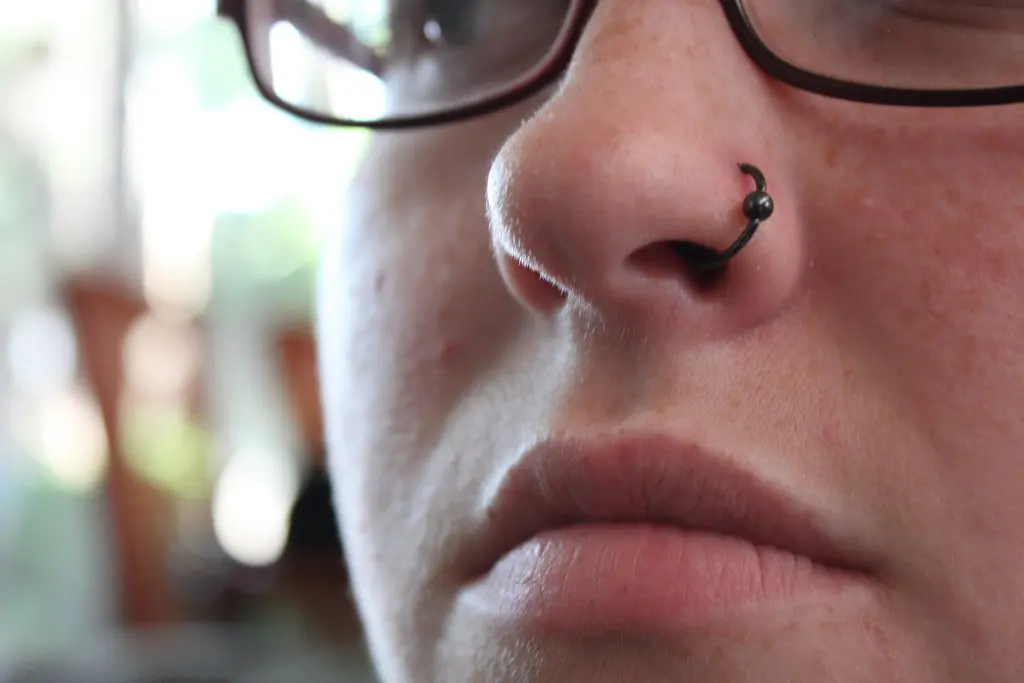
Photo by anna via Wikimedia Commons, CC BY 2.0.
The styles compared
| Style | What it is | When to wear it | Watch out for |
|---|---|---|---|
| Flat-back labret stud | Straight post, flat disc inside the nostril, decorative top | New and healed piercings. The standard | The post must be the right length |
| Nose bone | Straight post with a small ball fused on the end | Healed only, if at all | You force the ball through the channel each time |
| L-shape | Post with a right-angle bend that hooks inside | Healed only | The bend rotates as you move |
| Nose screw | Post curled into a spiral, twisted in | Healed only, with care | Corkscrews through the channel |
| Hoop (seamless or captive bead ring) | A ring worn around the nostril rim | Healed only | Sizing, and constant movement |
| Clicker | A hinged ring that clicks shut | Healed only | More handling means more irritation |
| Retainer | A clear or skin-tone post | When you need to hide it | Sizing. See piercing retainers |
Jewelry is behind more nostril problems than almost anything else, and the nostril guide explains why. The three styles at the top of the risk list are the nose bone, the L-shape and the screw: cheap, sold everywhere, and difficult to put in without tearing a fresh channel.
What to wear and when
| When | Wear | Why |
|---|---|---|
| Piercing day | Flat-back labret, a long post, 18 gauge | Leaves room for swelling |
| 4-8 weeks | The same stud, downsized by your piercer | A long post catches on towels and pillows |
| 4-6 months | Fully healed: change style yourself | Only after it passes the four tests |
| After that | Hoops, clickers, whatever fits | Dangles and heavy pieces sparingly |
The tests are: no tenderness, no discharge or crusting for two weeks, no redness, and jewelry that moves freely. When can I change my nose piercing explains them, and nose piercing healing times compares every nose placement.
Choosing a stud
Look for three things:
- Post length. The wearable post runs from the flat disc to the top. The right length sits flush without pressing. Nose ring sizes covers standard lengths and how to measure.
- A secure top. Threadless (push-pin) and internally threaded tops are both accepted by the Association of Professional Piercers. The threadless vs threaded guide explains how they differ.
- A small, low top while healing. Save large or decorative tops for when it has healed.
The flat disc matters as much as the top. It should sit flat against the inside of the nostril without digging in. A disc that is too big or a post that is too long presses on the inner wall.
Choosing a hoop
Hoops are for healed piercings only. They are sized by inner diameter, and most nostrils take between 6 and 10 mm. Measure the distance from your piercing to the edge of the nostril and add about a millimetre.
- A hoop that stands away from the nose is too big.
- A hoop that pinches or will not close comfortably is too small.
A hoop moves more than a stud and rests against the inside of the nostril, so watch for irritation in the first weeks after switching. The ring styles guide explains seamless rings, captive bead rings and clickers.
Material
The Association of Professional Piercers sets standards for jewelry in a new piercing:
- Implant-grade titanium, certified to ASTM F136. The usual choice.
- Niobium or platinum.
- Solid gold, 14k or higher, nickel- and cadmium-free.
- A polished, mirror finish without nicks or burrs.
Avoid plated, gold-filled and vermeil jewelry, whose thin gold layer can wear off, and steel that does not state its standard.
Nickel in cheap jewelry is a common cause of a reaction that looks like a healing problem. The materials guide explains what each standard means, and nickel allergy and piercings covers how to recognise a reaction.
The multipack problem
Nose jewelry is sold in packs of twenty for the price of one good stud. It is usually described as small, medium or large, and made from an unnamed metal.
That tells you nothing about gauge, post length or alloy, which is the information you need. A seller who cannot give those in millimetres and by standard is not selling body jewelry. Buy the material properly once.
Which style suits which placement
| Placement | Jewelry |
|---|---|
| Nostril | Flat-back stud while healing. Stud or hoop when healed |
| High nostril | Studs only. No rim at that height for a hoop |
| Double nostril | A stud in each, matched in size. A snug hoop in the lower one once healed |
| Septum | Circular barbell or retainer first. See septum piercing jewelry |
| Bridge | A surface barbell sized to the pinch of skin |
| Mantis | Two flat-back studs. No rings |
| Nasallang | A long straight barbell |
Hiding a nose piercing
If you need to hide it for work, school or a medical scan, a retainer is better than taking the jewelry out. The channel of a nostril piercing is short and can shrink quickly. A retainer keeps it open. See piercing retainers.
Signs the jewelry is wrong
- A bump next to the piercing. Usually a mechanical cause, and often the jewelry. See nose piercing bumps.
- Itching, redness or weeping after a new piece goes in. It can be a reaction to the metal.
- The disc pressing into the inside of the nostril, or the stud sliding around.
- A hoop that stands away from the nose or pinches.
Cost
Titanium studs run from about $25, and solid gold from around $80. The nose piercing cost guide has a table of jewelry prices and the full first-year total.
Frequently asked questions
What is the best jewelry for a new nose piercing?
A flat-back labret stud in implant-grade titanium: a straight post with a flat disc that sits inside the nostril. It stays still, does not press on the inside of the nostril, and goes in and out cleanly. Everything else waits until the piercing has healed.
Is a nose stud or a hoop better?
A stud, for a healing piercing, and often for good. A hoop moves with every expression and rests against the inside of the nostril, so it is a healed-piercing choice, four to six months in at the earliest. Once healed, both are fine and the choice is style.
Nose bone, L-shape or nose screw: which is best?
None of them for a healing piercing. A nose bone has a ball you have to force through the channel, an L-shape has a bend that rotates inside the nostril, and a screw is twisted in like a corkscrew. They are cheap, widely sold and a frequent cause of nostril bumps.
What material should nose jewelry be made of?
Implant-grade titanium (ASTM F136) is the standard. Niobium, platinum and solid gold of 14k or higher, nickel-free, are also accepted. Avoid plated and gold-filled jewelry, and steel that does not state its standard.
Can I wear a hoop in a new nose piercing?
Not until it has healed, at four to six months for a nostril. A hoop drags through the new channel with every expression and is one of the most reliable ways to cause a bump.
Why does my nose stud keep falling out?
Usually the post is the wrong length or the top is not fully seated. A post that is too long slides around, and one that is too short presses on the nostril. Check the top is on tightly, or that a threadless pin is bent correctly, and have a piercer measure your post.
Sources
- Association of Professional Piercers - Jewelry for initial piercingshttps://safepiercing.org/jewelry-for-initial-piercings/
- Association of Professional Piercers - Suggested aftercare for body piercingshttps://safepiercing.org/aftercare/
- Association of Professional Piercers - Troubleshootinghttps://safepiercing.org/troubleshooting/