A dermal piercing has two parts, and only one of them is meant to be changed. The part under the skin is not.
This page follows Healthline’s dermal article (last updated in 2018, so some details may be dated) and the Association of Professional Piercers (APP), and says where our own pages go further. Details are as read in October 2026.
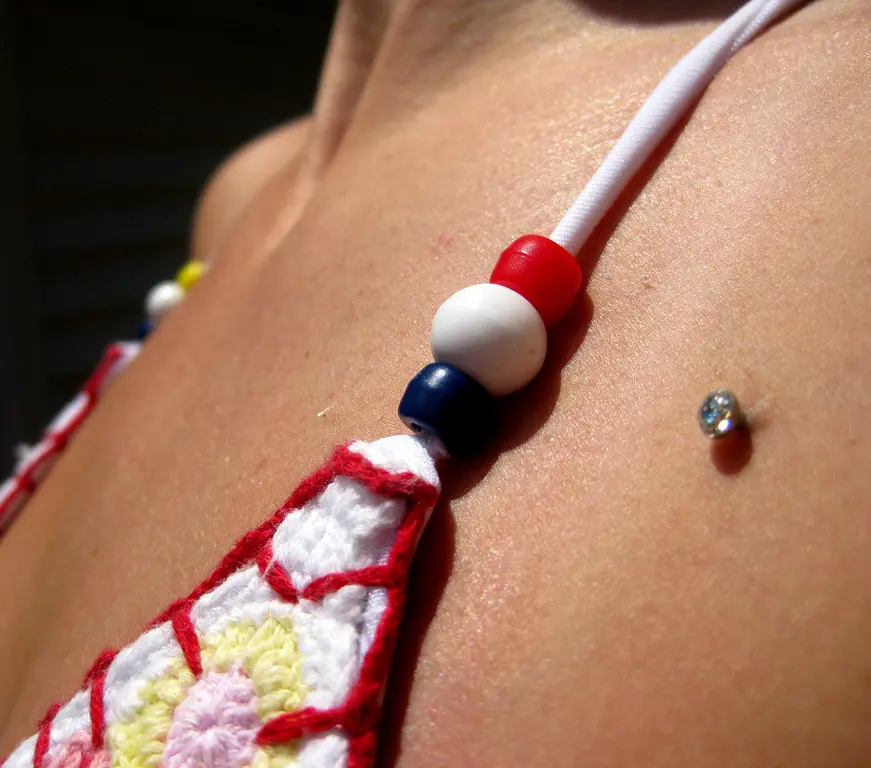
Photo by Melanie Tata via Wikimedia Commons, CC BY 2.0.
The two parts
| Part | What it is | Can you change it? |
|---|---|---|
| Anchor | Sits under the skin. Healthline says the base is typically 6 or 7 mm long, just enough to secure the post | Not normally. The APP says removing the base causes the loss of the piercing |
| Top | The decorative jewelry, screwed onto the post, resting on the surface like a bead on the skin | Yes, once healed, ideally done by your piercer |
The APP’s initial-jewelry page makes the same point for surface anchors: the threaded top may be changed, and removing the base of the jewelry causes the loss of the piercing, so this is not normally done.
Changing the top
Healthline says you can change the external top once the piercing has fully healed, which it puts at about three months, and that it is best to have your piercer do it so you avoid complications such as accidental anchor dislodgement. It describes a do-it-yourself method, unscrewing the top counterclockwise and screwing the new one on clockwise. Our view is to follow the first part of its advice and have it done at a studio. Our dermal cost guide lists what studios charge for a jewelry change.
Not every system fits
Healthline says a traditional anchor is the most common type and that diver-style jewelry is not interchangeable with anchor-and-top jewelry. Our suggestion, not Healthline’s: ask your piercer which system you have before buying a top. The APP lists threaded and threadless jewelry as different ways pieces fasten, and our threaded vs threadless guide explains the difference for other piercings.
Materials
Healthline says titanium may be the least likely to cause irritation and recommends it for sensitive skin. It also covers surgical stainless steel, niobium and gold, and warns that gold-plated jewelry can cause infections and allergic reactions. The APP says gold-plated, gold-filled and gold overlay or vermeil jewelry is not acceptable for fresh piercings. See the materials guide and hypoallergenic earrings for how the metal lists compare.
When jewelry goes wrong
Healthline lists infection, displacement, rejection, tissue damage, hypergranulation and scarring among the risks. It says if the anchor is not inserted deep enough it may become dislodged within the dermis and move to another area of skin, and that rejection occurs when skin tissue expands in the dermis until the jewelry is completely pushed out. Our piercing rejection guide and surface piercings guide cover what to look for.
Healthline puts healing at one to three months, and says the first couple of weeks bring crusting and minor swelling. Our dermal page gives four to twelve weeks, which is close, and says dermals are not permanent.
Cost
Healthline cites $70 to $100 for the piercing and an extra $10 to $20 for jewelry, from a 2018 estimate. In the studio price lists we read in September 2026, a dermal was $35 to $50 for the service or $60 to $118 with jewelry included, and Oakland and Philadelphia charged $10 for a jewelry change. The piercing prices by placement page has the tables.
Frequently asked questions
What is a dermal anchor and a top?
Healthline says the anchor sits under the skin, with a base typically 6 or 7 millimetres long, just enough to secure the post. The decorative jewelry, called the top, is screwed onto the post, so it rests on the surface like a bead on the skin.
Can I change the top of a dermal?
Yes once it has healed. Healthline says you can change the external top once the piercing has fully healed, about three months, and that it is best to have your piercer do it to avoid complications such as accidental anchor dislodgement. The APP says the threaded top may be changed but removing the base causes the loss of the piercing.
What are dermal anchors made of?
Healthline says titanium may be the least likely to cause irritation and recommends it for sensitive skin, and also covers surgical stainless steel, niobium and gold. It warns that gold-plated jewelry can cause infections and allergic reactions. The APP names implant-certified titanium for initial piercings.
Are all dermal jewelry interchangeable?
No. Healthline says a traditional anchor is the most common type, and that diver-style jewelry is not interchangeable with anchor-and-top jewelry. Ask your piercer which system was used before you buy a replacement top.
How much does dermal jewelry cost?
Healthline cites $70 to $100 for the piercing, with jewelry possibly an extra $10 to $20. In the six studio price lists we read in September 2026, a dermal was $35 to $50 for the service or $60 to $118 with jewelry included. See our dermal cost guide.
Do dermals need a downsize?
Our dermal guide says there is nothing to downsize, because the top that goes in first stays until the anchor has settled. Your piercer should do the first change.
Sources
- Healthline - Dermal piercing: pictures, placement, procedure, care, risks and morehttps://www.healthline.com/health/dermal-piercing
- Association of Professional Piercers - Jewelry for initial piercingshttps://safepiercing.org/jewelry-for-initial-piercings/